
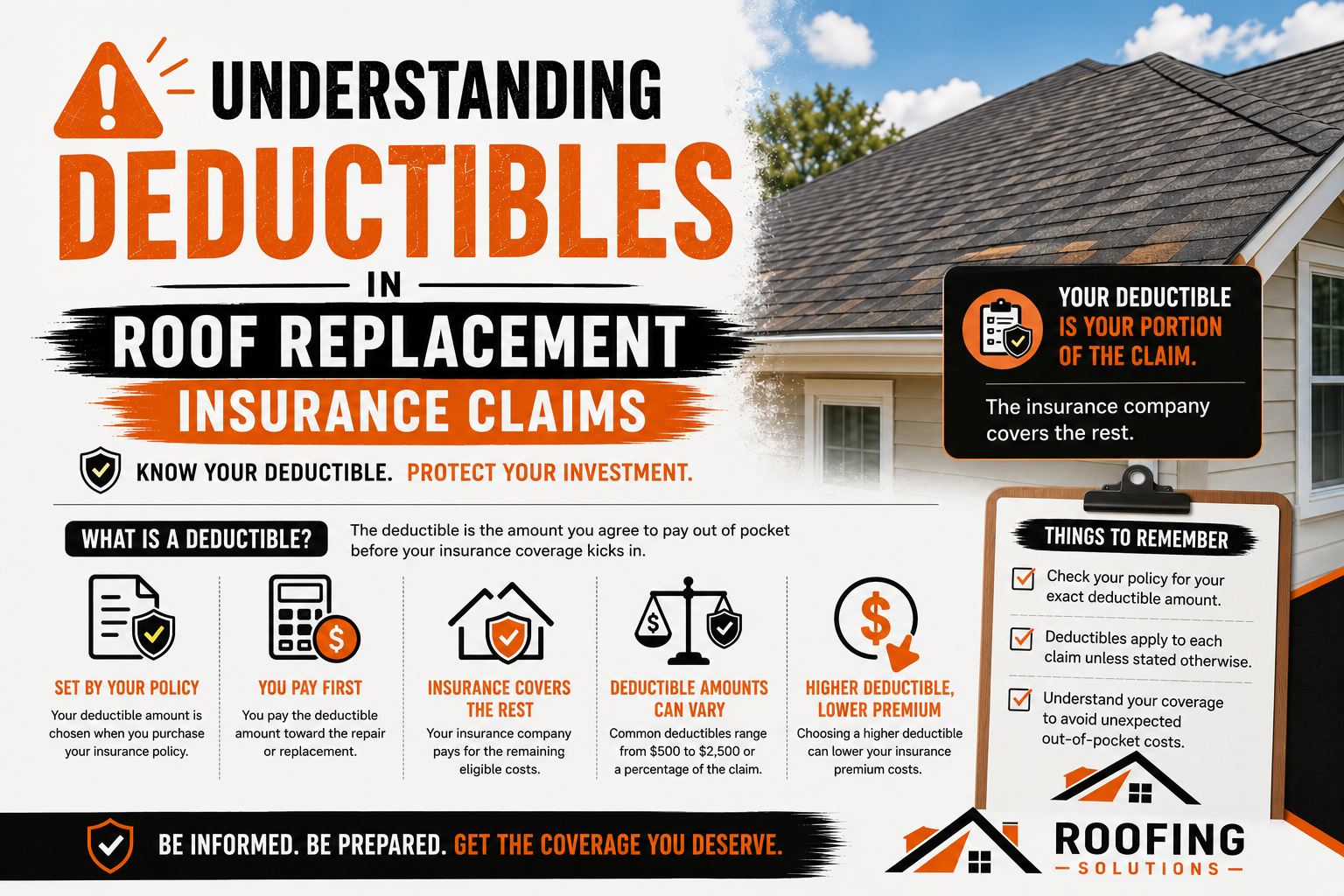
Understanding Deductibles in Roof Replacement Insurance Claims
Introduction
Roof replacement is one of the most expensive repairs a homeowner may face, especially after severe weather such as hail, strong winds, or falling trees damages the roofing system. While homeowners insurance can significantly reduce the financial burden, it rarely covers the entire cost of replacing a roof. One of the most important factors affecting the final payment is the insurance deductible.
Many homeowners hear the term “deductible” when purchasing insurance but do not fully understand how it works until they need to file a claim. When roof damage occurs, confusion about deductibles often leads to unrealistic expectations regarding insurance payments. Some homeowners believe the insurance company will pay the full replacement cost, while others are surprised to learn they must contribute part of the expense themselves.
Understanding your deductible before filing a roof replacement claim helps you prepare financially and avoid unexpected costs. It also allows you to evaluate whether filing a claim makes financial sense based on the estimated repair or replacement cost. Knowing how deductibles interact with insurance coverage, settlement calculations, and policy terms provides a much clearer picture of your actual financial responsibility.
Deductibles are not the same for every homeowner or every insurance policy. Some policies use a fixed dollar amount, while others calculate deductibles as a percentage of the home’s insured value. Different deductibles may even apply depending on whether the damage resulted from hail, wind, hurricanes, or other covered events.
This guide explains how roof replacement insurance deductibles work, why they exist, how they affect claim payments, and what homeowners should know before beginning the insurance process. By understanding these concepts, you will be better prepared to manage roof replacement expenses and make informed decisions when unexpected damage occurs.
What a Roof Replacement Insurance Deductible Is
A deductible is the portion of a covered insurance claim that the homeowner is responsible for paying before the insurance company contributes toward the remaining eligible costs. It represents the homeowner’s share of the financial responsibility and is one of the fundamental components of nearly every homeowners insurance policy.
Rather than paying every claim in full, insurance companies require policyholders to participate in the cost of covered losses. This system helps reduce small claims while encouraging homeowners to maintain their property responsibly. Once the deductible has been satisfied, the insurer pays the remaining covered expenses according to the policy terms and coverage limits.
For example, imagine a roof replacement costs twenty thousand dollars and the homeowner’s deductible is two thousand dollars. Assuming the damage is fully covered under the policy, the homeowner pays the first two thousand dollars while the insurance company pays the remaining eligible amount. The deductible applies regardless of how large the approved claim becomes.
It is important to understand that the deductible is not an additional fee charged after the insurance company pays the claim. Instead, it is the portion of the covered loss that remains the homeowner’s responsibility from the beginning. This distinction helps homeowners better understand why insurance settlement amounts are often lower than the total replacement estimate.
Deductibles are established when the insurance policy is purchased or renewed. Homeowners generally select from several deductible options offered by the insurance company. Choosing a higher deductible usually lowers the annual insurance premium, while selecting a lower deductible generally increases the premium because the insurer assumes more financial responsibility during future claims.
The deductible also serves as a risk-sharing mechanism between the homeowner and the insurance company. By requiring policyholders to contribute toward covered losses, insurers can provide protection against major financial events while keeping insurance programs sustainable over time.
Understanding this basic concept provides the foundation for everything else involved in roof replacement insurance claims. Once homeowners understand what a deductible represents, it becomes much easier to interpret settlement offers and estimate their expected out-of-pocket expenses.

How Deductibles Work During a Roof Insurance Claim
Understanding the role of the deductible throughout the claims process helps homeowners know what to expect after roof damage occurs. Although every insurance policy has unique terms, the overall process follows a similar sequence from the time the claim is reported until the final payment is issued.
The process begins when the homeowner discovers roof damage caused by a covered event such as hail, wind, or a fallen tree. After documenting the damage, the homeowner contacts the insurance company to report the loss. The insurer then assigns a claims adjuster to inspect the roof and determine whether the damage qualifies for coverage.
Once the adjuster completes the inspection, the insurance company calculates the approved replacement or repair cost according to the policy terms. At this stage, the deductible is subtracted from the approved settlement because it remains the homeowner’s responsibility. The insurance company pays the remaining eligible amount according to the type of coverage provided by the policy.
Many homeowners mistakenly believe they must send the deductible directly to the insurance company before receiving payment. In reality, the deductible is usually reflected in the overall financial arrangement between the homeowner, insurance company, and roofing contractor. The homeowner remains responsible for covering that portion of the replacement cost regardless of how payments are distributed.
Some insurance companies issue payment in multiple stages. For example, under replacement cost coverage, the insurer may first issue payment based on the actual cash value of the roof. After the roof replacement has been completed and documented, the remaining recoverable depreciation may be released, while the deductible remains the homeowner’s responsibility throughout the process.
The deductible applies only if the insurance company approves the claim. If the roof damage does not qualify for coverage because it resulted from normal wear and tear, poor maintenance, or another excluded cause, the homeowner is responsible for the full replacement cost rather than only the deductible.
Understanding how deductibles fit into the overall claims process helps homeowners plan financially while avoiding confusion about insurance payments and contractor invoices.
Different Types of Roof Insurance Deductibles
Not every homeowners insurance policy uses the same deductible structure. Insurance companies offer several types of deductibles, and understanding the differences helps homeowners evaluate both insurance coverage and future financial responsibilities.
The most common deductible is the fixed dollar deductible. Under this arrangement, the homeowner pays a specific amount every time a covered claim occurs. Whether the roof replacement costs ten thousand dollars or thirty thousand dollars, the deductible remains the same fixed amount specified in the policy.
Some insurance policies instead use percentage deductibles. Rather than charging a fixed dollar amount, the deductible is calculated as a percentage of the home’s insured value. This means homeowners with higher property values may have significantly larger deductibles even if the roof replacement cost is similar to neighboring homes.
Percentage deductibles are particularly common in regions frequently affected by hailstorms, hurricanes, tornadoes, or other severe weather events. Insurance companies use these deductibles to manage the increased financial risk associated with repeated weather-related claims.
Certain policies also contain separate deductibles for specific types of losses. For example, the standard deductible may apply to fire damage, while a different deductible applies to wind or hail claims. Homeowners should review their policy carefully because these specialized deductibles may differ substantially from the standard deductible.
Some insurers also offer optional deductible endorsements that allow homeowners to customize their coverage. These endorsements may provide additional flexibility when balancing annual premium costs against future out-of-pocket expenses.
Understanding which deductible structure applies to your policy helps eliminate surprises after roof damage occurs. Reviewing your policy before filing a claim allows you to estimate your financial responsibility more accurately.
Factors That Affect Your Deductible Amount
Several factors influence the deductible associated with a homeowners insurance policy. Understanding these factors helps explain why deductible amounts vary from one homeowner to another and why insurance companies structure policies differently depending on the level of risk.
One of the primary factors is the deductible selected when purchasing the insurance policy. Homeowners generally choose from several available deductible options based on their financial preferences. Lower deductibles reduce out-of-pocket costs during future claims but usually result in higher annual insurance premiums. Higher deductibles reduce premium costs while increasing the homeowner’s financial responsibility if damage occurs.
Property location also plays an important role. Homes located in areas frequently affected by hailstorms, hurricanes, tornadoes, or severe wind events often have different deductible structures than homes in regions with lower weather-related risk. Insurance companies adjust policy terms according to historical claim patterns and regional weather exposure.
The insured value of the home influences percentage deductibles because these deductibles are calculated using the property’s insured value rather than the actual roof replacement cost. As property values increase, percentage deductibles increase proportionally even if the roofing system itself remains relatively similar.
Insurance companies also consider overall underwriting risk when determining available deductible options. Factors such as previous claims history, property characteristics, roof age, construction materials, and local building conditions may influence both premium pricing and deductible availability.
Policy endorsements can further affect deductible requirements. Some optional coverage enhancements modify how deductibles apply under certain circumstances, while specialized weather endorsements may introduce separate deductible calculations for specific natural disasters.
Homeowners should periodically review their insurance policy to ensure the deductible still matches their financial situation. Changes in home value, roof condition, or insurance needs may justify adjusting deductible levels during policy renewal.
Understanding the factors affecting deductibles allows homeowners to make more informed decisions when purchasing or renewing insurance coverage while preparing for future roof replacement expenses.
When Homeowners Pay the Deductible
One of the most common questions homeowners ask after roof damage occurs is exactly when the deductible must be paid. Although payment procedures vary slightly among contractors and insurance companies, the homeowner remains responsible for the deductible whenever a covered roof replacement claim is approved.
The deductible is generally paid as part of the overall roof replacement project rather than as a separate payment to the insurance company. Depending on the contractor’s payment schedule, homeowners may contribute the deductible before construction begins, during the installation process, or upon project completion. The timing depends on the agreement established with the roofing contractor.
Insurance companies expect homeowners to pay their deductible according to the terms of the policy. Reputable roofing contractors understand this requirement and include it as part of the project payment process. Homeowners should be cautious of contractors who advertise that they will waive, absorb, or eliminate the deductible because such arrangements may violate insurance regulations in many jurisdictions.
When planning for roof replacement, homeowners should prepare financially before construction begins. Setting aside funds for the deductible helps prevent delays once insurance approval has been received. Budgeting early also reduces stress during the restoration process.
The following situations commonly involve homeowner responsibility for the deductible:
- Approved roof replacement after hail damage.
- Windstorm roof replacement claims.
- Fire damage requiring roof replacement.
- Roof replacement following damage from falling trees.
- Other covered roof replacement claims under the policy.
Understanding when the deductible becomes due allows homeowners to prepare financially while avoiding confusion during the insurance settlement process. As the roof replacement claim continues, additional financial concepts such as depreciation, settlement calculations, actual cash value, replacement cost coverage, and budgeting strategies become equally important. These topics build upon the deductible principles discussed here and play a major role in determining the homeowner’s final out-of-pocket expense.

How Deductibles Affect Insurance Claim Payments
The deductible directly influences how much money the insurance company pays after approving a roof replacement claim. While many homeowners focus on the total replacement cost, the deductible is one of the first amounts considered when the insurance settlement is calculated. Understanding this process helps eliminate confusion when reviewing payment documents.
After the insurance adjuster completes the inspection, the insurer prepares an estimate based on the approved scope of work. This estimate includes roofing materials, labor, underlayment, flashing, ventilation components, and any additional covered repairs. Once the approved replacement cost has been determined, the deductible is subtracted because it remains the homeowner’s financial responsibility.
For example, suppose a roof replacement is approved for twenty-five thousand dollars and the homeowner has a two-thousand-dollar deductible. Assuming all work qualifies under the policy, the insurance company calculates payment after accounting for the deductible. The homeowner contributes the deductible, while the insurer pays the remaining covered amount according to the policy terms.
The deductible applies regardless of whether the roof requires minor repairs or complete replacement. As long as the claim is approved, the homeowner is responsible for the deductible before insurance covers the remaining eligible expenses. This structure remains consistent even if additional supplemental payments are approved later during construction.
Replacement cost policies sometimes divide payments into multiple stages. The initial payment may represent the actual cash value of the roof, with the remaining recoverable depreciation released after the completed replacement has been verified. Even in these situations, the deductible continues to be the homeowner’s responsibility throughout the claim.
Understanding how deductibles affect insurance payments allows homeowners to budget more accurately while avoiding unrealistic expectations about the amount they will receive from the insurance company.
Percentage Deductibles vs Fixed Dollar Deductibles
Homeowners insurance policies generally use one of two deductible structures: fixed dollar deductibles or percentage deductibles. Although both serve the same purpose, they calculate the homeowner’s financial responsibility in different ways. Understanding these differences helps homeowners better estimate future roof replacement costs.
A fixed dollar deductible requires the homeowner to pay a specific amount whenever a covered claim occurs. The deductible remains the same regardless of the home’s insured value. This structure provides predictable financial planning because homeowners know exactly how much they will contribute if roof damage occurs.
Percentage deductibles are calculated differently. Instead of using a fixed amount, the deductible is based on a percentage of the home’s insured value. As property values increase, the deductible also increases because it is tied directly to the insurance coverage rather than the roof replacement cost.
For example, if a home is insured for four hundred thousand dollars and the policy includes a one percent deductible, the homeowner’s deductible would be four thousand dollars. If another home with similar roofing materials is insured for six hundred thousand dollars, the same one percent deductible would equal six thousand dollars. Although both homes may require similar roof replacements, their deductibles differ because of the insured property value.
Insurance companies commonly use percentage deductibles in areas that experience frequent hailstorms, hurricanes, tornadoes, or severe wind events. These deductibles help insurers manage higher weather-related risks while giving homeowners flexibility when selecting coverage options.
The table below compares the two deductible structures.
| Feature | Fixed Dollar Deductible | Percentage Deductible |
|---|---|---|
| Calculation Method | Fixed amount listed in policy | Percentage of insured home value |
| Predictability | Easy to budget | Varies with insured property value |
| Common Usage | Standard homeowners policies | High-risk weather regions |
| Effect of Higher Home Value | No change | Deductible increases |
| Financial Planning | More predictable | Requires calculation before claims |
Understanding which deductible structure applies to your policy helps you estimate your financial responsibility more accurately before filing a roof replacement claim.

Deductibles and Replacement Cost vs Actual Cash Value Policies
The deductible is only one part of the financial calculation during a roof replacement insurance claim. The type of insurance coverage also affects the final payment homeowners receive. Two of the most common policy structures are replacement cost coverage and actual cash value coverage.
Replacement cost coverage generally pays the amount required to install a comparable new roof using similar materials after the deductible has been satisfied. This type of coverage focuses on restoring the home to its previous condition without reducing payment solely because of the roof’s age.
Actual cash value coverage works differently because it considers depreciation. Since roofing materials lose value over time due to aging and weather exposure, the insurance company subtracts depreciation before calculating the payment. Older roofs therefore receive smaller settlements than newer roofs with similar storm damage.
The deductible applies under both policy types, but the homeowner’s total out-of-pocket expense may differ significantly. Under actual cash value coverage, homeowners are responsible not only for the deductible but also for the value lost through depreciation. Under replacement cost coverage, the deductible remains the primary financial responsibility after all eligible payments have been made.
Many replacement cost policies issue payments in stages. The insurer may first pay the actual cash value, then release recoverable depreciation after the completed roof replacement has been documented. This process encourages homeowners to complete the approved repairs while ensuring funds are used appropriately.
Before filing a claim, homeowners should review their policy carefully to determine which type of coverage applies. Understanding this distinction helps explain why insurance settlement amounts sometimes differ even when two homes experience similar hail or wind damage.
Common Misconceptions About Roof Insurance Deductibles
Insurance deductibles are often misunderstood, particularly by homeowners filing their first roof replacement claim. Misunderstandings about deductibles can create unrealistic expectations regarding insurance payments and project costs. Learning the facts helps homeowners make more informed decisions throughout the claims process.
One common misconception is that the insurance company pays the deductible. In reality, the deductible is always the homeowner’s responsibility whenever a covered claim is approved. The insurance company calculates payment after accounting for this required contribution.
Another misunderstanding is that contractors can legally eliminate or absorb the deductible. While some homeowners receive advertisements promising “free deductibles” after storms, these offers should be approached with caution. In many jurisdictions, intentionally avoiding deductible payments may violate insurance regulations and create legal issues for both the homeowner and contractor.
Some homeowners also believe they should avoid filing any claim because the deductible makes insurance unnecessary. This assumption often overlooks the much larger financial benefit insurance provides during major roof replacements. Paying a deductible is usually far less expensive than funding an entire replacement independently after severe storm damage.
Another misconception is that every deductible remains the same throughout the policy. Some insurance contracts include separate deductibles for hail, wind, hurricanes, or other weather events. Reviewing policy details before filing a claim helps eliminate confusion regarding the applicable deductible.
Finally, some homeowners assume the deductible applies after the insurance company sends payment. In reality, the deductible forms part of the settlement calculation from the beginning. Understanding this sequence helps explain why insurance payments are generally lower than the total replacement estimate.
Clarifying these misconceptions allows homeowners to approach the claims process with realistic expectations while avoiding unnecessary misunderstandings.
Mistakes Homeowners Make When Managing Deductibles
Even when homeowners understand the purpose of deductibles, mistakes during the claims process can still create financial difficulties. Many of these problems are avoidable with careful planning and a clear understanding of insurance policy requirements.
One common mistake is failing to review the deductible before filing a claim. Homeowners sometimes assume they know the deductible amount based on previous policies or older documents. Insurance policies change over time, so reviewing current coverage before submitting a claim is always advisable.
Another mistake involves filing relatively small claims where the repair cost is only slightly higher than the deductible. In these situations, homeowners may receive little financial benefit after the deductible has been applied. Carefully comparing repair estimates with the deductible helps determine whether filing a claim is worthwhile.
Some homeowners fail to budget for the deductible before construction begins. Since the deductible remains the homeowner’s responsibility, setting aside funds early prevents payment delays once the roof replacement has been approved. Financial preparation also reduces stress throughout the restoration project.
Choosing contractors who promise unrealistic deductible arrangements is another avoidable mistake. Reputable roofing companies explain deductible requirements clearly and expect homeowners to fulfill their policy obligations. Working with experienced professionals protects both the homeowner and the integrity of the insurance claim.
Poor recordkeeping can also complicate deductible management. Insurance estimates, contractor invoices, payment receipts, and settlement documents should all be organized carefully. Accurate records simplify communication with both the insurance company and the contractor throughout the project.
Avoiding these common mistakes helps homeowners navigate the claims process more efficiently while maintaining realistic financial expectations.
Tips for Budgeting Your Roof Replacement Deductible
Planning ahead for the deductible makes roof replacement much less stressful if unexpected storm damage occurs. Since homeowners are responsible for this portion of every approved claim, preparing financially before an emergency arises is one of the most effective ways to manage future roofing expenses.
Begin by reviewing your insurance policy each year to confirm the current deductible amount. Homeowners sometimes forget deductible changes made during policy renewals or adjustments to insurance coverage. Staying informed allows you to estimate future financial responsibilities accurately.
Creating a dedicated home maintenance or emergency repair savings fund is another practical strategy. Setting aside small amounts regularly can make it much easier to cover the deductible if roof damage occurs unexpectedly. Even modest monthly contributions gradually build financial security over time.
It is also wise to obtain periodic roof inspections. Identifying maintenance issues early may prevent avoidable damage while allowing homeowners to budget for future roof replacement before emergency situations develop. Preventive maintenance often reduces overall roofing expenses in the long run.
The following budgeting strategies can help homeowners prepare for future roof replacement deductibles:
- Review your insurance policy every year.
- Confirm whether your deductible is fixed or percentage based.
- Build an emergency home repair savings fund.
- Schedule regular professional roof inspections.
- Maintain complete roof maintenance records.
- Obtain multiple contractor estimates before beginning replacement.
- Keep insurance documents organized and easily accessible.
Budgeting for the deductible is an important part of responsible homeownership. However, selecting the right deductible when purchasing insurance, understanding how different deductible amounts affect premiums, and deciding which deductible best fits your financial situation are equally important considerations. These topics, along with frequently asked homeowner questions and practical decision-making guidance, will be explored in the final part of this guide.
How to Choose the Right Deductible for Future Coverage
Selecting the right deductible is one of the most important decisions homeowners make when purchasing or renewing a homeowners insurance policy. While many people focus primarily on the annual premium, the deductible has a direct impact on how much they will pay if roof damage occurs. Choosing the right balance between monthly savings and future financial responsibility requires careful planning.
A lower deductible generally means the insurance company assumes a larger share of the financial risk. Because the insurer is accepting greater responsibility, the annual premium is usually higher. This option often appeals to homeowners who prefer predictable out-of-pocket expenses and want to minimize unexpected costs after a major storm.
A higher deductible usually reduces the annual insurance premium because the homeowner agrees to pay a larger portion of future claims. Over several years, these premium savings can become significant. However, homeowners should only select a higher deductible if they are confident they could comfortably afford it during an emergency.
The right deductible depends largely on your personal financial situation. A homeowner with a well-funded emergency savings account may be comfortable choosing a higher deductible to reduce yearly insurance costs. Someone with limited emergency savings may prefer a lower deductible, even if it means paying a higher premium each year.
Another important consideration is where the home is located. Properties in regions that experience frequent hailstorms, hurricanes, tornadoes, or severe wind events face a greater likelihood of roof damage. Homeowners living in these areas should evaluate whether they could realistically pay a larger deductible if a storm occurred tomorrow.
The age and condition of the roof should also influence the decision. Older roofs may be more susceptible to weather damage than newer roofing systems. While insurance does not cover normal wear and tear, roofs nearing the end of their expected lifespan may require greater financial planning because future repair or replacement becomes more likely.
Homeowners should also think about long-term ownership plans. If you intend to stay in the home for many years, your insurance choices today may affect several future claims. Selecting a deductible based only on the lowest premium may not always provide the best long-term financial value.
Before changing your deductible, ask your insurance company how different deductible options affect your annual premium. Sometimes increasing the deductible by a substantial amount produces only a modest reduction in premium. In other situations, the savings may be large enough to justify accepting greater financial responsibility.
Comparing several deductible options side by side often makes the decision easier. Instead of asking which deductible is cheapest, ask which option best balances affordable premiums with manageable out-of-pocket expenses during a roof replacement claim.
It is also wise to review your deductible whenever major life changes occur. Purchasing a new home, replacing the roof, improving your financial situation, or increasing the insured value of your property may justify adjusting the deductible during policy renewal.
Many homeowners overlook the importance of reviewing their deductible every year. Insurance needs change over time, and a deductible that made sense several years ago may no longer match your current financial circumstances. An annual policy review helps ensure your coverage continues to meet your needs.
Discussing deductible options with your insurance agent can also provide valuable insight. Agents can explain how various deductible amounts affect premiums, claim payments, and long-term costs while helping you understand any special deductibles that apply to hail, wind, or hurricane damage.
The goal is not simply to select the lowest premium or the smallest deductible. Instead, homeowners should choose an option that provides financial protection without creating unnecessary hardship if a roof replacement claim becomes necessary.
Frequently Asked Questions About Roof Insurance Deductibles
What is the purpose of a roof insurance deductible?
A deductible represents the portion of a covered insurance claim that the homeowner agrees to pay before the insurance company contributes toward eligible replacement costs. It allows insurance companies to share financial responsibility with policyholders while helping keep insurance premiums more affordable.
Do I always have to pay the deductible?
Yes. If your roof replacement claim is approved under the terms of your insurance policy, you are generally responsible for paying the deductible. The deductible remains your financial obligation regardless of the size of the approved claim.
Can a roofing contractor waive my deductible?
Homeowners should be cautious of contractors who advertise that they will eliminate or absorb insurance deductibles. In many areas, these practices may violate insurance regulations because deductibles are a required part of the insurance contract between the homeowner and the insurance company.
Is a higher deductible always better because it lowers my premium?
Not necessarily. Although higher deductibles usually reduce annual premiums, they also increase the amount you must pay if roof damage occurs. The best choice depends on your financial situation, emergency savings, and ability to manage unexpected repair expenses.
Does every roof insurance claim have the same deductible?
No. Some homeowners insurance policies include different deductibles for different types of losses. For example, hail or wind claims may have separate deductible requirements that differ from those used for fire or other covered events.
How do I know whether my policy has a fixed or percentage deductible?
Your insurance declarations page or policy documents identify the deductible structure. If the wording is unclear, your insurance agent or company representative can explain whether your deductible is a fixed dollar amount or a percentage of your home’s insured value.
What happens if my roof replacement costs less than my deductible?
If the total approved repair or replacement cost does not exceed the deductible, the insurance company generally does not issue payment because the entire cost remains the homeowner’s responsibility. In these situations, filing a claim may not provide any financial benefit.
Does paying a higher deductible affect claim approval?
No. The deductible amount does not determine whether a claim is approved. Claim approval depends on whether the roof damage resulted from a covered event and whether the policy conditions have been satisfied. The deductible only affects how the financial responsibility is divided after approval.
Can I change my deductible after filing a roof claim?
No. Once a claim has occurred, the deductible that applies is the one listed in the policy at the time the damage happened. Changes made during future policy renewals apply only to future claims rather than existing ones.
Should I review my deductible every year?
Yes. Annual policy reviews allow homeowners to adjust deductibles based on changes in income, savings, property value, insurance premiums, and financial goals. Regular reviews help ensure your insurance coverage continues meeting your needs.
Conclusion
Understanding roof replacement insurance deductibles is one of the most important aspects of managing homeowners insurance effectively. Although deductibles may seem like a simple policy feature, they influence nearly every stage of the claims process, from deciding whether to file a claim to determining the final amount the insurance company pays. Homeowners who understand how deductibles work are far better prepared to manage both expected and unexpected roofing expenses.
Throughout this guide, we have explored the purpose of deductibles, how they function during roof replacement claims, the different deductible structures used by insurance companies, and the financial factors that influence deductible amounts. We also examined the differences between fixed dollar and percentage deductibles, explained how replacement cost and actual cash value policies interact with deductibles, and addressed several common misconceptions that often create confusion during insurance claims.
Another important takeaway is that the lowest insurance premium is not always the best financial decision. Selecting a higher deductible may reduce annual insurance costs, but it also increases the amount homeowners must pay if severe roof damage occurs. Likewise, choosing a lower deductible generally increases premiums while reducing financial stress during a major insurance claim. Finding the right balance requires careful consideration of emergency savings, long-term financial goals, and local weather risks.
Preparation also plays a major role in successful roof replacement claims. Reviewing your insurance policy regularly, understanding deductible requirements before damage occurs, maintaining accurate roof maintenance records, and budgeting for future deductible expenses all contribute to a smoother claims experience. Homeowners who plan ahead are less likely to encounter unexpected financial challenges when storms damage their property.
It is equally important to work with reputable roofing contractors and communicate openly with your insurance company throughout the claims process. Honest documentation, professional inspections, and organized records help ensure that claims are handled efficiently while reducing misunderstandings regarding deductibles, settlement calculations, and payment responsibilities.
Ultimately, a deductible should not be viewed as a penalty or an unexpected expense. Instead, it represents a shared financial responsibility that allows homeowners insurance to provide meaningful protection against costly events such as hailstorms, wind damage, fire, and falling trees. By understanding how deductibles work and selecting coverage that matches your financial situation, you can approach future roof replacement claims with greater confidence and fewer surprises.
A well-informed homeowner is better equipped to make sound insurance decisions before damage occurs rather than reacting under the pressure of an emergency. Whether you are purchasing a new insurance policy, reviewing existing coverage, or preparing to file a roof replacement claim, understanding deductibles provides the knowledge needed to protect both your home and your financial future.