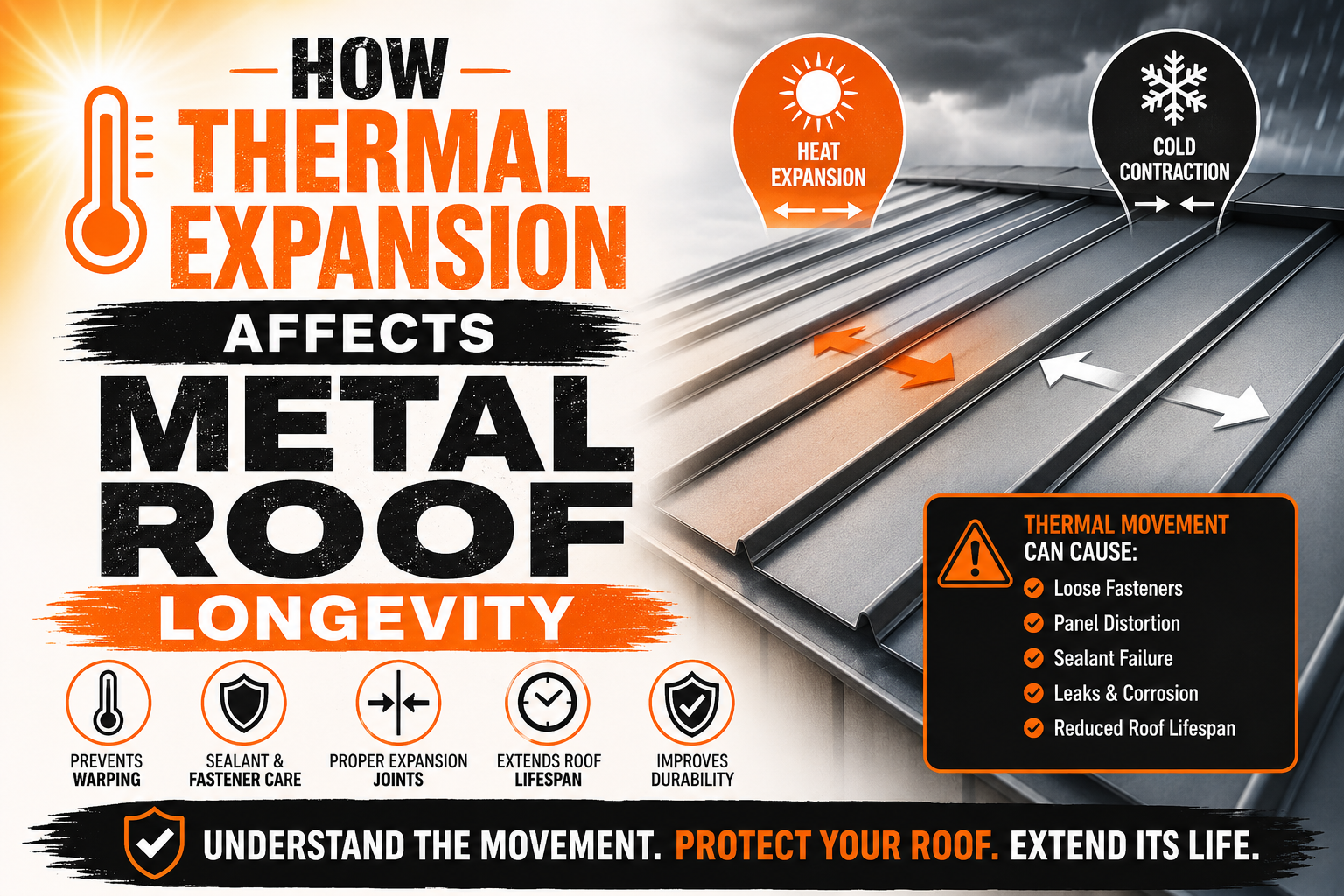
How Thermal Expansion Affects Metal Roof Longevity
Introduction
Metal roofing has become one of the most trusted roofing solutions for residential, commercial, industrial, and agricultural buildings because of its durability, energy efficiency, and long service life. A properly installed metal roof can last for several decades while providing excellent protection against rain, snow, wind, and extreme temperatures. Despite these advantages, metal roofing systems are constantly affected by one natural process that every property owner should understand, thermal expansion.
Thermal expansion occurs whenever metal changes size in response to temperature fluctuations. As temperatures rise during the day, metal roofing panels expand slightly. When temperatures fall at night or during colder seasons, those same panels contract. Although these movements are often measured in fractions of an inch, they occur repeatedly throughout the life of the roof and can place considerable stress on fasteners, seams, flashing, and other roofing components.
Many roofing problems develop gradually because thermal expansion is a slow process rather than a sudden event. Unlike storm damage or falling debris, expansion related issues often appear after years of repeated heating and cooling cycles. Small amounts of daily movement eventually loosen fasteners, weaken sealants, enlarge attachment holes, and create pathways for water intrusion. If these problems remain unnoticed, they can shorten the lifespan of the entire roofing system.
Metal roofs are specifically designed to accommodate controlled movement, but their long term performance depends heavily on proper installation and routine maintenance. Roofing systems that cannot expand and contract freely often experience greater stress, leading to premature wear and expensive repairs. Understanding how thermal expansion affects different roofing components helps property owners recognize early warning signs before major damage develops.
The type of metal, roof design, climate, panel length, and installation methods all influence how much movement occurs over time. Some roofing systems manage expansion exceptionally well, while others require more frequent inspections to ensure attachment systems continue performing as intended.
This guide explains how thermal expansion works, why it affects every metal roof, and what factors influence the amount of movement within a roofing system. It also discusses early warning signs, environmental conditions, and roof characteristics that determine how thermal expansion impacts long term roof longevity. Later sections will explore repair strategies, prevention methods, maintenance recommendations, and best practices for maximizing the lifespan of a metal roof.
What Is Thermal Expansion in Metal Roofing?
Thermal expansion is the natural process through which metal increases in size as its temperature rises. When the material cools, it contracts and returns toward its original dimensions. This constant cycle of expansion and contraction occurs every day as outdoor temperatures change.
Although the amount of movement during a single temperature change is relatively small, the cumulative effect becomes significant over many years. A long metal roof panel may expand several millimeters during a hot summer afternoon before contracting again overnight. This movement repeats thousands of times throughout the life of the roof.
Every metal roofing material responds to temperature changes according to its own physical properties. Aluminum, steel, copper, and zinc all expand and contract at different rates. These differences influence material selection, fastening methods, and installation techniques for different roofing systems.
Expansion occurs uniformly throughout the panel when temperatures increase evenly. However, roofs rarely heat uniformly because sunlight, shade, roof color, insulation, and ventilation create varying temperatures across different sections. Uneven heating introduces additional stresses that roofing systems must accommodate safely.
Modern metal roofing systems are designed with thermal movement in mind. Expansion joints, sliding clips, concealed fasteners, and carefully planned attachment spacing allow panels to move naturally without damaging surrounding components. These design features help preserve structural integrity while maintaining weather resistance.
Problems arise when movement becomes restricted. If panels cannot expand freely, stress accumulates around fasteners, seams, flashing, and roof penetrations. Over time, these concentrated forces may loosen connections, distort panels, or weaken waterproof seals.
Thermal expansion itself is not a defect or sign of poor roofing quality. Instead, it is an expected characteristic of every metal roofing system. Successful roof design focuses on managing this movement rather than preventing it entirely.
Understanding this natural behavior helps explain why installation quality is just as important as material quality. Even premium roofing panels may experience premature failures if expansion is not properly accommodated during construction.
Why Metal Expands and Contracts
The reason metals expand and contract lies within their microscopic structure. Metal atoms constantly vibrate, and the amount of vibration changes with temperature. As heat increases, atomic movement becomes greater, causing the material to occupy slightly more space. When temperatures decrease, atomic vibration slows, allowing the material to contract.
Although these dimensional changes are small, roofing panels often cover considerable distances across a building. A slight increase in length over a very long panel creates enough movement to influence fasteners, clips, seams, and flashing connections.
Daily temperature changes create one expansion cycle every twenty four hours under normal conditions. During summer months, roof surface temperatures may rise far above the surrounding air temperature because dark colored roofing absorbs significant solar energy. This increases the amount of panel movement throughout the day.
Seasonal changes produce even greater expansion and contraction. Roofs exposed to freezing winter temperatures followed by intense summer heat experience much larger annual movement ranges than buildings located in moderate climates.
Weather conditions also affect expansion rates. Bright sunshine rapidly heats exposed metal surfaces, while passing clouds, rainfall, or evening shade cause relatively quick cooling. These changing conditions subject roofing materials to repeated movement throughout a single day.
Roof orientation influences temperature exposure as well. South facing roof sections often receive more direct sunlight than north facing areas, creating different expansion patterns across the same building. Uneven movement increases stress where roof sections intersect or connect.
Metal thickness also affects how quickly roofing responds to temperature changes. Thinner panels typically heat and cool more rapidly than heavier structural roofing components. While both materials expand, the rate of temperature change may differ significantly.
The roofing system must accommodate all these movement patterns simultaneously. Proper design allows panels to shift slightly without transferring excessive stress to fasteners or structural supports.
Understanding why expansion occurs helps property owners appreciate the importance of installation details that might otherwise appear insignificant. Small allowances for movement during construction often determine whether a roof performs reliably for decades.
How Daily and Seasonal Temperature Changes Affect Roof Panels
Temperature fluctuations influence every metal roof regardless of geographic location. Whether a building is located in a hot desert, a snowy mountain region, or a moderate coastal climate, changing temperatures continuously affect roofing materials.
During sunny mornings, metal panels begin warming shortly after sunrise. As surface temperatures increase, panels gradually expand in length and width. By afternoon, roof temperatures may exceed the surrounding air temperature by several degrees depending on roof color and solar exposure.
When evening arrives, temperatures begin falling and the panels slowly contract. This daily expansion and contraction cycle repeats throughout the year, producing thousands of movement cycles over the lifespan of the roof.
Summer conditions generally create the greatest expansion because prolonged sunlight heats roofing materials for extended periods. Longer daylight hours and stronger solar radiation increase both the amount and duration of panel movement.
Winter introduces different challenges. Although colder temperatures reduce expansion during the day, large differences between daytime and nighttime temperatures still produce regular movement cycles. Snow cover may also create uneven temperature patterns as some roof sections remain shaded while others receive direct sunlight.
Rapid weather changes produce additional stresses. A sudden rainstorm after intense sunshine cools roofing panels quickly, causing faster contraction than gradual evening cooling. These rapid changes place extra demands on fasteners and attachment systems.
Large roof panels experience greater total movement than shorter panels because expansion accumulates across the entire panel length. This is one reason manufacturers often specify maximum panel lengths or require expansion joints on larger roofing projects.
Roof accessories also respond differently to temperature changes. Flashing, gutters, ridge caps, vents, and mechanical supports may expand at slightly different rates than the main roofing panels. Proper detailing allows these components to move independently without compromising waterproofing.
Although these movements are normal, repeated stress eventually affects roofing components that cannot accommodate expansion effectively. Understanding these temperature related changes helps explain why routine maintenance remains important even when no visible roof damage is present.
Common Types of Metal Roofing Most Affected by Thermal Movement
Every metal roofing system experiences thermal expansion, but the degree of movement and the way it affects the roof depend on the roofing design. Some systems are specifically engineered to accommodate expansion more effectively than others.
Standing seam metal roofs generally perform exceptionally well because concealed clips allow controlled panel movement. Rather than fixing every panel rigidly to the structure, sliding clip systems permit expansion while maintaining secure attachment.
Exposed fastener roofing systems experience greater stress around attachment points because screws pass directly through the panels. As panels expand and contract, repeated movement gradually affects washers, fastener holes, and sealing performance.
Corrugated metal roofs commonly used for agricultural and industrial buildings also experience thermal movement. Their ribbed design provides structural strength, but long panel lengths still require careful fastening to prevent movement related problems.
Structural standing seam systems designed for large commercial buildings often incorporate specialized expansion features. These roofs accommodate significant movement while maintaining high wind resistance and weather protection.
Architectural metal roofs emphasize appearance as well as performance. Although they generally include movement accommodating features, complex roof shapes may require additional detailing around valleys, hips, and penetrations.
Copper roofing deserves special mention because copper expands more than many other roofing metals. Traditional copper roofing systems account for this behavior through specialized joints and fastening methods developed over many years.
Aluminum roofing also exhibits relatively high expansion rates compared to steel. Installers must consider these characteristics carefully when selecting fasteners, clip spacing, and panel lengths.
Understanding how different roofing systems respond to thermal movement helps property owners appreciate why manufacturer specific installation methods should always be followed during repairs or new construction.
Early Signs of Thermal Expansion Problems
Thermal expansion related damage usually develops gradually rather than appearing suddenly. Recognizing early warning signs allows property owners to address small issues before they become expensive structural repairs.
One of the earliest indicators is backed out fasteners. As roofing panels move repeatedly, screws may slowly loosen and rise above the panel surface. This reduces washer compression and increases the likelihood of water infiltration.
Cracked or deteriorated sealants around flashing and penetrations often signal repeated movement. Sealants remain flexible for many years, but continuous expansion eventually causes aging materials to separate or crack.
Panel noise provides another useful warning sign. Popping, clicking, or creaking sounds during rapid temperature changes usually indicate normal expansion. However, unusually loud or frequent noises may suggest excessive movement or restricted panel travel.
Visible panel distortion may also develop over time. Slight waviness, buckling, or uneven alignment often indicates that expansion stresses have accumulated within the roofing system.
Interior leaks sometimes originate from thermal movement rather than storm damage. Water entering through loosened fasteners or separated flashing may appear long after the actual movement begins.
Rust around fastener heads or seams may indicate moisture intrusion resulting from movement related seal failures. Corrosion often accelerates once protective coatings become damaged.
Property owners should also inspect flashing around chimneys, skylights, vents, and roof mounted equipment. These areas experience concentrated movement because different roofing components expand at different rates.
The following warning signs deserve prompt attention:
- Loose or backed out fasteners
- Cracked sealants around flashing
- Unusual roof movement or noise
- Buckled or uneven panels
- Water stains inside the building
- Rust around fasteners or seams
- Separated flashing at roof penetrations
Addressing these symptoms early often prevents widespread roofing damage while extending the overall service life of the metal roof.
Factors That Influence Thermal Expansion in Metal Roofs
Although every metal roof expands and contracts, the amount of movement varies considerably depending on several important factors. Understanding these influences helps explain why some roofs experience more expansion related problems than others.
Climate is one of the most significant factors. Buildings located in regions with extreme seasonal temperature differences experience greater annual movement than those in mild climates. Desert environments, mountain regions, and areas with intense summer heat often place additional stress on roofing systems.
Roof color also affects expansion. Dark colored panels absorb more solar energy than lighter colors, resulting in higher surface temperatures during sunny weather. Increased heat generally produces greater daily expansion.
Panel length influences total movement as well. Longer roofing panels naturally experience more expansion than shorter panels because dimensional changes accumulate across the full length of the material.
Roof orientation changes the amount of sunlight different sections receive throughout the day. South and west facing slopes often experience greater temperature fluctuations than shaded roof areas.
Ventilation beneath the roof helps moderate temperature extremes. Well ventilated roof assemblies remain cooler during summer while reducing rapid temperature changes that increase expansion stresses.
Installation quality ultimately determines how successfully the roofing system accommodates movement. Proper clip placement, correct fastener spacing, adequate expansion clearances, and manufacturer approved installation techniques all contribute to long term roof performance.
Understanding these factors allows building owners to appreciate why thermal expansion should be considered throughout the entire life of a metal roof, from initial design and installation to routine maintenance and future repairs.
In the next part of this guide, we will examine how thermal expansion affects fasteners, seams, flashing, roof coatings, and waterproofing systems, compare the behavior of different roofing metals, explore effective repair methods, and discuss the installation mistakes that often increase expansion related damage over time.
How Thermal Expansion Damages Fasteners, Seams, and Flashing
Thermal expansion is a natural process, but the repeated movement it creates places continuous stress on the components that hold a metal roof together. Fasteners, seams, flashing, and attachment systems absorb these forces every day. Over time, this constant movement can gradually weaken connections and reduce the roof’s ability to resist water intrusion.
Fasteners are often the first components affected by expansion. As roofing panels expand and contract, slight movement occurs around each attachment point. Thousands of movement cycles over many years can slowly loosen screws, enlarge fastener holes, and reduce the pressure applied by sealing washers.
Exposed fastener systems are particularly vulnerable because the screws pass directly through the roofing panels. Every expansion cycle transfers movement directly to the fastener. If the movement exceeds the flexibility of the washer or the holding strength of the screw, leaks may eventually develop.
Standing seam systems generally manage expansion more effectively because concealed clips allow controlled panel movement. However, these clips also experience repeated stress. Over time, worn or damaged clips may no longer guide panel movement correctly, leading to excessive shifting or seam separation.
Roof seams also experience significant stress during temperature changes. Interlocking seams are designed to remain secure while allowing limited movement, but years of expansion and contraction can weaken the locking mechanism if the roof was improperly installed or subjected to unusually severe environmental conditions.
Flashing around chimneys, skylights, vents, and roof mounted equipment experiences even greater stress because it connects materials that often expand at different rates. Metal flashing attached to masonry, wood, or mechanical equipment must accommodate movement from multiple directions simultaneously.
Sealants applied around flashing gradually lose flexibility with age. As expansion continues, hardened sealants may crack or separate, allowing rainwater to enter beneath the roofing system. Once moisture reaches the roof deck, deterioration may spread long before interior leaks become visible.
Expansion related movement can also affect ridge caps, trim pieces, and roof transitions. These accessories rely on secure attachments and properly sealed joints to maintain weather resistance. Continuous movement eventually weakens these connections if maintenance is neglected.
Although individual movements appear minor, their cumulative effect over decades significantly influences the lifespan of every metal roofing system.
Effects on Standing Seam and Exposed Fastener Roof Systems
Standing seam and exposed fastener roofs respond differently to thermal expansion because of their attachment methods. Understanding these differences helps property owners appreciate why maintenance requirements vary between roofing systems.
Standing seam roofs use concealed clips that secure panels without restricting normal movement. These clips slide slightly as temperatures change, allowing panels to expand and contract without placing excessive stress on the fasteners. This design is one of the primary reasons standing seam systems often achieve longer service lives.
Even with concealed clips, standing seam roofs are not immune to expansion related issues. If clips become damaged, improperly spaced, or installed incorrectly, panel movement may become restricted. Restricted movement concentrates stress in localized areas, increasing the likelihood of seam deformation or clip failure.
Exposed fastener systems depend on screws that penetrate directly through the roofing panels. Although this attachment method provides excellent holding strength, every expansion cycle transfers movement directly to the fastener assembly. Over many years, repeated movement gradually affects screw threads, sealing washers, and attachment holes.
Rubber washers beneath exposed fastener heads must remain flexible enough to accommodate movement while maintaining a watertight seal. As washers age, they harden and lose elasticity, reducing their ability to compensate for thermal expansion.
Panel overlap areas also behave differently in the two systems. Standing seam roofs rely on interlocking vertical seams that naturally accommodate movement. Exposed fastener roofs depend more heavily on overlapping panel joints and sealants, making proper installation especially important.
Maintenance requirements differ as well. Exposed fastener roofs generally require more frequent inspection because every attachment point remains exposed to sunlight, moisture, and temperature fluctuations. Standing seam systems protect their attachment hardware but still require periodic evaluation of clips, seams, and flashing.
Neither roofing system is inherently immune to thermal expansion. Long term performance depends on proper design, quality installation, compatible materials, and consistent maintenance throughout the roof’s lifespan.
Impact on Roof Coatings and Protective Finishes
Protective coatings play an important role in extending the life of metal roofing. These finishes shield the underlying metal from moisture, ultraviolet radiation, corrosion, and environmental contaminants. Thermal expansion, however, places repeated stress on these protective layers as the roofing panels continuously move.
Modern roof coatings are formulated to remain flexible while bonded to expanding metal surfaces. High quality coatings stretch and contract with the panels during normal temperature changes without cracking or peeling. Their flexibility helps preserve both appearance and corrosion resistance.
As coatings age, their ability to accommodate movement gradually decreases. Continuous exposure to sunlight, temperature extremes, and weather slowly reduces elasticity. Once flexibility is lost, small cracks may begin forming across the coating surface.
These cracks often develop first near fasteners, seams, bends, and panel edges because movement is greatest in these locations. Moisture entering through damaged coatings can reach the underlying metal, initiating corrosion that weakens the roofing system over time.
Surface scratches caused by maintenance activities or airborne debris create additional weak points. When thermal expansion repeatedly stresses these damaged areas, protective finishes may separate more rapidly than surrounding coatings.
Different coating systems respond differently to expansion. Premium fluoropolymer coatings generally retain flexibility longer than standard polyester finishes, making them well suited for regions with large temperature variations. Selecting appropriate coating systems during installation contributes to improved long term roof performance.
Routine inspection of roof coatings helps identify early signs of deterioration before widespread corrosion develops. Prompt touch up repairs preserve the protective barrier while preventing expansion related damage from spreading across larger roof sections.
Water Leaks Caused by Thermal Movement
Many property owners associate roof leaks with storms or physical damage, but thermal expansion can be just as responsible for water intrusion. Repeated movement gradually affects the watertight seals that protect vulnerable areas of the roofing system.
Loose fasteners represent one of the most common leak sources. As screws back out slightly over time, sealing washers lose compression and no longer prevent water from entering around the fastener head. Even very small openings can admit moisture during heavy rain.
Flashing failures also contribute significantly to thermal expansion related leaks. Continuous movement between roofing panels and roof penetrations eventually weakens sealants or separates flashing joints. Water entering these openings often travels beneath the roofing panels before becoming visible inside the building.
Seam separation creates another potential leak pathway. If expansion stresses exceed the ability of interlocking seams to remain engaged, small gaps may develop between adjoining panels. Wind driven rain can penetrate these openings even when ordinary rainfall does not.
Expansion may also enlarge existing defects caused by aging, improper installation, or previous repairs. Small imperfections that initially appear harmless often become larger after years of repeated movement, increasing the likelihood of water intrusion.
Interior leaks rarely appear directly beneath the source of the problem. Water frequently travels along roof decking, insulation, structural members, or panel ribs before dripping inside the building. This makes professional leak detection particularly valuable for expansion related roofing issues.
Early leak detection significantly reduces repair costs because moisture damage spreads quickly once it reaches insulation and structural materials. Addressing thermal movement before leaks develop is generally more economical than repairing extensive water damage later.
Comparing Thermal Expansion Effects on Different Metal Roofing Materials
Different roofing metals expand and contract at different rates. Material selection influences both the amount of movement and the installation methods required to manage that movement successfully.
| Roofing Material | Relative Thermal Expansion | Common Advantages | Expansion Considerations |
|---|---|---|---|
| Steel | Moderate | Strong, durable, cost effective | Requires proper fastener spacing and movement allowance |
| Aluminum | High | Lightweight and corrosion resistant | Greater expansion requires careful installation |
| Copper | High | Extremely durable and attractive | Specialized fastening systems accommodate movement |
| Zinc | Moderate to High | Self healing protective surface | Requires compatible installation techniques |
| Galvalume Steel | Moderate | Excellent corrosion resistance | Performs well with proper expansion detailing |
Although expansion rates vary, every roofing material benefits from installation methods that allow controlled movement. Selecting the appropriate material depends on climate, building design, maintenance expectations, and project budget.
Repairing Damage Caused by Thermal Expansion
Repairing thermal expansion damage begins with identifying the specific components affected by repeated movement. Simply sealing visible leaks without correcting the underlying cause often leads to recurring problems.
Fasteners showing signs of loosening should be replaced rather than simply retightened when washers have deteriorated or attachment holes have enlarged. New fasteners restore holding strength while improving weather resistance.
Damaged flashing should be inspected carefully because movement often affects adjacent roofing components as well. Replacing flashing without correcting panel movement may only provide temporary improvement.
Cracked sealants should be removed completely before applying compatible replacement materials. New sealants require clean, properly prepared surfaces to achieve reliable long term adhesion.
Panels that have shifted out of alignment should be repositioned before securing replacement fasteners. Locking misaligned panels into place creates additional stress that accelerates future expansion related damage.
Standing seam systems require particular care during repairs because concealed clips must continue allowing thermal movement after the repair is completed. Restricting panel movement defeats one of the primary advantages of this roofing design.
Roof coatings damaged by repeated expansion should also be restored where appropriate. Maintaining protective finishes helps prevent corrosion while preserving the overall lifespan of the roofing system.
Successful repairs focus on restoring the roof’s ability to accommodate natural movement rather than attempting to eliminate expansion entirely.
Common Mistakes That Increase Thermal Movement Damage
Many thermal expansion problems can be traced to installation or maintenance mistakes that prevent the roofing system from functioning as designed. Avoiding these errors significantly improves long term roof performance.
One common mistake is overtightening exposed fasteners. Excessive pressure crushes sealing washers and restricts the natural movement of roofing panels. Over time, this creates unnecessary stress around every attachment point.
Improper clip spacing on standing seam roofs is another frequent issue. Clips installed too far apart may allow excessive movement, while overly restrictive spacing limits the controlled expansion the system was designed to provide.
Using incompatible sealants often causes premature failure. Some general construction sealants lack the flexibility required for metal roofing and crack after repeated temperature cycles.
Ignoring expansion clearances during installation also creates problems. Panels require sufficient space to move naturally, and restricting this movement concentrates stress around fasteners, seams, and flashing.
Mixing incompatible roofing materials may introduce different expansion rates within the same assembly. These differences increase stress at joints where different materials meet.
Delaying routine maintenance allows minor movement related problems to become larger structural issues. Loose fasteners, aging washers, and deteriorated sealants should be addressed before they allow moisture to enter the roofing system.
Finally, performing repairs without considering the cause of the movement often leads to repeated failures. Effective repairs restore both weather resistance and the roof’s ability to expand and contract as intended.
The next part of this guide will explain how to prevent thermal expansion damage, discuss installation practices that maximize roof longevity, outline long term maintenance strategies, examine when roof replacement becomes necessary, answer frequently asked questions, and conclude with the key practices that help metal roofing systems achieve their full service life.
Preventing Thermal Expansion Damage
Thermal expansion cannot be eliminated because it is a natural property of metal. The goal is not to stop the movement but to manage it effectively so the roofing system can expand and contract without causing damage. Proper planning, quality materials, and regular maintenance all contribute to reducing the long term effects of thermal movement.
The first step in prevention is selecting a roofing system designed for the building’s climate and structural requirements. Areas that experience significant temperature swings require roofing systems capable of accommodating larger amounts of movement. Choosing the appropriate panel design helps minimize stress throughout the roof.
Allowing adequate expansion space during installation is equally important. Roofing panels should never be installed so tightly that they cannot move naturally. Proper clearances reduce pressure on fasteners, seams, and flashing while preserving the roof’s structural integrity.
Using high quality fastening systems also improves long term performance. Modern clips, screws, and washers are engineered to maintain secure attachment while allowing controlled movement. Inferior components often deteriorate more quickly under repeated expansion cycles.
Flexible sealants designed specifically for metal roofing should always be used around roof penetrations and flashing. These products remain elastic as temperatures change, maintaining weather resistance even after years of expansion and contraction.
Protective roof coatings help moderate surface temperatures while shielding metal panels from environmental exposure. Reflective finishes reduce heat absorption during hot weather, decreasing the amount of daily expansion experienced by the roofing system.
Routine inspections allow maintenance personnel to identify early signs of movement before major damage develops. Correcting small issues promptly usually prevents more expensive repairs later.
Preventive maintenance does not eliminate thermal expansion, but it significantly reduces the stress that movement places on roofing components throughout the roof’s lifespan.
Best Installation Practices for Long Lasting Metal Roof Performance
Proper installation plays a greater role in roof longevity than many property owners realize. Even premium roofing materials cannot deliver their expected lifespan if thermal movement is not considered during construction. Careful installation allows the roof to function as a complete system rather than a collection of individual components.
Manufacturers provide detailed installation guidelines based on extensive engineering and testing. These recommendations specify panel lengths, clip spacing, fastener locations, expansion allowances, and acceptable attachment methods. Following these instructions helps ensure the roofing system performs as intended.
Panel alignment should remain consistent across the entire roof. Straight panel placement distributes expansion forces evenly while reducing localized stress concentrations. Misaligned panels may appear acceptable initially but often experience greater movement related problems over time.
Expansion joints should be incorporated wherever recommended by the roof manufacturer or design engineer. These joints provide controlled locations where thermal movement can occur without damaging surrounding roofing components.
Fasteners should always be installed using the correct torque settings. Overtightened screws restrict panel movement and crush sealing washers, while loose fasteners fail to maintain proper attachment. Correct installation balances secure fastening with the flexibility needed for thermal expansion.
Roof penetrations require careful detailing because they interrupt the continuous movement of roofing panels. Flashing should be installed to accommodate movement without separating from adjoining materials. Proper detailing greatly reduces the risk of future leaks around chimneys, vents, skylights, and mechanical equipment.
Roof ventilation also contributes to long term performance. Adequate airflow beneath the roofing system helps moderate temperature extremes, reducing the amount of expansion that occurs during hot weather. Cooler roof temperatures generally place less stress on attachment systems and protective coatings.
Experienced installers understand how different roofing materials respond to changing temperatures. Their knowledge helps ensure every component works together to support long term durability rather than restricting the natural movement of the roofing system.
Importance of Routine Maintenance and Inspections
Routine maintenance is one of the most effective ways to protect a metal roof from expansion related damage. Regular inspections identify developing problems before they affect the structural integrity or weather resistance of the roofing system.
Property owners should inspect metal roofs at least once or twice each year. Additional inspections are recommended after severe storms, extended heat waves, or unusually cold weather because these conditions may increase thermal stress on roofing components.
Fasteners should be examined carefully during every inspection. Loose screws, deteriorated washers, or early signs of corrosion should be corrected promptly before water infiltration occurs. Replacing individual fasteners early is generally much less expensive than repairing widespread roof damage later.
Sealants around flashing and roof penetrations also deserve regular attention. Flexible sealants gradually lose elasticity as they age, making periodic replacement an important part of preventive maintenance. Fresh sealants help preserve waterproofing while allowing continued thermal movement.
Roof coatings should be inspected for scratches, peeling, fading, or cracking. Maintaining protective finishes helps prevent corrosion while preserving the roof’s ability to withstand repeated expansion cycles. Small coating repairs often prevent much larger restoration projects in the future.
Cleaning the roof contributes to better long term performance as well. Dirt, leaves, branches, and other debris trap moisture against the roofing surface, increasing corrosion risks and reducing drainage efficiency. A clean roof dries more quickly after rainfall and remains easier to inspect.
Maintenance records provide valuable information over the life of the roof. Documenting inspections, repairs, weather events, and replacement components helps identify recurring issues while supporting warranty claims and future maintenance planning.
Consistent maintenance extends the service life of metal roofing by addressing small expansion related issues before they become major structural concerns.
When Thermal Expansion Damage Requires Roof Replacement
Although many expansion related issues can be repaired successfully, some situations indicate that roof replacement is the more practical long term solution. Understanding when repairs are no longer sufficient helps property owners make informed investment decisions.
One of the clearest indicators is widespread fastener failure across large roof sections. When numerous attachment points have deteriorated simultaneously, replacing individual components may become less efficient than restoring or replacing the roofing system.
Severe panel distortion is another warning sign. Panels that have permanently buckled, warped, or twisted because of years of restricted thermal movement often cannot be restored to their original performance. Replacement usually provides a more reliable long term solution.
Extensive seam separation also deserves careful evaluation. While localized seam repairs are often possible, widespread failure may indicate that the roofing system has experienced stresses beyond its design capacity.
Water damage beneath the roofing panels can also influence replacement decisions. If thermal expansion has allowed moisture to deteriorate roof decking, insulation, or structural framing, repairing only the roofing surface may leave significant hidden damage unresolved.
Roof age should always be considered when evaluating repair options. A roof approaching the end of its expected service life may not justify repeated repairs, especially if multiple components show signs of deterioration at the same time.
Corrosion that extends beyond surface staining presents another concern. Deep rust affecting structural components reduces the roof’s overall strength and may compromise attachment systems beyond practical repair.
Property owners should evaluate several factors before deciding whether replacement is appropriate:
- Overall condition of roofing panels.
- Extent of fastener and seam deterioration.
- Presence of structural damage beneath the roof.
- Amount of corrosion throughout the roofing system.
- Frequency of recurring leaks or repairs.
- Long term maintenance costs compared with replacement.
Professional roof assessments provide valuable guidance when deciding between continued repairs and complete roof replacement. Evaluating the entire roofing system rather than isolated problems usually leads to the most cost effective long term decision.
Benefits of Professional Installation and Repairs
Thermal expansion affects every component of a metal roof, making proper installation and repair techniques especially important. Professional roofing contractors understand how different roofing systems respond to changing temperatures and use methods that preserve both structural integrity and weather resistance.
Experienced professionals begin with comprehensive roof inspections. They evaluate panel movement, fasteners, flashing, seams, protective coatings, and structural components to identify both visible and hidden damage. Their experience often reveals developing problems before they become obvious to property owners.
Professional installation follows manufacturer specifications regarding fastener spacing, clip placement, expansion joints, and panel alignment. These details play a major role in determining how successfully the roof accommodates thermal movement over several decades.
Contractors also have access to specialized tools and materials designed specifically for metal roofing systems. Using compatible fasteners, sealants, and repair components helps maintain warranty coverage while improving long term durability.
Safety is another important advantage of hiring professionals. Metal roofing surfaces can become slippery, particularly during wet weather or when roof slopes are steep. Qualified roofing teams use appropriate fall protection equipment and established safety procedures throughout the project.
Professional documentation also benefits property owners. Inspection reports, repair records, and photographs provide valuable references for insurance claims, maintenance planning, and future roof evaluations.
Although professional installation may require a greater initial investment, it often reduces lifetime ownership costs by preventing premature failures and minimizing the need for repeated repairs.
Frequently Asked Questions
Does every metal roof experience thermal expansion?
Yes. Every metal roofing material expands when heated and contracts as temperatures decrease. The amount of movement varies depending on the type of metal, panel length, and environmental conditions.
Which metal roofing material expands the most?
Aluminum and copper generally experience greater thermal expansion than steel. However, all metal roofing systems are designed with movement in mind when installed according to manufacturer recommendations.
Can thermal expansion cause roof leaks?
Yes. Repeated expansion and contraction may loosen fasteners, crack sealants, separate flashing, or weaken seams over time. These issues can eventually create pathways for water intrusion if maintenance is neglected.
How often should a metal roof be inspected for expansion related problems?
Most roofing professionals recommend inspections at least once or twice each year. Additional inspections should be performed after severe weather or whenever unusual roof movement or leaks are observed.
Can thermal expansion be prevented?
No. Thermal expansion is a natural property of metal and cannot be stopped. Proper roof design, correct installation, and routine maintenance allow the roofing system to accommodate this movement safely.
Does roof color affect thermal expansion?
Yes. Dark colored roofs absorb more solar heat than lighter colors, causing higher surface temperatures and greater daily expansion. Reflective coatings and lighter colors generally reduce heat absorption.
Conclusion
Thermal expansion is an unavoidable part of every metal roofing system, but it does not have to shorten the life of the roof. When roofing panels are allowed to expand and contract naturally through proper design and installation, the movement becomes a normal operating characteristic rather than a source of damage. Problems arise only when this movement is restricted or when routine maintenance is neglected over time.
Repeated expansion and contraction gradually affect fasteners, seams, flashing, sealants, and protective coatings. While these changes occur slowly, they can eventually lead to leaks, corrosion, structural deterioration, and reduced roof performance if early warning signs are ignored. Regular inspections help identify these issues while they remain relatively simple and affordable to repair.
Long term roof longevity depends on a combination of quality materials, professional installation, preventive maintenance, and timely repairs. Choosing roofing systems that accommodate thermal movement, maintaining flexible sealants, replacing aging fasteners, and monitoring protective coatings all contribute to extending the roof’s service life. By understanding how thermal expansion affects metal roofing and addressing its impact proactively, property owners can protect their investment and ensure reliable performance for many decades.