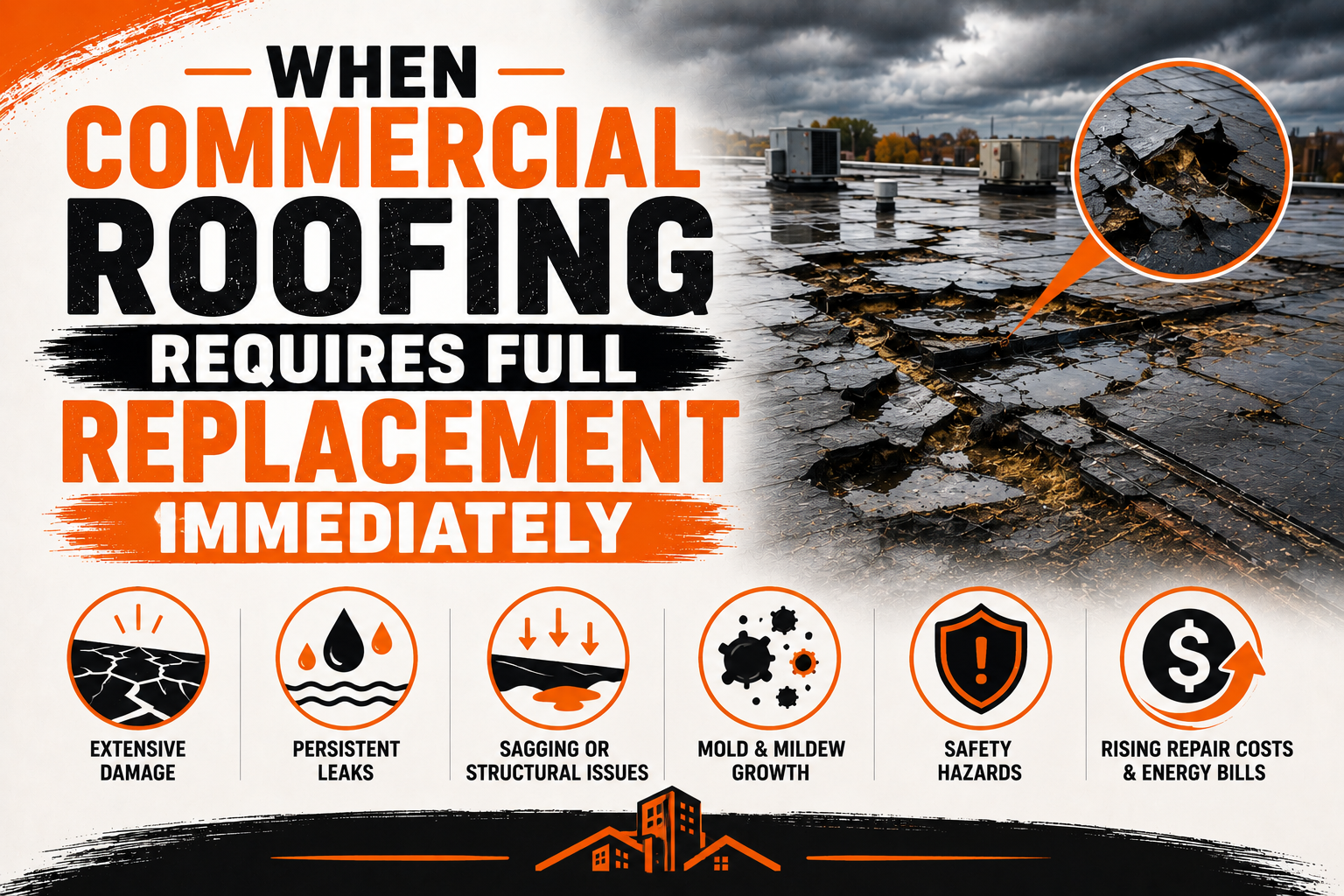
When Commercial Roofing Requires Full Replacement Immediately
Introduction
A commercial roof is one of the most important protective systems in a business property. It shields inventory, equipment, employees, customers, electrical systems, interior finishes, and daily operations from rain, wind, heat, and other environmental conditions. When serious roofing problems develop, deciding whether to repair the damage or replace the entire system can become an urgent business decision.
Not every leak or damaged section requires full replacement. Localized problems can often be repaired when the underlying roofing system remains structurally sound and has sufficient remaining service life. However, widespread deterioration, severe structural damage, extensive moisture intrusion, or repeated system failures can indicate that repairs are no longer a practical long-term solution.
The word “immediately” should also be understood carefully. In many cases, it does not mean replacing the roof within a few hours. It means that the building owner should not continue postponing a professional evaluation or rely on temporary repairs when the roofing system has reached a condition where continued use creates significant property, safety, or operational risks.
A professional inspection is essential before making a replacement decision. Qualified roofing professionals can examine the membrane, flashing, insulation, drainage, roof deck, penetrations, and other components to determine whether the damage is localized or widespread.
Several warning signs can indicate that a commercial roof has moved beyond ordinary maintenance. Understanding these signs helps property owners recognize when a repair strategy may no longer provide reliable protection.
Signs That Commercial Roof Damage Has Become Severe
The first step in determining whether full replacement may be necessary is understanding the difference between isolated damage and widespread system failure. A commercial roof can experience minor punctures, damaged flashing, loose components, or small leaks during its service life without requiring complete replacement. Problems become more concerning when they appear across multiple areas or continue despite previous repairs.
One important warning sign is the frequency of problems. If a roof begins developing leaks in different sections every few months, the issue may be related to the overall condition of the roofing system rather than one isolated defect. Repeated repairs can indicate that the roof is deteriorating faster than individual maintenance efforts can address it.
The condition of the membrane or primary roofing material should also be evaluated. Large areas of cracking, splitting, puncturing, separation, or deterioration can indicate widespread failure. When damage extends across significant portions of the roof, replacing individual sections may provide only temporary improvement.
The roof’s age is another factor, although age alone should not automatically trigger replacement. Different roofing systems have different expected service lives, and installation quality, maintenance, climate, exposure, and building conditions can influence actual performance. An older roof with widespread deterioration deserves closer evaluation than an older roof that remains in good condition.
Moisture is another major concern. Persistent water intrusion can damage insulation, decking, interior finishes, and building contents. If moisture has spread throughout a large portion of the roofing assembly, removing and replacing the affected system may be more practical than attempting isolated repairs.
Structural concerns require immediate attention. If the roof deck has significant corrosion, deterioration, deformation, or other structural problems, the issue extends beyond the visible roofing membrane. A qualified professional should evaluate the structure before continued roofing work or access.
A combination of these warning signs can provide a stronger indication that replacement is necessary. For example, an aging roof with repeated leaks, saturated insulation, deteriorated flashing, and widespread membrane damage may no longer be a suitable candidate for simple repairs.
Extensive and Repeated Roof Leaks
Leaks are among the most obvious signs of commercial roof problems, but the presence of a leak does not automatically mean the entire roof needs replacement. The key questions are how often leaks occur, how widespread they are, where they originate, and whether the underlying roofing system remains capable of performing after repairs.
A single leak caused by damaged flashing or a small puncture may be relatively straightforward to correct. If the surrounding roofing system is in good condition, a targeted repair may restore performance without requiring a full replacement.
The situation changes when leaks appear in numerous locations. Multiple active leaks can indicate that the roofing membrane, seams, flashing, drainage system, or other components are deteriorating throughout the roof. Repeated water intrusion can also make it difficult to identify and correct every individual failure point.
Interior evidence can provide additional warning signs. Water stains on ceilings, damaged insulation, deteriorated drywall, wet electrical areas, or recurring moisture odors can indicate that water intrusion is not a one-time event.
Businesses should take recurring leaks seriously because water damage can affect more than the roof itself. Inventory, computers, machinery, documents, electrical systems, and interior finishes may all be vulnerable to moisture.
Repeated emergency repairs can also become expensive. If a business spends significant amounts of money repairing leaks year after year, those costs should be compared with the investment required for a complete replacement. Continuing to repair an aging system may eventually cost more without providing the reliability of a new roof.
Roof leaks should therefore be investigated rather than simply covered. A professional assessment can determine whether the problem is localized or evidence of broader roofing failure.
Widespread Membrane or Roofing Material Failure
The primary roofing membrane or covering provides the main weather barrier, so widespread deterioration can be a strong indication that replacement is necessary. The exact warning signs vary according to the type of commercial roofing system installed.
Single-ply membranes can develop punctures, seam failures, deterioration, shrinkage, cracking, or other problems. Modified bitumen and built-up systems can experience splitting, surface deterioration, blistering, or failures at seams and transitions. Metal roofing can develop corrosion, failed fasteners, damaged panels, or deteriorated coatings.
The location and extent of damage are important. A few isolated defects may be repaired effectively, but extensive deterioration across large portions of the roof can make patching increasingly difficult.
Repeated patching can also create a complicated roof surface. Numerous repair areas may indicate that the system has already undergone significant deterioration. Although individual patches can address specific defects, they do not necessarily restore the condition of the entire roofing assembly.
A professional inspection should evaluate the overall condition rather than focusing only on visible holes or leaks. The inspector may look at membrane condition, seams, attachment, flashing, insulation, drainage, and other components.
The roof’s remaining service life should also be considered. If a system is already approaching the end of its expected useful life and has widespread damage, investing heavily in repairs may not provide good long-term value.
Replacement can provide an opportunity to address multiple problems at once. A new system can incorporate updated insulation, improved drainage, new flashing, and other components rather than repeatedly repairing individual sections of an aging assembly.
Severe Roof Deck Damage and Structural Concerns
The roof deck is the structural surface supporting the roofing assembly, making its condition particularly important. If the deck is severely damaged, replacing only the visible roofing material may not solve the underlying problem.
Steel decks can experience corrosion, particularly when moisture has entered the roofing assembly over a long period. Wood decks can suffer from rot or deterioration, while other deck types can develop cracks, weaknesses, or other structural problems depending on their construction and exposure.
Some deck damage may be limited to individual areas and can be repaired during a roofing project. However, widespread deterioration can require substantial replacement work before a new roofing system can be installed.
Structural warning signs should never be ignored. Sagging areas, unusual deflection, significant corrosion, or other suspected structural problems require professional evaluation. Workers should not continue accessing questionable areas simply because the roofing surface appears intact.
A roofing contractor may discover deck problems during tear-off that were not visible during the initial inspection. This is one reason replacement budgets should allow for possible concealed conditions.
Structural repairs may involve coordination with qualified engineers or other specialists. The roofing contractor should not be expected to make assumptions about structural capacity when significant damage is discovered.
A roof with widespread deck deterioration may therefore require more than a membrane replacement. The project may involve removing the existing roofing system, repairing or replacing damaged structural components, and then installing a new roofing assembly.
Addressing structural problems early is important because the roof deck supports the entire system. A new membrane installed over a seriously compromised foundation may not provide the expected long-term performance.
Extensive Water Damage and Saturated Insulation
Water can remain trapped inside a commercial roofing assembly for long periods without being immediately visible from inside the building. When insulation becomes saturated, its thermal performance can decline, and prolonged moisture exposure can contribute to deterioration of other components.
A small wet area may sometimes be removed and replaced without replacing the entire roof. The decision depends on the extent of moisture, the condition of surrounding materials, and the type of roofing assembly.
Widespread saturated insulation presents a different situation. If moisture has affected large areas of the roof, removing isolated sections may become inefficient and may leave additional moisture trapped elsewhere.
Wet insulation can also increase the risk of continued roof problems. Simply covering affected materials with a new membrane may not address the underlying moisture condition when removal is necessary.
Professional roof inspections may use visual examination and other appropriate assessment methods to identify moisture-affected areas. The exact inspection approach depends on the roof system and site conditions.
Interior evidence can also provide clues. Recurring ceiling stains, damp insulation, peeling finishes, mold-like odors, or unexplained moisture can indicate that the roofing assembly needs further investigation.
Businesses should not assume that a new surface coating or patch will resolve widespread moisture problems. If the underlying assembly has extensive damage, full replacement may provide a more reliable solution.
Moisture problems can also affect business operations. Water can damage inventory, equipment, electrical components, and interior spaces, potentially causing interruptions that are more expensive than planned roofing work.
For this reason, widespread water damage should be treated as a serious warning sign. The longer moisture-related problems remain unresolved, the greater the possibility of additional deterioration.
Major Storm or Weather-Related Roof Damage
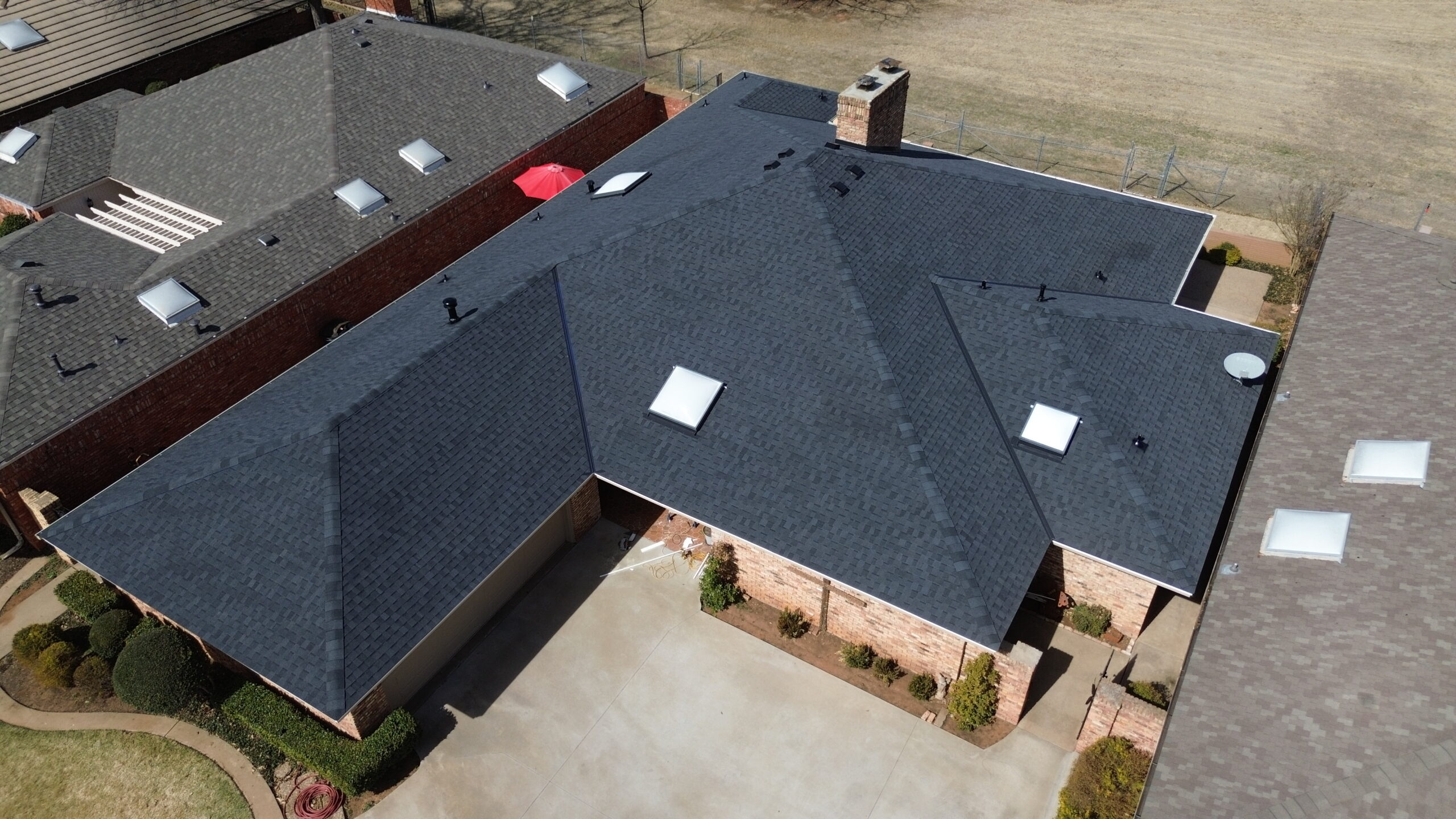
Severe weather can cause sudden and extensive commercial roofing damage. High winds, hail, heavy rain, falling branches, and other events can affect membranes, metal panels, flashing, insulation, edge systems, and rooftop equipment.
After a major storm, businesses should arrange a professional inspection rather than assuming that visible damage represents the full extent of the problem. Some damage may be concealed beneath the roofing surface or may not become obvious until the next rainfall.
Wind can damage seams, edges, flashing, and membrane sections. Hail can create impact damage that may be difficult to identify from ground level. Falling objects can puncture roofing materials or damage the roof deck.
A severe storm can also affect drainage systems. Debris may block drains and outlets, while displaced components can alter water flow. These issues can create additional problems if they are not addressed promptly.
Whether storm damage requires full replacement depends on its extent. Insurance coverage may also influence the financial decision, although property owners should not assume that insurance automatically covers every roofing condition.
When damage affects a substantial percentage of the roof or compromises multiple components, replacement may be more practical than repairing scattered areas. A professional assessment can help document the condition and determine the appropriate next step.
The important point is to respond quickly after a major weather event. Temporary protection may be necessary to limit interior damage while a detailed assessment is arranged.
A commercial roof that develops widespread leaks, extensive membrane failure, serious deck deterioration, saturated insulation, or major storm damage may no longer be a suitable candidate for repeated repairs. These conditions can indicate that the roofing system has reached a critical stage where full replacement deserves serious consideration.
Roof Damage Around Multiple Penetrations and Flashing Areas
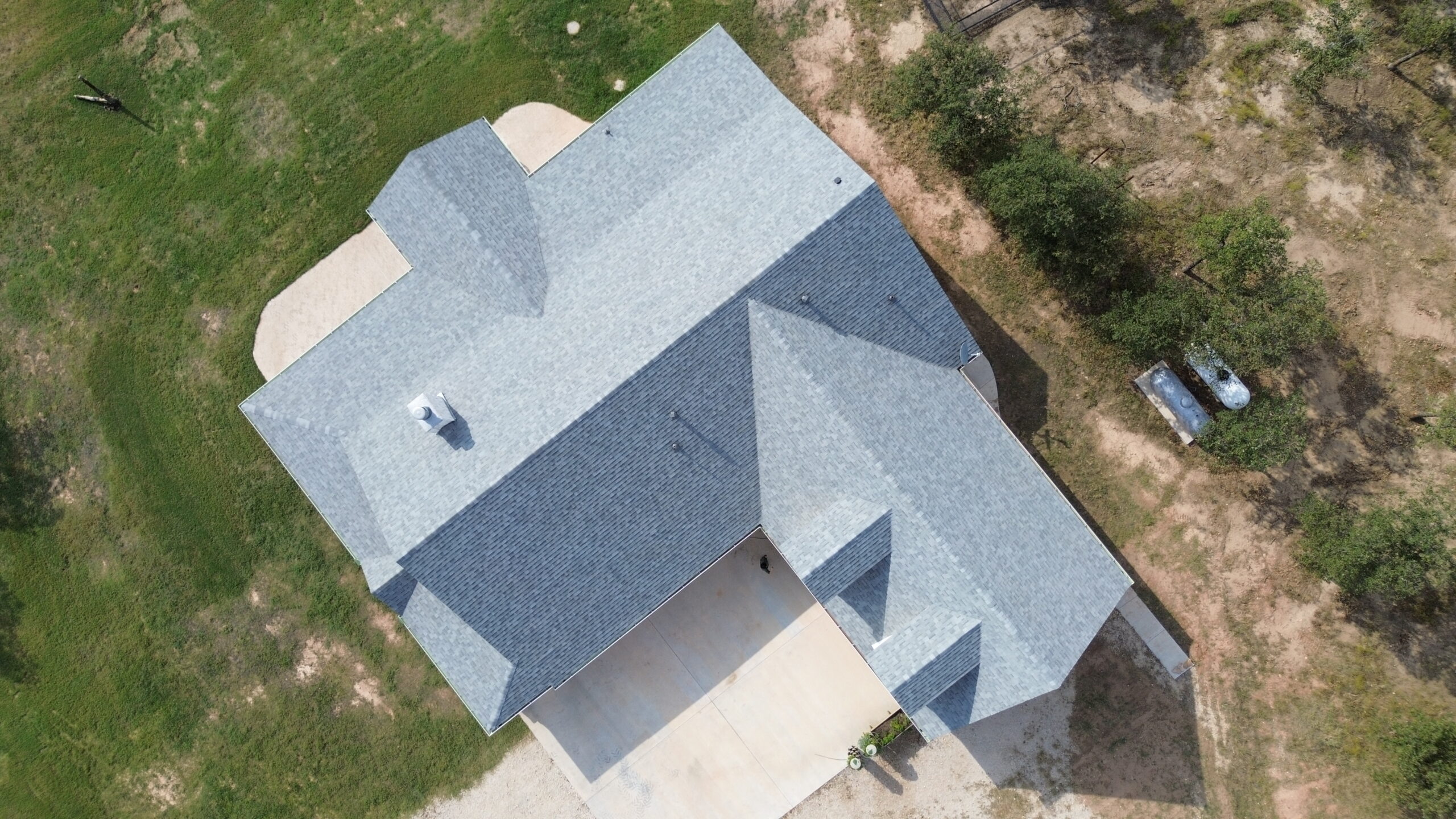
Roof penetrations and flashing details are among the most vulnerable parts of a commercial roofing system. Pipes, vents, HVAC curbs, skylights, drains, parapet walls, and equipment supports all create transitions where the roofing material must connect with other building components. When these areas repeatedly fail across the roof, the problem may indicate broader deterioration rather than a few isolated defects.
A single damaged flashing section can often be repaired without replacing the entire roof. However, widespread deterioration around numerous penetrations can become difficult to manage through individual repairs. If several areas require recurring patching, the overall waterproofing system may be approaching the end of its useful service life.
Repeated flashing failures can also allow moisture to reach insulation and the roof deck. Water may travel beneath the roofing surface before appearing inside the building, making the visible leak location different from the original entry point. This can make recurring repairs frustrating and expensive when the underlying system continues to deteriorate.
Rooftop equipment can make replacement more complicated as well. HVAC units and other mechanical systems may have been installed at different times, creating multiple generations of flashing and penetration details. A comprehensive replacement can provide an opportunity to address these transitions together instead of repeatedly repairing individual sections.
The condition of perimeter flashing deserves equal attention. Deteriorated coping, edge metal, wall flashing, and termination details can expose the roofing assembly to wind and water. If these components are failing throughout the building, simply patching the membrane may not provide dependable long-term protection.
A professional inspection should assess the entire roof rather than focusing only on the most obvious leak. If flashing and penetration failures are widespread, the cost of continued repairs should be compared with the cost and benefits of complete replacement.
Severe Ponding Water and Drainage Failure
Commercial roofs require effective drainage to move rainwater away from the building. When water repeatedly remains on the roof after normal rainfall, the issue may indicate inadequate slope, blocked drains, structural movement, damaged drainage components, or changes in the roofing assembly. Severe and persistent ponding can become a major factor when determining whether replacement is necessary.
Some temporary standing water can occur under certain conditions, but persistent ponding deserves professional attention. Water that remains for extended periods adds weight to the roof and can increase stress on roofing materials and structural components. It can also contribute to accelerated deterioration of some roofing systems.
Blocked drains are sometimes a simple maintenance issue. Removing debris and restoring drainage may resolve the problem when the underlying roof design is adequate. However, repeated ponding after drainage components have been cleaned can indicate a deeper design or structural problem.
Tapered insulation or other drainage improvements may sometimes correct slope deficiencies. In other situations, drains, scuppers, gutters, or other components may need replacement or modification. The appropriate solution depends on the building and existing roof assembly.
Replacement becomes more compelling when drainage problems are widespread and cannot be reasonably corrected without rebuilding significant portions of the roof. A new roofing project can provide an opportunity to redesign drainage and improve water flow.
Businesses should not ignore persistent ponding simply because the roof is not currently leaking. Standing water can contribute to deterioration before an interior leak becomes visible.
A professional assessment should consider both the roofing surface and the underlying structure. If ponding is caused by structural deflection or other significant conditions, additional expertise may be necessary before deciding on the appropriate roofing solution.
Widespread Roof Blistering, Cracking, or Splitting
Visible deterioration across a commercial roof can provide important evidence about its overall condition. Blisters, cracks, splits, open seams, surface erosion, or widespread material deterioration may indicate that the roofing system is no longer performing as intended.
The significance of these conditions depends on the roofing material and their extent. An isolated defect may be repairable, while widespread deterioration across large sections can indicate systemic aging or material failure.
Blistering can occur for different reasons, including trapped moisture or other conditions within certain roofing systems. A roofing professional should determine the cause rather than assuming that every blister requires the same repair method.
Cracking and splitting are also important warning signs. If cracks appear repeatedly across the roof surface, patching individual locations may not address the underlying deterioration. Temperature changes, material aging, movement, and other factors can contribute to these conditions.
Open or failing seams can create direct pathways for water intrusion. When seams are failing throughout a large portion of the roof, restoring every section can become increasingly labor-intensive.
The age and repair history of the roof should be considered alongside visible deterioration. A relatively new roof with a limited defect may have a very different outlook from an older roof covered with numerous repairs and widespread cracking.
Replacement can become the more practical option when deterioration affects a substantial portion of the system. It can allow the entire roofing assembly to be rebuilt instead of repeatedly treating individual symptoms.
Businesses should document widespread deterioration with professional inspection reports and photographs when appropriate. This documentation can help property owners understand the condition and make informed budgeting decisions.
Repeated Emergency Repairs Are No Longer Practical
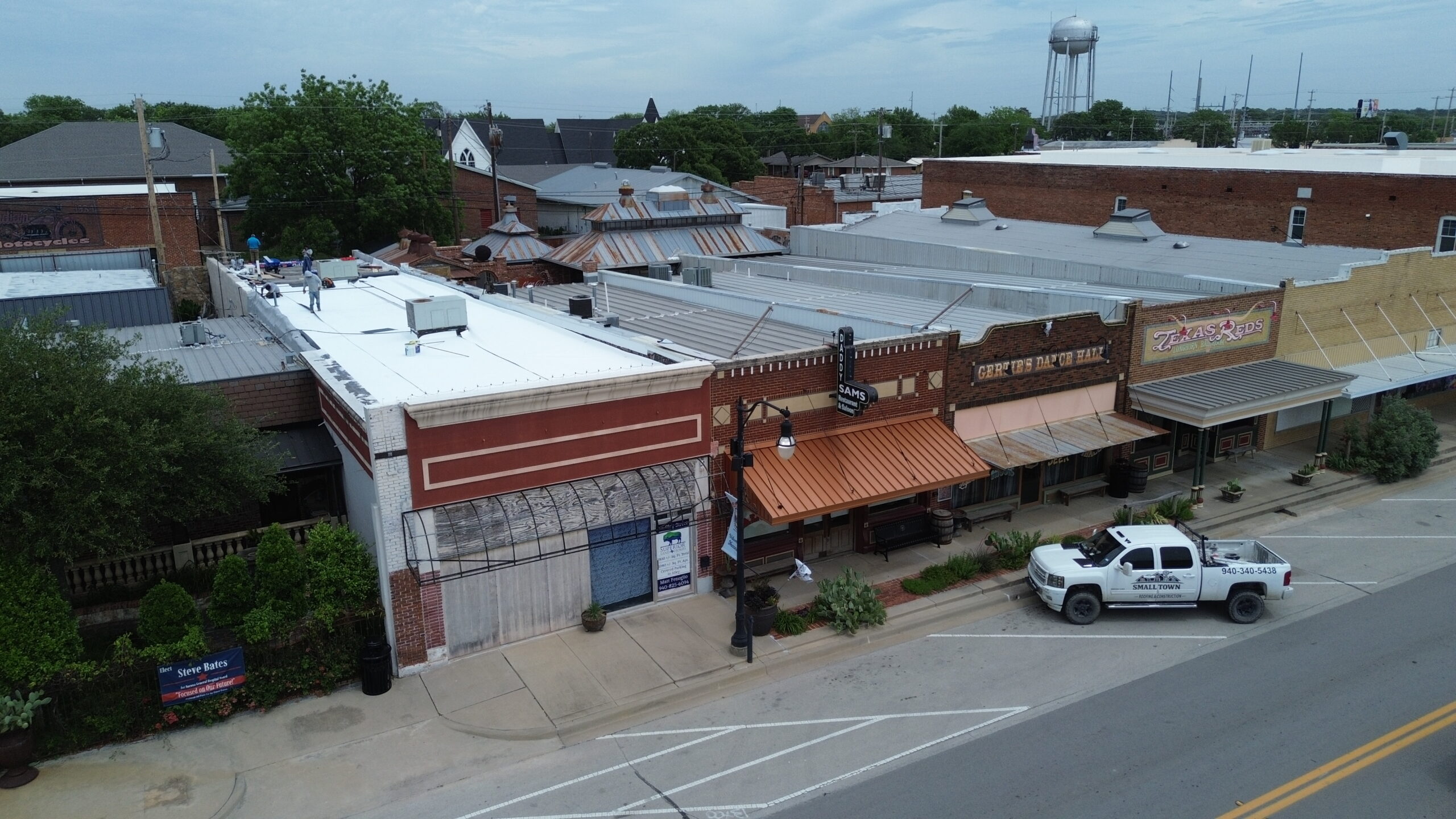
Emergency roof repairs can be necessary when a business needs to control an active leak quickly. Temporary measures may protect interior areas while a more complete repair can be scheduled. Problems arise when emergency repairs become a regular part of roof management.
A roof that requires frequent emergency service may be signaling that its underlying system has become unreliable. Repeated calls to contractors, temporary patches, interior cleanup, and operational disruptions can create significant cumulative costs.
The financial impact extends beyond the roofing contractor’s invoice. Water damage can affect inventory, equipment, ceilings, electrical systems, flooring, and other building components. Employees may also have to work around buckets, restricted areas, or damaged spaces.
Business disruption can become particularly expensive when leaks affect production areas, retail spaces, offices, warehouses, or customer-facing areas. A roof that repeatedly fails can interfere with normal operations even when each individual repair seems relatively inexpensive.
Property owners should therefore evaluate the total cost of repeated repairs over time. If the building has required numerous repairs during the last few years, comparing those expenses with the estimated cost of replacement can provide useful perspective.
Repeated repairs can also create uncertainty. Businesses may not know when the next leak will occur or which area will fail next. A properly planned replacement can provide a more predictable approach to managing the property’s roofing needs.
This does not mean every frequently repaired roof automatically requires replacement. Some systems can be successfully restored or repaired when their underlying condition remains suitable. The decision should be based on professional assessment, remaining service life, repair history, and overall economics.
When emergency repairs become routine rather than exceptional, however, the property owner should seriously consider whether continued repair spending remains a sensible strategy.
Aging Roofing System With Declining Performance
Age alone does not necessarily mean that a commercial roof requires immediate replacement. Roofing systems can perform well for many years when properly designed, installed, inspected, and maintained. However, age becomes more significant when combined with widespread deterioration and declining performance.
An aging roof may show several warning signs at the same time. Leaks may become more frequent, seams may deteriorate, flashing may require replacement, insulation may become damaged, and repairs may no longer provide lasting results.
The remaining useful life is an important consideration. If a roofing system is already near the end of its expected service period and requires major repairs, investing heavily in those repairs may not provide good value.
Businesses should also consider future operating plans. A property expected to remain in use for many years may benefit from replacing an aging roof before failures become severe. Waiting until a major leak occurs can make the project more disruptive and difficult to schedule.
Older roofing systems may also have components that are difficult to match or replace. Manufacturers, materials, installation practices, and building conditions can change over time, making repeated repairs increasingly complicated.
A professional inspection can help determine whether an aging roof remains a reasonable candidate for restoration or repair. The evaluation should consider the entire assembly rather than relying solely on the roof’s installation date.
Planning replacement before complete failure can provide more control over scheduling, contractor selection, material choice, and business continuity. It can also reduce the likelihood of an emergency situation forcing the owner to make rushed decisions.
Fire, Chemical, or Mechanical Damage to the Roof
Some forms of commercial roof damage can be severe enough to require replacement even when the system is not particularly old. Fire, chemical exposure, major mechanical damage, and other unusual events can compromise roofing materials and underlying components.
Fire can damage membranes, insulation, decking, flashing, and structural components. The visible surface may not reveal the full extent of the damage, so a professional evaluation is important after a significant fire event.
Chemical exposure can also affect roofing materials. Manufacturing facilities, industrial properties, laboratories, warehouses, and other specialized buildings may expose roofing systems to substances that can deteriorate certain materials. The appropriate response depends on the chemical involved and the roofing system’s compatibility.
Mechanical damage can occur when heavy equipment, rooftop installations, maintenance activities, or construction work puncture or deform roofing components. A few isolated punctures may be repaired, but widespread mechanical damage can require more extensive replacement.
Falling equipment or structural components can create particularly serious damage. If the impact affects the roof deck or supporting structure, the project may require more than ordinary roofing repairs.
Businesses should document major damage events and arrange professional assessment promptly. Continuing to use a severely damaged roof without evaluation can expose the building to additional moisture or structural risks.
Replacement may be appropriate when damage has compromised a large portion of the roofing assembly or when restoration would require removing and rebuilding substantial sections anyway.
Safety Risks That Make Continued Roof Use Unreasonable
Safety should be a major consideration when deciding whether a commercial roof can continue operating. Roofing deterioration can create hazards for maintenance personnel, contractors, building occupants, and others who may need access to the roof.
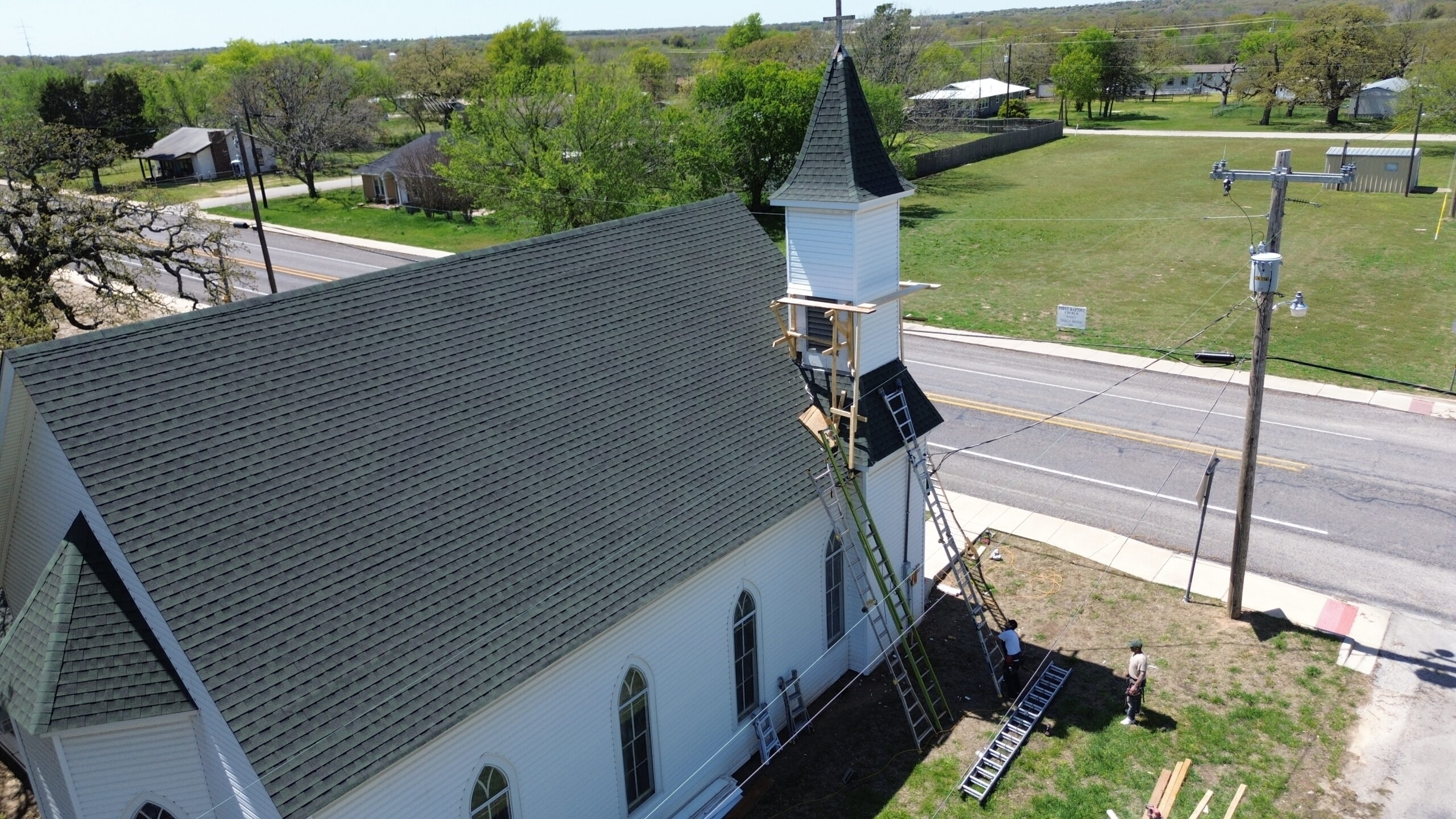
Unstable or damaged roof decking is an especially serious concern. Areas showing significant deterioration should be professionally evaluated before workers are allowed to access them. Roofing personnel should not be expected to work over questionable structural surfaces without appropriate assessment and controls.
Openings, damaged skylights, deteriorated edges, loose components, and unstable materials can also create hazards. These conditions may require immediate temporary protection while a long-term solution is developed.
A roof that cannot be safely accessed for necessary maintenance may create an ongoing operational problem. Building owners need to consider not only whether the roof keeps water out but also whether essential equipment can be safely serviced.
Rooftop HVAC equipment, electrical systems, communications equipment, and other installations often require periodic maintenance. If deterioration makes access unsafe or impractical, the property owner may need to address the roofing system more comprehensively.
Safety concerns should never be managed simply by continuing to patch visible defects. A qualified professional should determine whether the roof can be safely repaired, restored, or accessed.
When widespread deterioration creates unacceptable safety risks, replacement may become necessary to restore a stable and manageable roofing environment.
A combination of flashing failures, drainage problems, widespread surface deterioration, recurring emergency repairs, advanced age, severe event-related damage, and safety concerns can provide strong evidence that a commercial roof is approaching complete failure.
How Professionals Determine Whether Replacement Is Necessary
Determining whether a commercial roof needs full replacement requires more than identifying one visible problem. A professional assessment should consider the condition of the roofing membrane, insulation, flashing, drainage, roof deck, penetrations, edge details, and other components. The goal is to understand whether the existing system can be reliably repaired or whether its overall condition has deteriorated beyond practical restoration.
The inspection usually begins with a review of the roof’s history. Information about its installation date, previous repairs, recurring leaks, maintenance records, storm damage, and past modifications can help explain current conditions. A roof that has required frequent repairs may have a different replacement outlook from one with a similar age but a strong maintenance history.
The visible roof surface is then evaluated for signs of deterioration. Depending on the roofing system, professionals may look for damaged seams, cracks, punctures, blisters, membrane shrinkage, corrosion, loose components, failed flashing, and other defects. The extent and distribution of these problems are more important than the presence of one isolated defect.
The underlying assembly may also need investigation. Moisture-affected insulation, damaged decking, or other concealed conditions can significantly change the recommended scope. In some cases, additional testing or selective openings may be necessary to understand what is beneath the visible surface.
Drainage is another major part of the assessment. Persistent ponding, damaged drains, blocked outlets, and inadequate slope can reduce the performance of a roofing system. A replacement plan should address these conditions rather than simply installing a new surface over an unresolved drainage problem.
The final decision should consider both technical condition and financial practicality. If extensive repairs would approach the cost of a new system while leaving an aging roof in place, replacement may offer better long-term value.
When Temporary Repairs Are Not Enough
Temporary repairs have an important role in commercial roofing, particularly when a sudden leak or storm event needs immediate attention. They can help reduce water intrusion while the property owner arranges a more comprehensive solution. However, temporary measures should not become a substitute for addressing widespread roof failure.
A patch may stop water from entering through one puncture, but it cannot restore an entire membrane that is deteriorating throughout the roof. Similarly, replacing one damaged flashing section may not solve repeated failures occurring around multiple penetrations.
Temporary repairs can also become increasingly complicated as a roof ages. New patches may need to connect with older materials, previous repair areas, and deteriorated surfaces. This can make achieving a reliable long-term repair more difficult.
Businesses should also consider the cumulative cost of temporary work. Each individual repair may seem manageable, but repeated service calls, emergency labor, interior cleanup, and business disruption can add up over time.
A repair strategy becomes less attractive when problems continue appearing in different areas despite previous interventions. This pattern may indicate that the roof has a systemic condition rather than a collection of unrelated defects.
Temporary protection can still be useful while a replacement project is being planned. The important distinction is that temporary work should protect the property during the transition rather than create the assumption that a failing roof has been permanently restored.
Property owners should ask contractors to explain whether a proposed repair is intended as a short-term measure or a durable solution. Understanding the expected outcome makes financial planning much easier.
How Delaying Full Replacement Can Increase Business Costs
Postponing a necessary roof replacement may appear to save money because the business avoids a large immediate investment. However, the cost of delay can increase when roofing problems begin affecting other parts of the building.
Water intrusion is one of the biggest concerns. A failing roof can allow moisture into insulation, ceilings, walls, electrical areas, flooring, inventory, and equipment. The longer the problem continues, the greater the potential for secondary damage.
Business interruption can also become expensive. A leak in a warehouse may damage stored products, while a leak above office space may disrupt employees. In retail or customer-facing environments, recurring roof problems can affect the appearance and usability of the property.
Emergency repairs can also cost more than planned work. When a major leak develops during severe weather or outside normal working hours, the business may have limited options and may need immediate service.
Delaying replacement can reduce scheduling flexibility as well. A planned project can be arranged around business operations, seasonal conditions, equipment access, and contractor availability. An emergency replacement may require faster decisions and create more disruption.
There is also the possibility of worsening structural conditions. If moisture reaches the roof deck or other building components, repairs may become more extensive than they would have been if the roofing problem had been addressed earlier.
The financial impact should therefore be considered as a complete picture. The relevant question is not simply how much replacement costs today but how much the business may spend on repairs, damage, interruptions, and emergency response by continuing to postpone it.
Planning an Urgent Commercial Roof Replacement
When a roof requires urgent replacement, careful planning remains important. Moving quickly does not mean skipping inspections, scope development, or contractor evaluation. A rushed project can create new problems if critical details are overlooked.
The first step is to confirm the extent of the damage. A qualified roofing professional should document the existing condition and determine whether temporary measures are needed while the replacement is being organized.
The business should then establish a clear project scope. This should identify the roofing system, tear-off requirements, insulation, deck preparation, flashing, drainage, edge details, penetrations, cleanup, and warranty expectations.
Contractor selection should focus on experience with comparable commercial projects. Businesses should review relevant qualifications, references, insurance, safety practices, and the contractor’s ability to manage work around an occupied facility.
The project schedule should also be discussed early. If the building must remain operational, the contractor may need to divide the project into phases. This can help maintain access to important areas and reduce disruption.
Material delivery and equipment access should be planned before work begins. Cranes, lifts, dumpsters, staging areas, and worker access routes can all affect project efficiency.
Weather conditions should also be considered. Roofing installation may be sensitive to rain, high winds, temperature, or other environmental conditions depending on the system. The schedule should provide reasonable flexibility for changing conditions.
A well-defined plan allows the business to respond quickly without sacrificing important quality and safety considerations.
How to Minimize Business Disruption During Replacement
Commercial roofing replacement can affect daily operations, but careful coordination can reduce the impact. The contractor and property management team should discuss building activities before construction starts.
Phased construction is one possible approach. Instead of exposing the entire roof to construction activity at once, crews can work in defined sections. This may help maintain access to important building areas while allowing the roofing work to progress.
Communication is equally important. Employees, tenants, customers, delivery personnel, and other affected parties should receive appropriate information about temporary access changes, noise, parking restrictions, and construction schedules.
Material deliveries should be coordinated to avoid unnecessary interference with business activities. Equipment placement should also be planned so that entrances, emergency routes, loading areas, and essential services remain accessible when required.
Interior protection may be necessary in areas directly below active roofing work. Contractors should use appropriate measures to protect building contents and reduce the possibility of construction debris entering occupied spaces.
Businesses should also identify sensitive operations before construction. Manufacturing processes, customer appointments, inventory storage, data centers, and other activities may require additional coordination.
Daily communication between the contractor and property representative can help identify problems early. If weather or unexpected site conditions require a schedule change, the business can adjust its operations accordingly.
The objective is not to eliminate every inconvenience because major roofing work naturally creates some disruption. Instead, effective planning can make the disruption predictable, controlled, and manageable.
Choosing the Right Replacement Roofing System
Once replacement has been confirmed, selecting the right roofing system becomes an important decision. The best system depends on the building’s design, climate, occupancy, roof slope, drainage, energy requirements, maintenance expectations, and budget.
Different commercial roofing systems have different characteristics. Single-ply membranes, modified bitumen, built-up roofing, metal systems, and other assemblies can be suitable for different applications.
The decision should not be based solely on the lowest installation price. Businesses should consider expected service life, maintenance requirements, installation conditions, warranty coverage, energy performance, and compatibility with the existing building.
Insulation should be included in the discussion. A replacement project can provide an opportunity to improve thermal performance and address moisture or damaged insulation within the existing assembly.
Drainage should also be reviewed as part of the new design. If the previous roof experienced persistent ponding, simply installing the same configuration may not address the underlying problem.
Rooftop equipment and future maintenance should be considered as well. HVAC units, vents, skylights, solar equipment, and other installations can affect roof detailing and access requirements.
The replacement system should ultimately be selected as a complete assembly rather than as a single roofing product. Membrane, insulation, attachment, flashing, edges, drainage, and other components need to work together.
Conclusion
A commercial roof does not automatically require full replacement because of one leak, one damaged section, or normal aging. However, widespread deterioration can indicate that repairs are no longer a reliable or financially sensible solution. Repeated leaks, extensive membrane failure, damaged decking, saturated insulation, severe drainage problems, major storm damage, widespread flashing failures, and serious safety concerns are all warning signs that deserve immediate professional attention.
The condition of the entire roofing assembly should be considered before making the final decision. A professional evaluation can identify whether damage is localized or systemic and whether restoration, repair, or replacement provides the most practical long-term solution.
Temporary repairs can be valuable when immediate protection is needed, but they should not be allowed to mask a failing roofing system indefinitely. When emergency repairs become frequent and problems continue appearing across the roof, the business should evaluate the cumulative cost of continuing with short-term solutions.
Delaying necessary replacement can create additional expenses through interior water damage, damaged inventory, equipment problems, emergency service, business interruption, and worsening structural conditions. A planned replacement generally gives the property owner more control over contractor selection, scheduling, materials, and operational coordination.
Urgent replacement should still be approached systematically. Businesses should document the roof condition, define a complete scope, select an experienced commercial roofing contractor, establish a realistic schedule, plan material access, and coordinate construction around important business activities.
Choosing the replacement system is equally important. The decision should consider the building’s roof design, climate, drainage, insulation requirements, expected service life, maintenance needs, and long-term budget rather than focusing only on initial installation price.
Most importantly, property owners should respond to serious warning signs before a roofing failure becomes a major business emergency. A roof that is repeatedly leaking, structurally compromised, severely deteriorated, or no longer capable of providing dependable protection may require complete replacement rather than another temporary patch.
Recognizing the difference between an isolated repair and widespread roofing failure allows businesses to make better decisions. With professional assessment, careful planning, and the right replacement system, an urgent commercial roofing project can restore building protection while supporting safer and more predictable long-term operations.