
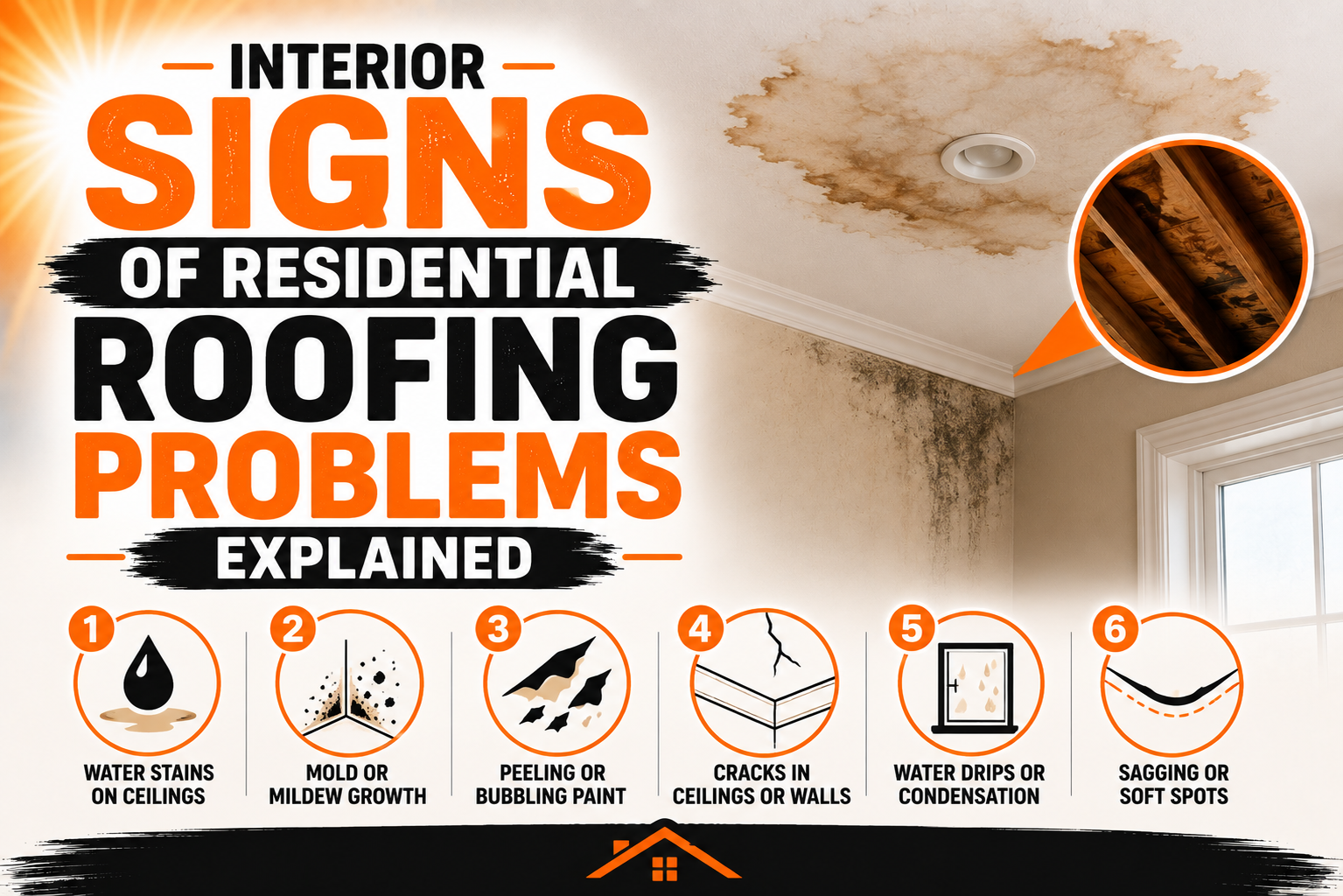
Interior Signs of Residential Roofing Problems Explained
Introduction
A residential roof is designed to protect the home from rain, wind, sunlight, and changing outdoor conditions. While many homeowners look at shingles and other exterior materials when checking roof condition, some of the earliest warning signs can appear inside the house. Ceilings, walls, attic spaces, insulation, and upper-floor rooms can reveal evidence of moisture intrusion or other roofing problems that may not be immediately visible from outside.
Interior signs should never be ignored simply because the roof looks acceptable from the ground. Water can enter through a small damaged area and travel along roof decking, framing, insulation, or other building materials before appearing inside the home. This means that an interior stain may be located some distance from the actual point where water entered the roofing system.
Some interior warning signs are easy to recognize, such as brown ceiling stains or dripping water after rainfall. Other signs are more subtle, including peeling paint, musty odors, damp insulation, condensation, or small changes in ceiling texture. Understanding these conditions can help homeowners recognize potential roofing concerns before they develop into more extensive damage.
An interior inspection should be performed carefully and should focus on safe, accessible areas. Homeowners should never touch exposed electrical components affected by water or enter an unsafe attic. When significant moisture, structural deterioration, or recurring leaks are discovered, a qualified roofing professional should evaluate the condition and determine the likely source.
Ceiling Stains and Discoloration
Ceiling stains are among the most recognizable interior signs of a possible roofing problem. They may appear as brown, yellow, gray, or darkened areas on drywall, plaster, or other ceiling materials. These marks can develop after water enters through damaged roofing materials, flashing, roof penetrations, or other vulnerable areas.
A stain does not always mean that water is currently entering the home. Some leaks occur only during specific weather conditions, such as heavy rain combined with strong wind. After the roof dries, the visible stain may remain even though active dripping is no longer occurring.
Homeowners should pay attention to whether a stain changes after rainfall. A mark that becomes darker, larger, or wetter during or after storms may indicate recurring moisture intrusion. Recording when the stain appears can provide useful information for a professional investigation.
The position of a ceiling stain can offer clues, but it should not be assumed to identify the exact leak location. Water can move along roof decking, rafters, insulation, and other surfaces before reaching the ceiling. For this reason, a roofing professional may need to inspect a broader area around the visible stain.
Multiple stains can provide additional information. If several marks appear in different rooms or along the same upper section of the home, the roof may have more than one vulnerable area. However, multiple stains can also have different causes, so each condition should be evaluated carefully.
Ceiling stains should not simply be covered with fresh paint. Painting over a mark may improve its appearance temporarily while leaving the underlying moisture problem unresolved. If the source continues to allow water into the home, the stain may return and the damage may become more extensive.
Homeowners should photograph visible stains and record their location. Comparing photographs over time can help determine whether the affected area is changing. If the stain continues to grow or appears after multiple rainfall events, professional assessment should be arranged.
Peeling Paint, Bubbling, and Damaged Wall Finishes
Changes to interior paint and wall finishes can also provide clues about moisture exposure. Peeling paint, bubbling surfaces, swollen drywall, or wallpaper that begins to separate may indicate that moisture has entered the building materials. These signs can appear on ceilings as well as upper portions of walls.
Paint may begin to bubble when moisture becomes trapped beneath the surface. The affected area can initially look like a small raised section before gradually becoming more noticeable. If the source of moisture remains active, the finish may eventually peel or deteriorate.
Wallpaper can also react to moisture by lifting at seams or separating from the wall. These changes are particularly important when they occur near exterior walls or upper-floor areas beneath the roof. However, interior humidity, plumbing leaks, and other sources can create similar symptoms.
Swollen drywall is another condition that deserves attention. When drywall absorbs water, it can lose its original shape and strength. A ceiling or wall may appear uneven, soft, or distorted compared with surrounding areas.
Homeowners should avoid pressing on visibly damaged drywall, especially when the material appears wet or weakened. A damaged ceiling can become less stable when moisture exposure is severe. If there is significant sagging or active water entry, the area should be treated as a safety concern.
The location and pattern of damaged finishes can help provide context. A small area near a skylight may suggest one type of issue, while a long stain extending along a ceiling may indicate that water has traveled through the building structure. Professional inspection is often needed to determine the exact source.
Interior finishes can also deteriorate after repeated moisture exposure even when individual leaks are relatively small. Repeated wetting and drying can weaken materials over time. This is why recurring peeling or bubbling should be investigated instead of repeatedly repaired at the surface level.
A homeowner should document the condition before repainting or replacing damaged materials. Photographs can help preserve evidence of the original problem and may be useful when a roofing professional evaluates the property.
Water Damage Around Attic and Upper Floors
Upper floors are often the first interior areas where roofing-related water intrusion becomes visible. Because the roof is directly above these spaces, moisture entering through damaged materials may eventually reach ceilings, walls, or other interior surfaces. Attic spaces can provide even earlier evidence before water becomes visible in living areas.
After rainfall, homeowners can safely inspect accessible upper-floor areas for new moisture marks. Pay attention to ceilings near exterior walls, roof valleys, skylights, chimneys, and other roof features. A new stain that appears after a storm can be an important clue.
Attic access points should also be checked when they can be reached safely. Look for water marks on the underside of the roof deck, damp wood, wet insulation, or other unusual changes. A flashlight can make discoloration easier to identify in areas with limited natural lighting.
Water does not always move directly downward. It may travel along structural members before reaching a visible interior location. This can make it difficult to connect a ceiling stain with the corresponding exterior roof area.
Upper-floor walls may also show signs of moisture. Discoloration, peeling finishes, or changes around wall-to-ceiling joints can indicate that water has moved through the building assembly. These signs should be considered alongside exterior roofing conditions.
The timing of moisture can provide useful information. If the problem appears only during heavy rainfall, the roof may have a localized weakness that is activated by large amounts of water. If moisture appears even during dry weather, another source such as plumbing or indoor condensation may need to be considered.
Homeowners should not assume that every upper-floor water stain comes from the roof. Plumbing systems, HVAC equipment, condensation, and other building components can produce similar symptoms. A professional assessment may be needed when the source is uncertain.
Prompt attention is particularly important when water damage continues to spread. Persistent moisture can affect drywall, wood, insulation, and other materials. Addressing the source early can help limit secondary damage and reduce the complexity of future repairs.
Damp or Damaged Insulation
Insulation in an attic can provide valuable evidence of moisture problems. When water enters through the roofing system, insulation may become damp, compressed, stained, or otherwise altered. Because insulation can conceal portions of the roof structure, these changes may sometimes be the first indication that moisture has reached the attic.
Wet insulation should not be treated as a normal condition. Moisture can reduce the effectiveness of some insulation materials and create conditions that may contribute to additional building problems. The underlying source should be identified rather than simply replacing the visible insulation.
Discoloration is another sign to watch for. Insulation that appears darker or different from surrounding areas may have been exposed to moisture. However, appearance alone cannot determine how long the material has been wet or whether the moisture came from a roof leak.
Compressed insulation may also deserve attention. Water can change the physical condition of some materials, while repeated moisture exposure can cause deterioration. Homeowners should avoid disturbing insulation unnecessarily because attic materials can contain dust, fibers, or other substances that require appropriate protective measures.
The location of wet insulation can provide useful clues. If it is concentrated near a roof penetration, valley, or exterior wall, that area may deserve closer inspection. However, water can move through insulation, so the visible location should not automatically be considered the exact entry point.
Insulation should also be evaluated in relation to attic ventilation and indoor humidity. Not every damp area is caused by rain entering through the roof. Condensation can develop when warm, moist air contacts cold surfaces, particularly when attic airflow or air sealing conditions are inadequate.
Professional evaluation is recommended when significant insulation damage is discovered. A roofing professional can investigate potential exterior causes, while other specialists may be appropriate when ventilation, insulation, indoor humidity, or broader building-envelope conditions are involved.
Musty Odors and Signs of Persistent Moisture
Unusual odors can sometimes provide an early warning that moisture is present inside a home. A persistent musty or damp smell in an attic, upper floor, or room beneath the roof may indicate that an area has experienced prolonged moisture exposure. Odor alone does not prove that the roof is leaking, but it can justify further investigation.
Musty smells are particularly important when they occur alongside visible staining, damp insulation, peeling finishes, or condensation. The combination of several signs provides stronger evidence that moisture may be affecting the building. Homeowners should investigate recurring odors rather than masking them with air fresheners.
An odor that becomes stronger after rainfall may be especially noteworthy. Moisture entering through the roof can increase humidity in enclosed areas and make existing damp conditions more noticeable. Recording when the odor occurs can help professionals understand the pattern.
Persistent moisture can affect wooden roof components, insulation, drywall, and other materials. Long-term exposure may cause materials to deteriorate and can create conditions favorable to unwanted biological growth. Early identification can therefore help homeowners address the underlying moisture source before damage expands.
Homeowners should avoid disturbing areas where extensive mold-like growth or significant dampness is suspected. Cleaning the visible surface without correcting the moisture source may not resolve the underlying problem. Appropriate professional evaluation can help determine the source and the safest response.
Interior odors should also be considered alongside other possible sources. Plumbing leaks, drainage problems, HVAC systems, crawl spaces, and general indoor humidity can produce similar smells. A complete investigation should therefore consider the entire building rather than automatically blaming the roof.
Keeping records of recurring odors can be useful. Note the location, weather conditions, timing, and any related visible signs. These observations can help a roofing professional or building specialist narrow down potential causes.
Visible Mold-Like Growth and Moisture-Related Deterioration
Visible mold-like growth or dark organic-looking patches inside a home can be associated with persistent moisture, particularly when they occur near ceilings, attic areas, or upper walls. Such growth should not automatically be assumed to come from a roof leak because indoor humidity, condensation, plumbing leaks, and other moisture sources can produce similar conditions.
The location of the growth can provide useful context. Growth near a recurring ceiling stain may suggest that moisture is entering from above, while growth around an HVAC system may have a different cause. Identifying the moisture source is more important than simply removing the visible surface growth.
Wooden roof components may also show signs of moisture-related deterioration. Darkened wood, staining, discoloration, or changes in surface condition can indicate prolonged exposure. However, visual inspection alone cannot always determine whether the material remains structurally sound.
Homeowners should avoid scraping, cutting, or aggressively cleaning suspected growth or damaged materials without appropriate precautions. Disturbing affected materials can spread particles and may create additional exposure concerns. Professional evaluation is appropriate when growth is extensive or the source of moisture is unclear.
Moisture-related deterioration can become more serious when it continues for a long period. Roofing problems that begin with a small leak may eventually affect insulation, ceiling materials, framing, and other parts of the home. Recognizing interior warning signs early gives homeowners an opportunity to investigate the source before the damage spreads.
The key is to treat interior signs as clues rather than isolated diagnoses. A ceiling stain, damp insulation, musty odor, or area of mold-like growth may indicate a roofing issue, but each can also have other explanations. Comparing interior evidence with exterior roofing conditions and seeking professional evaluation when necessary provides the most reliable way to understand the problem.
Attic Roof Deck Stains and Moisture Marks
The underside of the roof deck can provide important evidence when homeowners are investigating possible roofing problems. Because the roof deck sits directly beneath the exterior roofing materials, water entering through damaged shingles, flashing, valleys, or penetrations may eventually leave visible marks on its surface. These signs can sometimes appear in the attic before moisture reaches the finished ceiling below.
Dark streaks or irregular stains on roof decking are common warning signs that deserve closer attention. The appearance of a stain does not necessarily mean that the roof is currently leaking, because an old leak can leave a permanent mark after the affected wood has dried. However, unexplained staining should be documented and evaluated, especially if it becomes darker or wetter following rainfall.
Water marks may appear around nails, seams, roof penetrations, or areas where different roof sections meet. These locations can be vulnerable because water may enter through small gaps and then travel along the underside of the roof deck. A stain near a chimney, skylight, vent, or valley may justify a closer examination of the corresponding exterior area.
Homeowners should also look for dampness rather than relying only on visible discoloration. Fresh moisture may appear as a darker patch or a wet surface, particularly after significant rainfall. If moisture is actively present, the area should be treated as evidence of a potentially unresolved problem rather than simply an old stain.
The pattern of the staining can provide useful clues. A concentrated mark around one penetration may suggest a localized issue, while widespread staining across several roof sections may indicate a larger moisture or ventilation concern. Water can travel before reaching the attic, so the most obvious mark is not always directly beneath the original entry point.
Rusted roofing nails can sometimes appear alongside moisture-related staining. Repeated exposure to moisture can cause metal components to corrode, although rust alone does not prove that the roof is leaking. It should be considered together with other findings such as damp wood, water marks, or interior staining.
Homeowners should avoid stepping directly on exposed roof decking unless the area is specifically designed for safe access. Damaged or weakened wood may not support a person’s weight reliably. A qualified roofing professional can inspect questionable areas using appropriate access and safety procedures.
Attic findings should also be compared with exterior observations. If an interior stain appears beneath a roof valley where debris has accumulated, both conditions may be related. Likewise, staining near a roof penetration may lead an inspector to examine the surrounding flashing and roofing materials more closely.
Condensation and Excessive Attic Humidity
Not every moisture-related sign inside a home is caused by rain entering through the roof. Condensation can create many symptoms that resemble a roofing leak, particularly in attic spaces. Understanding the difference is important because repairing exterior roofing materials will not solve a problem caused primarily by indoor humidity or inadequate ventilation.
Condensation develops when warm, moisture-filled air comes into contact with a colder surface. During cooler weather, the underside of roof decking can become cold enough for water vapor to condense on it. Repeated condensation can leave damp areas, dark stains, wet insulation, and other visible signs.
Homeowners may notice condensation around roofing nails, metal components, or the underside of the roof deck. These surfaces can become colder than surrounding materials and may collect moisture more readily. If similar moisture appears across large portions of the attic, ventilation and indoor humidity should be considered as possible contributing factors.
Bathroom and kitchen activities can introduce significant moisture into a home. Showering, cooking, drying clothes, and other everyday activities release water vapor into the indoor environment. If that moisture reaches the attic because of air leakage or inadequate ventilation, it can contribute to condensation.
Poor attic ventilation can also affect moisture management. Roof ventilation systems are designed to support appropriate airflow, but their effectiveness depends on the overall design of the building assembly. Blocked vents, inadequate airflow, or improperly balanced ventilation can contribute to unfavorable attic conditions.
Homeowners should not seal or block attic vents simply because they notice moisture nearby. Ventilation changes should be considered carefully because an improperly modified system may create additional problems. A roofing or building professional can evaluate the existing arrangement and determine whether changes are appropriate.
Seasonal patterns can provide useful information. Condensation may be more noticeable during cold periods when warm indoor air meets colder roof surfaces. A leak caused by rainfall, on the other hand, may become more obvious during or shortly after storms.
The distinction between condensation and a roof leak is not always obvious from a visual inspection. Both conditions can produce stains and damp materials. Professionals may need to examine weather patterns, attic ventilation, indoor humidity, exterior roofing conditions, and the location of moisture before determining the likely cause.
Damaged or Deteriorated Roof Framing
Roof framing provides essential structural support for the roofing system, so changes in the condition of rafters, trusses, or other structural components should be taken seriously. Interior inspection can sometimes reveal discoloration, cracking, warping, or deterioration that is not visible from outside the home. These findings may result from long-term moisture exposure or other structural conditions.
Darkened or stained wood can indicate that a component has experienced moisture exposure. A single old stain does not automatically mean that the framing has lost its strength, but it can indicate that further evaluation is appropriate. Repeated moisture exposure is more concerning because it can gradually affect wood materials.
Wood that appears soft, crumbly, split, or significantly deteriorated requires particular attention. Structural components should not be modified, cut, drilled, or reinforced by homeowners based only on a visual assumption. The appropriate response depends on the extent and cause of the deterioration.
Cracks in framing can have different causes. Some small changes may be associated with normal movement or aging, while larger or unusual cracks can indicate a structural concern. The location, direction, size, and surrounding conditions all matter when interpreting a crack.
Signs of moisture around framing should also be compared with the exterior roof condition. A damaged flashing detail above a stained rafter may provide one possible explanation, while widespread attic condensation may suggest another. This comparison can help professionals determine whether the issue is localized or related to broader moisture conditions.
Roof framing can also be affected by long-term roof leaks. Water that repeatedly reaches structural wood may create conditions that allow deterioration to progress. Even when the original leak appears small, the resulting damage can extend beyond the immediate area.
Sagging or changes in the shape of framing deserve prompt attention. These conditions may indicate that a component has been weakened or subjected to an unusual load. Homeowners should avoid placing additional weight in an affected area and should arrange appropriate professional evaluation.
An interior roofing inspection is not necessarily a structural engineering assessment. If serious structural deterioration is suspected, a qualified structural professional may need to become involved. The roofing professional can help identify the relationship between the roof covering and visible structural concerns and recommend further evaluation when appropriate.
Sagging Ceilings and Uneven Interior Surfaces
A sagging ceiling can be a significant interior warning sign, particularly when it appears beneath an area with known roofing concerns. Moisture can cause drywall and other ceiling materials to absorb water, become heavier, and lose their original shape. A ceiling that appears swollen, bowed, or uneven should therefore be investigated rather than covered with new material.
Small changes in ceiling appearance may be difficult to notice at first. Homeowners can look across the ceiling from different angles to identify areas that appear lower or distorted compared with surrounding surfaces. Changes may become more visible when natural or artificial light creates shadows across an uneven surface.
A ceiling that sags after rainfall deserves immediate attention. Water entering through the roof can accumulate above the ceiling and increase the weight of the affected material. In severe cases, continued moisture accumulation may create a safety hazard.
Homeowners should not press against a visibly swollen ceiling to determine how soft it is. Damaged drywall can become unstable, and touching it may cause material to break or fall. If active water is present, the area should be kept clear while appropriate professional assistance is arranged.
Uneven ceilings can have causes unrelated to roofing. Building movement, installation issues, plumbing leaks, or structural changes may produce similar appearances. For this reason, the ceiling condition should be evaluated alongside the roof, attic, plumbing, and other relevant building systems.
Sagging may also occur in areas where a previous leak has already been repaired. Even if the roof is now watertight, interior materials damaged during the earlier event may remain distorted. The source of the original moisture should still be confirmed before interior repairs are completed.
Ceiling damage should be documented before repairs begin. Photographs taken from several angles can show the extent of the condition and help professionals understand whether the problem is localized. Homeowners should also note when the sagging was first observed and whether it changes after rainfall.
If multiple ceiling areas are sagging, the situation may require broader investigation. Widespread changes can indicate more than one leak or a building condition affecting several areas. A professional can determine the appropriate inspection scope based on the observed pattern.
Signs Around Skylights, Chimneys, Vents, and Roof Penetrations
Roof penetrations are common locations for potential moisture intrusion because they create interruptions in the continuous roofing surface. Skylights, chimneys, plumbing vents, exhaust vents, and other structures require proper flashing and weatherproofing. Interior signs around these features can provide useful clues when investigating a possible roof problem.
Water stains around a skylight may appear on the ceiling or surrounding wall surfaces. The staining can become more noticeable after heavy rain or wind-driven rain. While the skylight itself may be responsible, the surrounding roofing and flashing should also be examined.
Chimneys create multiple transition points between masonry and roofing materials. Interior staining near a chimney can be associated with damaged flashing, deteriorated sealant, masonry issues, or other conditions. The exact source should be determined through a complete evaluation rather than assuming that the visible stain identifies the cause.
Plumbing vents can also be associated with interior moisture problems. A damaged boot, flashing component, or surrounding roofing material may allow water to enter the roof assembly. Interior evidence below the penetration can help direct attention toward the corresponding exterior area.
Bathroom and kitchen exhaust vents deserve special consideration because they can create moisture problems when they are not functioning or discharging properly. If humid air is released into an attic instead of being properly directed outdoors, condensation can develop on roof components.
Homeowners should look for recurring stains, peeling finishes, or damp areas near these features. The timing of the symptoms can be helpful, especially when they appear after rainfall or during periods of high indoor humidity. Photographs and notes can make it easier for a professional to identify patterns.
Interior signs near roof penetrations do not always mean that the roofing materials are defective. A plumbing issue, condensation problem, or deterioration of another component may produce similar symptoms. A comprehensive assessment should therefore consider all potential moisture sources.
Because many penetration details contain hidden layers, homeowners should avoid attempting to remove flashing or roofing materials themselves. Improperly disturbing these components can create additional openings for water. Professional evaluation is safer and can help preserve the existing roofing system.
Electrical and Safety Concerns Related to Roof Leaks
Water entering a home through the roof can create safety concerns beyond damage to ceilings, insulation, and structural materials. Electrical components may be located within ceilings, walls, and attic spaces where moisture can travel. When water and electrical systems come into contact, the situation should be treated with caution.
Water stains near light fixtures, electrical outlets, switches, or other electrical components deserve immediate attention. Homeowners should not touch wet electrical devices or attempt to determine whether wiring has been affected. If water is actively entering near electrical equipment, appropriate professional assistance should be obtained.
Ceiling fixtures can be particularly concerning because water may collect above them before becoming visible. A dripping light fixture or wet electrical fitting should not be treated as an ordinary roof leak. Electrical safety should take priority over attempts to locate the roofing defect.
Attic wiring can also be affected by moisture. If water has entered the attic, homeowners should avoid handling cables, junction boxes, or other electrical equipment. A qualified electrician may be needed to assess electrical components after significant water exposure.
Other interior safety concerns can develop when roofing materials deteriorate. Wet insulation, damaged drywall, weakened framing, and slippery surfaces can increase the risk of injury. Homeowners should avoid entering areas that appear unstable or unsafe simply to investigate the source of a leak.
During an inspection, safety should always come before collecting additional information. A homeowner can document visible conditions from a safe location without climbing into dangerous spaces. Clear photographs, notes about rainfall, and descriptions of interior symptoms can provide useful information to professionals.
If water is actively entering the home, temporary measures may be necessary to limit additional damage, but homeowners should avoid climbing onto the roof during wet or stormy conditions. Emergency roofing work should be performed by professionals equipped to work safely. Interior containers can sometimes help manage minor dripping temporarily, but they do not address the underlying roof problem.
The presence of an interior warning sign does not automatically mean that the entire roof has failed. Many roofing problems are localized and can be repaired when identified early. However, recurring moisture, structural changes, electrical concerns, or extensive interior damage should receive professional attention promptly so the underlying cause can be identified and addressed.
How to Distinguish Roof Leaks From Other Moisture Sources
Interior moisture signs can strongly suggest a roofing problem, but not every stain, damp area, or musty odor originates from the roof. Water can enter a home through plumbing systems, HVAC equipment, windows, exterior walls, condensation, or drainage problems. Identifying the actual source is important because treating the wrong problem can leave the underlying damage unresolved.
The timing of the moisture can provide useful clues. If a ceiling stain becomes darker shortly after rainfall, roof-related water intrusion may be one possibility, particularly when the affected area is directly below an attic or roof section. If moisture appears regardless of weather conditions, plumbing leaks, condensation, or another interior source may deserve consideration.
The location of the damage is also helpful. A stain beneath a bathroom may be related to plumbing, while staining near a skylight or chimney may justify closer examination of the roof. However, water can travel through framing and other materials, so the visible location should never be treated as definite proof of the source.
Homeowners can record when a problem appears and what weather conditions were present. Photographs taken before and after rainfall can help show whether a stain changes over time. These records can be particularly useful when a leak occurs only during heavy rain or wind-driven storms.
Some signs can have multiple possible causes. For example, dark attic staining can result from roof leakage or condensation, while peeling paint may result from roofing moisture, plumbing problems, or high indoor humidity. A professional assessment may be necessary when the source cannot be identified through safe visual observation.
The best approach is to compare interior evidence with exterior and attic conditions. When ceiling staining, roof damage, and attic moisture occur in the same general area, the likelihood of a roofing-related issue may increase. Even then, the exact entry point may require further investigation.
Signs of Long-Term Hidden Roofing Damage
Some roofing problems develop gradually and remain hidden for months or even years before becoming obvious inside the home. Small amounts of moisture can repeatedly enter through damaged roofing materials and slowly affect insulation, roof decking, framing, and interior finishes. By the time a homeowner notices a ceiling stain, the underlying problem may have existed for some time.
Persistent discoloration is one possible indication of long-term moisture exposure. A stain that repeatedly returns after being cleaned or painted may suggest that the source has not been fully corrected. Homeowners should investigate recurring marks instead of repeatedly covering them with new finishes.
Wood deterioration can also indicate prolonged exposure. Darkened, weakened, cracked, or visibly deteriorated wood in an attic may require further evaluation. The condition of structural components should not be judged solely from appearance because the extent of damage may not be obvious without professional assessment.
Insulation can retain evidence of earlier moisture exposure as well. Areas that remain compressed, stained, or damaged may indicate that water has reached the attic. However, insulation problems can also result from condensation or installation conditions, so the surrounding evidence should be considered.
Persistent odors can provide another clue. A musty smell that remains in an attic or upper room may indicate ongoing or previous moisture. When the odor appears alongside staining, damaged materials, or condensation, a detailed investigation becomes more important.
Hidden damage can also extend beyond the immediate leak location. Water may travel along roof decking, rafters, insulation, and wall cavities before reaching a visible surface. This means that repairing only the area where a stain appears may not resolve the actual source.
Early inspection can reduce the chance of these hidden problems becoming extensive. Homeowners who notice repeated interior warning signs should arrange an appropriate evaluation rather than waiting for visible damage to become severe. Early identification can make it easier to determine the source and plan suitable repairs.
Seasonal Changes in Interior Roofing Problems
Some interior roofing problems become more noticeable during particular seasons because weather conditions influence how roofing systems and building materials behave. Heavy rainfall can expose leaks, while cold weather can increase condensation. Understanding seasonal patterns can help homeowners recognize recurring problems more accurately.
During rainy periods, roof leaks may become easier to identify. Ceiling stains can darken, attic materials may become damp, and water may appear around roof penetrations. Wind-driven rain can also reach areas that remain dry during ordinary rainfall.
Winter or cooler weather can create different concerns. Warm indoor air may move into the attic and contact cold roof surfaces, creating condensation. If this happens repeatedly, homeowners may notice damp roof decking, wet insulation, or dark moisture marks.
Hot weather can also affect roofing and attic conditions. High temperatures can increase attic heat, while inadequate ventilation may contribute to unfavorable conditions. Although heat alone does not prove that the roof has a problem, unusual attic conditions can justify a broader inspection.
Spring and autumn can bring changing weather patterns that reveal previously unnoticed issues. Heavy storms, falling leaves, and temperature changes can affect roofing and drainage systems. Interior symptoms that appear during these periods should be documented rather than assumed to be temporary.
Seasonal comparison is particularly useful when a problem occurs repeatedly. If a ceiling stain appears every time heavy rain occurs from a particular direction, the pattern may provide valuable information about the likely source. Similarly, attic condensation that occurs only during cold periods may point toward ventilation or indoor humidity concerns.
Homeowners should maintain simple inspection records throughout the year. Dates, weather conditions, photographs, and notes about new stains or odors can create a useful history. This information can help professionals understand whether a condition is seasonal, recurring, or progressively worsening.
What Homeowners Should Do After Finding Interior Warning Signs
When an interior roofing warning sign is discovered, the first step should be documenting the condition from a safe location. Photographs can show stains, peeling finishes, damp areas, or other visible changes. Homeowners should also note when the condition was first observed and whether it appeared after rainfall.
The next step is to consider whether the condition is active or historical. A dry stain may represent an old problem, while a wet or expanding stain may indicate ongoing moisture. Active water entry deserves faster attention because continued exposure can increase interior and structural damage.
Homeowners should avoid making cosmetic repairs before the moisture source is understood. Painting over a stain or replacing damaged drywall may hide the evidence without correcting the underlying problem. The roofing system and other possible moisture sources should be evaluated first.
If the attic can be accessed safely, homeowners may look for visible moisture marks or damp materials. However, they should not enter areas with unstable flooring, exposed electrical hazards, significant structural damage, or other safety concerns. Professional inspection is preferable when access is uncertain.
Temporary measures may sometimes reduce interior damage while professional assistance is being arranged. For example, containers can collect minor dripping water, and valuable belongings can be moved away from affected areas. These steps do not replace repair and should not involve climbing onto a roof during unsafe conditions.
Homeowners should also avoid attempting complex roofing repairs based solely on an interior symptom. The visible location of a ceiling stain may not correspond with the actual entry point. Improper repairs can sometimes create additional openings or make later professional investigation more difficult.
Keeping inspection and repair records is useful for future maintenance. Photographs, dates, professional reports, and repair details can help establish a history of the roofing system. This information may also help identify recurring problems if similar interior signs appear later.
When Interior Signs Require Professional Roofing Inspection
Some interior warning signs can be monitored, while others require prompt professional attention. Active leaks, rapidly expanding stains, significant ceiling sagging, damaged structural wood, persistent moisture, and repeated water intrusion should not be ignored. These conditions may indicate that the roofing system is no longer adequately protecting the home.
A professional inspection is particularly important when the source of moisture cannot be identified. Roofing professionals can examine exterior materials, flashing, roof penetrations, drainage areas, and other components that may not be visible from inside. Additional specialists may be recommended when plumbing, structural, electrical, or ventilation problems are suspected.
Storm-related interior damage also deserves timely assessment. A severe storm may create several small openings that allow water to enter during subsequent rainfall. A roof that looks acceptable from the ground can still contain localized damage that requires closer examination.
Structural signs require special caution. Sagging ceilings, damaged framing, significant roof movement, or weakened materials should not be treated as ordinary maintenance concerns. Homeowners should keep people away from unsafe areas and arrange appropriate professional evaluation.
Electrical concerns should also receive immediate attention. Water near light fixtures, outlets, wiring, or electrical equipment can create hazards that require qualified assessment. Homeowners should never handle wet electrical components simply to investigate a suspected roof leak.
The purpose of professional inspection is not automatically to recommend roof replacement. Many interior roofing problems are caused by localized defects that can be repaired when identified appropriately. A proper inspection helps determine whether the condition requires maintenance, repair, monitoring, or more extensive work.
Conclusion
Interior signs can provide some of the earliest and most useful warnings that a residential roofing system may have a problem. Ceiling stains, peeling paint, bubbling finishes, damp insulation, attic moisture, condensation, damaged framing, musty odors, and uneven ceilings can all indicate conditions that deserve attention. Recognizing these signs early can help homeowners investigate problems before they develop into more extensive damage.
The visible location of an interior symptom should not automatically be considered the source of the problem. Water can travel through roofing materials, roof decking, insulation, framing, and wall cavities before becoming visible. This is why interior findings should be compared with exterior roofing conditions and other possible moisture sources.
Seasonal patterns can also provide important information. Rainfall may reveal active roof leaks, while colder conditions may expose condensation problems within the attic. Keeping photographs and notes throughout the year can help homeowners and professionals recognize recurring patterns.
Homeowners should avoid relying on cosmetic repairs to solve moisture problems. Painting over a stain, replacing damaged drywall, or cleaning a musty area may improve the appearance temporarily but will not correct an unresolved source of moisture. The underlying cause should be identified before permanent interior repairs are completed.
Professional evaluation becomes especially important when moisture is active, damage is extensive, structural materials appear affected, or electrical components may have been exposed to water. A qualified roofing professional can evaluate the exterior system and determine whether additional specialists are needed.
Ultimately, interior warning signs should be treated as useful clues rather than definitive diagnoses. Regular observation, timely documentation, safe inspection practices, and professional evaluation when necessary can help homeowners protect their property and maintain the performance of their residential roofing system.