
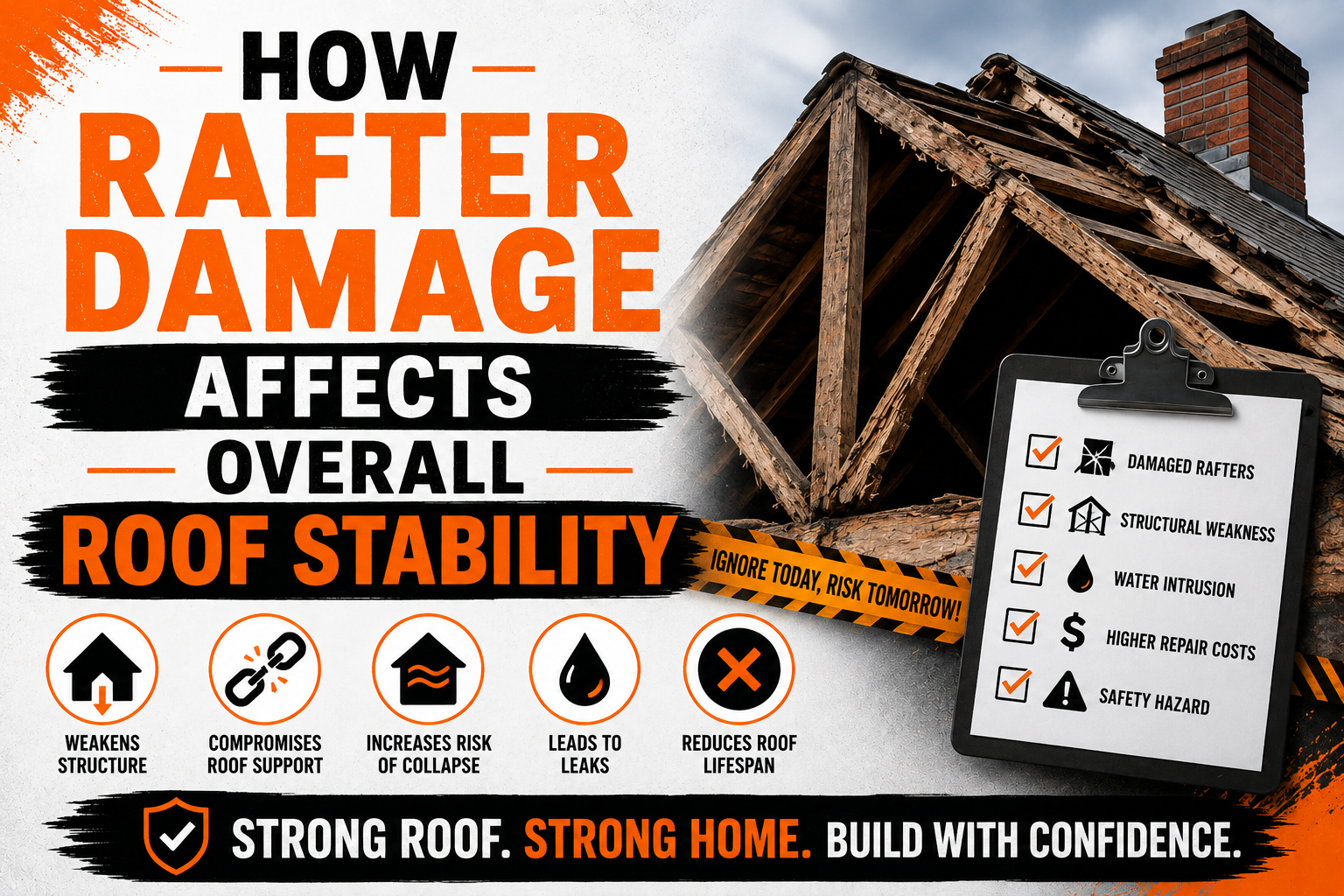
How Rafter Damage Affects Overall Roof Stability
Introduction
The strength of a roof depends on much more than its shingles, tiles, or metal panels. Hidden beneath the roofing materials is a structural framework that carries the weight of the entire roof, and one of its most important components is the rafter system. When roof rafters become damaged, the stability of the entire roofing structure can gradually decline, even if the exterior appears to be in good condition.
Many homeowners focus on visible roofing issues such as missing shingles or leaks while overlooking the structural elements beneath them. Unfortunately, problems affecting rafters often remain hidden inside the attic until noticeable signs like roof sagging, ceiling cracks, or water damage begin to appear. By the time these symptoms become obvious, the structural damage may already be significant.
Rafter damage rarely develops overnight. Moisture, aging materials, insect activity, excessive roof loads, poor construction practices, and long term structural movement all contribute to gradual weakening. As the damage progresses, the roof loses its ability to distribute weight evenly, placing additional stress on surrounding structural components.
Understanding how rafters function and recognizing the earliest warning signs of damage can help homeowners prevent costly repairs and reduce the risk of serious structural failure. This guide explains the role of roof rafters, the causes of damage, and why early intervention is essential for maintaining a safe and durable roofing system.
Understanding Roof Rafters and Their Structural Function
Roof rafters are sloped structural members that extend from the roof ridge down to the exterior walls. They form the skeleton of many residential roofing systems and provide the framework that supports the roof decking, underlayment, insulation, and exterior roofing materials.
Traditionally, rafters have been constructed from solid lumber because of its strength and ability to carry substantial loads. Modern construction may also use engineered wood products designed to provide consistent structural performance while minimizing natural defects found in solid timber.
Each rafter works together with neighboring rafters to distribute the roof’s weight across the supporting walls. Instead of allowing loads to concentrate in one location, the framing system spreads them evenly throughout the structure.
Without properly functioning rafters, even high quality roofing materials cannot provide adequate protection. Shingles, tiles, or metal panels depend entirely on the structural framework beneath them to remain properly aligned and securely supported.
Rafters also determine the roof’s shape and slope. Their spacing, size, and angle influence not only the appearance of the roof but also its ability to withstand weather conditions such as wind, rain, and snow.
In addition to supporting the roof itself, rafters contribute to the stability of the home’s upper structure. They help maintain the relationship between exterior walls, roof decking, and ridge components, allowing the building to function as a single structural system rather than a collection of individual parts.
How Roof Rafters Support the Entire Roofing System
Every component of a roof relies on the rafter system for structural support. While roofing materials provide weather protection, rafters supply the strength necessary to carry both permanent and temporary loads throughout the life of the building.
Permanent loads include the weight of roof decking, underlayment, shingles, insulation, flashing, and other construction materials. Temporary loads vary depending on weather conditions and maintenance activities.
Common loads supported by roof rafters include:
- Roofing materials.
- Roof decking.
- Snow accumulation.
- Wind forces.
- Rainwater loads.
- Maintenance workers and equipment.
These loads constantly change throughout the year. A properly designed rafter system accommodates these variations while maintaining the roof’s structural alignment.
When one rafter weakens, neighboring rafters begin carrying additional weight. Although this redistribution may temporarily prevent immediate failure, it gradually increases stress throughout the surrounding framework.
Over time, this uneven loading can cause roof sagging, fastener movement, cracking, and progressive structural deformation. What initially appears to be an isolated problem often develops into damage affecting multiple sections of the roof.
Roof rafters also provide attachment points for ceiling joists, collar ties, roof decking, and other structural members. Because these components are interconnected, damage to one part of the framing system frequently influences the performance of several others.
Maintaining strong rafters is therefore essential for preserving the overall stability of the roof as well as the long term structural health of the entire building.
Common Causes of Rafter Damage
Roof rafters are designed to remain structurally sound for many decades. However, continuous exposure to environmental conditions and structural stresses can eventually weaken them if problems are not addressed promptly.
Understanding the most common causes of rafter damage helps homeowners recognize potential risks before significant deterioration occurs.
Water Intrusion
Moisture remains the leading cause of structural wood damage.
Roof leaks caused by damaged shingles, deteriorated flashing, clogged valleys, or failed roof penetrations allow water to reach the wooden rafters. Once absorbed into the wood, moisture gradually reduces strength while creating favorable conditions for fungal growth and decay.
Because leaks often remain hidden inside attic spaces, water damage may continue unnoticed for months before visible symptoms appear.
Wood Rot
Wood rot develops when moisture remains trapped inside structural lumber for extended periods.
Fungi break down the wood fibers responsible for carrying structural loads, causing the rafters to soften and lose their original strength. Unlike temporary moisture exposure, advanced rot permanently damages the wood and usually requires replacement of the affected sections.
Rot frequently spreads beyond the initially damaged area, making early detection especially important.
Insect Infestation
Wood destroying insects can significantly weaken roof framing.
Termites consume structural wood from the inside, leaving a thin outer surface that may appear intact despite severe internal damage. Carpenter ants and certain wood boring beetles also contribute to gradual deterioration under suitable conditions.
Because insect activity often occurs within concealed spaces, homeowners may not notice the damage until structural movement becomes visible.
Excessive Roof Weight
Every roof is engineered to support a specific design load.
Additional roofing layers, heavy tile installations, rooftop equipment, accumulated snow, or standing water may place greater stress on rafters than originally intended.
Repeated overloading accelerates structural fatigue and increases the likelihood of bending, cracking, or permanent deformation.
Poor Construction Practices
Improper construction can shorten the lifespan of roof rafters even when quality materials are used.
Common construction issues include undersized lumber, excessive spacing between rafters, inadequate fastening, improper connections, or modifications made during renovations without structural evaluation.
These deficiencies may not create immediate problems, but they often become apparent after years of normal service.
Structural Settlement
Buildings naturally experience slight settlement over time.
When settlement occurs unevenly, roof loads shift in unexpected ways. Certain rafters begin carrying greater loads than others, increasing structural stress and contributing to gradual deformation.
Foundation movement, expansive soils, and changes in moisture beneath the building can all influence structural settlement.
Storm Damage
Severe weather can place tremendous forces on a roof.
High winds create uplift pressure, while heavy snowfall adds significant downward loads. Falling tree limbs and storm debris may also cause localized structural damage that weakens one or more rafters.
Even if the roof covering appears largely intact after a storm, hidden framing damage may still exist beneath the surface.
Early Warning Signs of Damaged Roof Rafters
Roof rafters usually provide warning signs before serious structural failure occurs. Recognizing these symptoms early allows repairs to be completed while damage remains relatively limited.
Because many warning signs develop gradually, homeowners should include attic inspections as part of their regular home maintenance routine.
Roof Sagging
One of the clearest indicators of rafter damage is a roofline that no longer appears straight.
Visible dips, uneven ridges, or sections that appear lower than surrounding areas often indicate that one or more rafters have weakened or shifted.
Although minor irregularities may exist in older homes, newly developed sagging should always be investigated.
Ceiling Cracks
Structural movement within the roof often transfers stress to the ceilings below.
Cracks appearing along drywall joints, corners, or ceiling surfaces may indicate that roof framing is no longer maintaining its original alignment.
While some cracks result from normal building movement, expanding or recurring cracks deserve closer evaluation.
Doors and Windows That Stick
Changes in roof framing sometimes influence the entire structure.
As roof loads shift, exterior walls may experience slight movement that causes doors and windows to become difficult to open or close properly.
Although several factors can cause this issue, it may accompany structural roof problems.
Water Stains Inside the Home
Persistent ceiling stains often indicate leaks affecting the roof structure.
Even if the visible water damage appears limited, moisture may already be weakening nearby rafters, insulation, and roof decking.
Addressing the leak promptly helps reduce the likelihood of more extensive structural deterioration.
Visible Cracks in Rafters
Attic inspections occasionally reveal splits or cracks within structural lumber.
Small surface checks caused by natural wood drying are generally not a concern. However, deep cracks extending through a significant portion of the rafter reduce its ability to safely carry structural loads.
Professional evaluation helps determine whether reinforcement or replacement is necessary.
Mold and Musty Odors
A damp attic often produces noticeable odors before structural damage becomes obvious.
Persistent mold growth or musty smells indicate elevated moisture levels that may eventually compromise wooden rafters if the underlying cause is not corrected.
Maintaining adequate attic ventilation helps reduce this risk.
Why Minor Rafter Damage Can Become a Major Structural Issue
Many homeowners assume that a small crack or isolated water stain can wait until the next roof replacement. Unfortunately, structural damage rarely remains confined to one location.
Roof rafters function as part of an interconnected framework. When one member weakens, adjacent rafters absorb additional stress to compensate for the reduced load carrying capacity.
Initially, this redistribution may prevent visible structural failure. However, the increased stress gradually accelerates wear throughout the surrounding framing, creating conditions where additional rafters begin weakening as well.
Moisture further compounds the problem. Water entering through damaged roofing materials spreads along wood fibers, affecting larger sections of the framing than initially expected. Over time, rot, mold, and fastener corrosion reduce the effectiveness of the entire roof structure.
Progressive structural movement may also loosen roof decking, shift shingles out of alignment, and create new openings for water infiltration. This cycle allows damage to expand steadily until repairs become significantly more extensive and expensive.
Addressing minor rafter damage early protects the surrounding structural components and helps preserve the overall stability of the roofing system. Timely repairs also reduce the likelihood of emergency situations that require major reconstruction rather than localized restoration.
How Rafter Damage Affects Overall Roof Stability
Roof rafters are the backbone of a traditional roofing system. Every rafter shares the responsibility of carrying loads from the roof covering, roof decking, underlayment, insulation, and environmental forces before transferring that weight to the supporting walls. When one or more rafters become damaged, this carefully balanced load distribution begins to change.
Unlike cosmetic roofing issues, structural damage affects the roof’s ability to perform its primary function safely. A damaged rafter does not simply weaken one section of the roof. Instead, it forces neighboring structural members to compensate by carrying additional weight, creating a chain reaction that can eventually impact the entire roofing system.
The effects of rafter damage often develop gradually. Initially, homeowners may notice only minor roof irregularities or occasional leaks. As the weakened rafters continue losing strength, more noticeable signs such as roof sagging, cracked ceilings, sticking doors, and uneven roof lines begin to appear.
The longer damaged rafters remain unrepaired, the greater the stress placed on surrounding components. This progressive deterioration increases repair costs while reducing the roof’s ability to withstand storms, heavy rainfall, snowfall, and strong winds.
Understanding exactly how rafter damage influences overall roof stability helps homeowners appreciate why early structural repairs are so important.
Uneven Load Distribution
Every roof is engineered to distribute weight evenly across all structural members.
When one rafter weakens because of rot, cracks, insect damage, or excessive loading, the surrounding rafters automatically begin carrying more weight. Although this redistribution may temporarily prevent collapse, it increases stress throughout the entire framing system.
Over time, neighboring rafters may begin bending under the additional load. As multiple structural members become stressed, the roof gradually loses its original alignment.
Eventually, the problem spreads beyond the damaged rafter, affecting larger portions of the roof than originally expected.
Roof Sagging
One of the most recognizable consequences of damaged rafters is roof sagging.
A healthy roof maintains straight ridges and smooth roof planes. When structural members lose strength, sections of the roof begin settling unevenly.
Sagging usually develops slowly. Homeowners may first notice subtle dips that become increasingly obvious over several months or years.
As the sagging worsens, rainwater may no longer drain efficiently from the affected area. Water begins collecting in low spots, increasing structural weight while accelerating moisture damage.
This combination of added weight and water intrusion often causes deterioration to progress much faster than expected.
Reduced Wind Resistance
Strong winds create both upward and lateral forces on a roof.
Healthy rafters help resist these forces by securely transferring loads throughout the structural framework. Damaged rafters reduce the roof’s ability to withstand wind uplift because weakened structural connections cannot distribute pressure as effectively.
During severe storms, this reduced resistance increases the likelihood of roofing material failure.
Shingles, flashing, roof decking, and even portions of the framing may become damaged when wind loads exceed the weakened roof’s remaining structural capacity.
Increased Risk of Water Infiltration
Structural movement caused by damaged rafters frequently affects the roof covering.
As framing shifts slightly, shingles may separate, flashing may loosen, and small openings develop around roof penetrations.
These gaps allow rainwater to enter beneath the roofing materials where it reaches the roof decking and structural lumber.
Moisture intrusion accelerates wood deterioration while creating favorable conditions for mold growth and insulation damage.
Without prompt repairs, water damage often spreads beyond the original structural problem, increasing both repair complexity and cost.
Progressive Structural Movement
Buildings are designed so that every structural component works together.
When rafters weaken, the movement rarely remains isolated.
Instead, gradual shifting begins affecting ridge boards, ceiling joists, roof decking, collar ties, and supporting walls.
This interconnected movement explains why roof framing problems often produce symptoms throughout the home rather than only within the attic.
Cracked drywall, uneven ceilings, misaligned doors, and interior wall cracks frequently accompany advancing roof structural damage.
Greater Vulnerability During Severe Weather
A structurally weakened roof may continue functioning during normal weather conditions.
However, storms expose weaknesses much more quickly.
Heavy rainfall adds considerable weight to saturated roofing materials. Snow accumulation places sustained downward pressure on rafters, while high winds repeatedly flex weakened framing members.
These environmental forces often accelerate deterioration that previously appeared stable.
Many roof failures occur during storms because the additional loading exceeds the remaining strength of already damaged structural components.
Shortened Roof Lifespan
Even if catastrophic failure never occurs, damaged rafters significantly reduce the expected lifespan of the roofing system.
Uneven movement causes shingles to wear prematurely.
Roof decking experiences increased stress.
Flashing separates more frequently.
Fasteners gradually loosen.
Each of these issues contributes to higher maintenance requirements and more frequent repairs throughout the life of the roof.
Rather than replacing roofing materials at the end of their intended service life, homeowners may need complete structural restoration years earlier because the framing no longer provides adequate support.
The Connection Between Rafters and Other Roofing Components
Although rafters receive much of the structural attention, they function as part of a larger system where every component depends on the others.
Damage to one element rarely remains isolated because structural loads constantly transfer throughout the framework.
Understanding these relationships explains why repairing only the visible damage often fails to solve the underlying problem.
Roof Decking
Roof decking rests directly on top of the rafters.
When rafters begin bending or twisting, the decking above them also deforms.
Initially, this may appear as slight waviness in the roof surface.
As movement increases, plywood or oriented strand board panels may crack, separate at joints, or develop soft areas due to repeated flexing.
Once the decking loses its structural integrity, roofing materials installed above it also begin deteriorating more rapidly.
Roofing Materials
Shingles, tiles, slate, and metal panels depend on a stable structural surface.
Damaged rafters create movement beneath these materials, causing them to shift out of alignment.
As roofing materials loosen, water infiltration becomes increasingly likely.
Wind resistance also decreases because roofing products no longer sit firmly against the roof surface.
Even premium roofing materials cannot compensate for structural deficiencies below them.
Ceiling Joists
In many residential homes, ceiling joists help resist the outward forces created by roof rafters.
When rafters weaken, ceiling joists often experience additional tension or compression.
This extra stress may cause ceilings to sag or drywall joints to crack.
Ignoring rafter damage therefore increases the likelihood of interior structural repairs beyond the roof itself.
Ridge Board or Ridge Beam
The ridge board connects opposing rafters at the highest point of the roof.
If several rafters become damaged, uneven loading develops along the ridge.
Over time, the ridge may begin shifting, twisting, or settling unevenly.
Once this occurs, correcting the structural problem becomes significantly more complex because multiple framing components require repair simultaneously.
Exterior Walls
Roof loads eventually transfer through the rafters into the home’s supporting walls.
Damaged rafters alter this load path.
Instead of distributing weight evenly, certain wall sections begin carrying greater loads than others.
Although walls are designed to support substantial weight, uneven loading contributes to cracking, settlement, and structural movement throughout the building.
Foundation
While the foundation is not directly connected to the rafters, roof structural changes influence the entire building.
As loads shift through the walls, stress eventually reaches the foundation.
In severe cases, long term roof framing problems may contribute to broader structural movement affecting multiple parts of the home.
This illustrates why roof framing should never be viewed as an isolated system.
Common Types of Rafter Damage and Their Repair Methods
Different forms of structural damage require different repair strategies.
Correctly identifying the type of damage helps determine whether reinforcement, partial replacement, or complete replacement provides the most effective long term solution.
Cracked Rafters
Cracks are among the most frequently encountered structural issues.
Small surface checks caused by natural drying are generally harmless.
However, deep structural cracks reduce the cross sectional strength of the lumber.
When the crack extends through a substantial portion of the rafter, reinforcement becomes necessary.
One common repair method involves sistering.
A new piece of structural lumber is securely fastened alongside the damaged rafter using bolts, screws, or structural fasteners.
The new member shares the structural load while restoring much of the original strength.
If the crack is extensive or accompanied by additional deterioration, complete replacement may be more appropriate.
Rotting Rafters
Wood rot develops when moisture remains trapped within structural lumber for prolonged periods.
Unlike temporary water exposure, fungal decay permanently destroys wood fibers.
Rotting wood cannot regain its original strength through drying alone.
Repair begins by eliminating the source of moisture.
Damaged flashing, leaking shingles, clogged gutters, or poor attic ventilation must all be corrected before replacing structural members.
The deteriorated section is then removed and replaced with new lumber that meets current structural requirements.
Insect Damage
Termites and other wood destroying insects frequently attack concealed framing.
Minor damage may be repaired by reinforcing the affected member.
More severe infestations require replacing compromised lumber after eliminating the insect activity.
Pest treatment should always occur before structural repairs begin.
Otherwise, newly installed lumber may become damaged as well.
Bowed Rafters
Excessive loading sometimes causes rafters to bend permanently.
Minor bowing can occasionally be corrected through reinforcement combined with controlled straightening techniques.
Severely deformed rafters usually require replacement because their original structural geometry has already changed.
Restoring the roof’s alignment often involves adjusting several adjacent framing members rather than only the visibly bowed rafter.
Split Connections
Structural joints are just as important as the lumber itself.
Fasteners may loosen over time because of seasonal expansion, contraction, or repeated loading.
Repair typically involves replacing damaged connectors while reinforcing the joint using approved structural hardware.
Proper fastening restores load transfer between framing components.
Repair or Replace: Evaluating the Best Solution
Determining whether to repair or replace damaged rafters requires careful structural evaluation.
The decision depends not only on the visible damage but also on the overall condition of the roof framing, roofing materials, and surrounding structural components.
Minor localized problems often respond well to reinforcement.
Large scale deterioration usually requires replacement to restore long term structural reliability.
Several factors influence the final recommendation.
The age of the roof is an important consideration. Older roofing systems approaching the end of their service life may benefit from more comprehensive structural restoration rather than isolated repairs.
The extent of moisture damage also plays a major role. If rot has spread into multiple rafters, replacing only one damaged member rarely addresses the full problem.
Roof loading requirements should also be evaluated. Homes located in regions with heavy snowfall or frequent storms require framing capable of safely resisting higher environmental loads.
Professional structural assessments consider not only current damage but also the likelihood of future deterioration.
Investing in comprehensive repairs often proves more economical than repeatedly addressing isolated failures over several years.
Comparing Common Rafter Repair Options
| Repair Option | Best Used When | Advantages | Limitations |
|---|---|---|---|
| Sistering a Rafter | Localized cracks or moderate weakening | Retains much of the original framing while restoring strength | Not suitable for severely rotted or broken rafters |
| Partial Rafter Replacement | Damage is limited to one section | Restores structural performance with less material | Requires precise structural connections |
| Full Rafter Replacement | Extensive decay, severe cracking, or major structural failure | Provides maximum long term reliability and full load carrying capacity | Higher labor requirements and project cost |
The objective should always be restoring the roof’s full structural integrity rather than simply making the damage less visible.
Step by Step Process for Repairing Roof Rafters
Professional rafter repairs follow a systematic process designed to maintain structural safety throughout the project.
Each step builds upon the previous one to ensure the roof remains properly supported while damaged framing is repaired or replaced.
- Perform a complete structural inspection to identify all damaged rafters and contributing causes.
- Install temporary supports where necessary to stabilize the roof before removing structural members.
- Remove roofing materials and roof decking above the affected area if access is required.
- Inspect adjacent rafters, ridge boards, ceiling joists, and roof decking for hidden damage.
- Eliminate the source of moisture, insect activity, or structural loading that caused the damage.
- Reinforce or replace damaged rafters using properly sized structural lumber.
- Install new fasteners and structural connectors according to engineering requirements.
- Replace roof decking, underlayment, flashing, and roofing materials.
- Verify roof alignment and perform a final structural inspection before completing the project.
Following a structured repair process ensures that the repaired framing functions as part of a complete structural system rather than as an isolated repair.
Simply replacing damaged wood without correcting the underlying cause often results in recurring problems.
Factors That Influence Repair Costs
The cost of repairing damaged rafters varies significantly because every roof presents unique structural conditions.
The number of affected rafters is one of the largest cost factors. Reinforcing a single cracked rafter requires considerably less labor than replacing multiple structural members throughout the roof.
Accessibility also influences repair costs. Steep roof slopes, limited attic access, and complex roof designs require additional labor and specialized safety equipment.
The extent of secondary damage further affects the overall project budget. Moisture that has spread into roof decking, insulation, ceiling finishes, or supporting walls increases both material and labor requirements.
Roofing material type is another important consideration. Asphalt shingles are generally easier to remove and reinstall than clay tiles, slate, or standing seam metal roofing systems.
Finally, regional labor rates, permit requirements, engineering evaluations, and material availability all contribute to variations in repair costs.
Although comprehensive structural repairs may require a greater initial investment, they typically provide better long term value by reducing future maintenance needs and extending the service life of the entire roofing system.
Preventing Future Rafter Damage Through Proper Roof Maintenance
Repairing damaged rafters restores structural integrity, but long term roof stability depends on preventing the same problems from developing again. A well maintained roof experiences less moisture intrusion, fewer structural stresses, and a significantly lower risk of expensive repairs. Preventive maintenance also allows homeowners to identify small issues before they affect the roof framing.
Many structural roofing problems begin with conditions that seem minor at first. A loose shingle, damaged flashing, or clogged gutter may not appear serious, but over time these issues allow moisture to penetrate the roofing system and reach the wooden rafters. Once water enters the structure, deterioration can progress unnoticed for months or even years.
Routine maintenance should become part of every homeowner’s annual property care plan. Rather than waiting for visible signs of structural damage, regular inspections help detect developing problems while repairs remain relatively simple and affordable.
Weather also plays an important role in roof maintenance. Seasonal changes expose roofing materials to expansion, contraction, wind, rain, snow, and ultraviolet radiation. These natural forces gradually wear down roofing components, making periodic inspections essential for preserving structural strength.
Professional roof inspections are particularly valuable after severe storms. High winds, hail, or fallen tree branches may create hidden structural damage that cannot be identified from the ground. Early detection reduces the likelihood of progressive deterioration affecting the rafters.
Keeping the roof clean also contributes to structural longevity. Leaves, moss, and other debris retain moisture against roofing materials, increasing the chance of leaks and wood decay. Regular cleaning allows water to flow freely toward gutters while reducing long term moisture exposure.
Attic inspections should not be overlooked. Many structural issues first become visible inside the attic long before they appear on the exterior roof. Looking for moisture stains, mold, unusual odors, cracked lumber, or signs of insect activity provides valuable insight into the health of the roof framing.
Preventive maintenance is ultimately far less expensive than emergency structural repairs. Consistent attention helps maximize the lifespan of both the rafters and the entire roofing system.
The Role of Moisture Control and Roof Ventilation
Moisture is one of the greatest threats to wooden roof rafters. Even high quality structural lumber gradually weakens when exposed to excessive humidity or repeated water intrusion. Controlling moisture therefore plays a critical role in preserving roof stability.
A properly ventilated attic allows warm, humid air to escape while drawing in cooler outside air. This continuous airflow helps regulate temperature and reduces condensation beneath the roof decking.
During winter, warm indoor air naturally rises into the attic. If ventilation is inadequate, this warm air meets the colder roof surfaces and forms condensation. Although the amount of moisture produced during a single day may appear small, repeated condensation over several years can significantly weaken structural lumber.
Summer conditions create different challenges. High attic temperatures increase the rate at which roofing materials age while trapping moisture inside enclosed spaces. Proper ventilation helps reduce heat buildup and allows damp materials to dry more efficiently after rainfall or humidity.
Insulation also works together with ventilation to protect the roof structure. Well installed insulation minimizes heat transfer from the living space into the attic, reducing condensation and maintaining more stable temperatures throughout the year.
Moisture control extends beyond ventilation alone. Flashing installed around chimneys, skylights, roof vents, and valleys must remain securely sealed to prevent water from entering the roof structure. Damaged flashing is one of the most common causes of hidden moisture problems affecting rafters.
Gutters and downspouts also contribute to moisture management. When gutters become clogged with leaves and debris, rainwater may back up beneath roofing materials or overflow along the roof edge. Prolonged exposure to standing water increases the risk of wood rot and structural deterioration.
Indoor humidity should also be monitored. Activities such as cooking, bathing, and laundry generate large amounts of moisture inside the home. Properly vented exhaust fans help remove this moisture before it migrates into the attic.
Maintaining balanced ventilation, effective waterproofing, proper insulation, and efficient drainage creates a roofing system that protects the rafters from long term moisture damage.
When to Call a Professional Roofing Contractor
While homeowners can perform basic visual inspections, structural rafter damage should always be evaluated by qualified professionals. Roofing contractors possess the experience, equipment, and technical knowledge necessary to determine the full extent of structural deterioration.
Several warning signs indicate that professional assistance should be sought immediately.
- Visible roof sagging or uneven roof lines.
- Large cracks in structural rafters.
- Persistent roof leaks despite previous repairs.
- Water stains that continue expanding.
- Soft or deteriorated roof decking.
- Mold growth or strong musty odors in the attic.
- Structural damage following severe storms.
- Evidence of termite or carpenter ant activity.
Professional contractors evaluate much more than the visibly damaged rafter. They inspect the surrounding framing, roof decking, ridge boards, ceiling joists, insulation, flashing, and ventilation system to identify all contributing factors.
Advanced diagnostic tools further improve inspection accuracy. Moisture meters help detect hidden water intrusion, while infrared imaging may identify damp insulation or concealed leaks without removing finished materials.
Professional repairs also ensure compliance with local building codes. Structural framing must meet minimum load requirements, and experienced contractors understand the fastening methods, connector systems, and material specifications necessary to restore full structural performance.
Homeowners should carefully select reputable contractors before authorizing repairs. Choosing the lowest estimate without evaluating qualifications often leads to incomplete repairs or recurring structural issues.
When comparing contractors, consider the following factors:
- Verify licensing and insurance where required.
- Request references from previous roofing projects.
- Review written estimates that clearly describe the scope of work.
- Confirm the materials and structural repair methods being proposed.
- Ask about workmanship warranties and manufacturer warranties where applicable.
Taking time to choose a qualified contractor helps ensure repairs address both the visible damage and its underlying causes.
Best Practices for Maintaining Strong Roof Rafters
Maintaining healthy rafters requires consistent attention throughout the year rather than waiting for visible structural problems to develop. Good maintenance habits protect the framing while extending the service life of every roofing component.
The following best practices help reduce the likelihood of future structural damage:
- Schedule a professional roof inspection annually.
- Inspect the attic several times each year for moisture or structural changes.
- Repair damaged shingles and flashing immediately.
- Keep gutters and downspouts free from debris.
- Trim tree branches that overhang the roof.
- Maintain proper attic ventilation and insulation.
- Address roof leaks as soon as they are discovered.
- Watch for signs of insect activity around structural wood.
- Avoid adding unnecessary weight to the roof without structural evaluation.
- Monitor the roof after major storms for signs of movement or damage.
These preventive measures work together to reduce structural stress while protecting the rafters from moisture, excessive loading, and environmental deterioration. Consistent maintenance also provides peace of mind by reducing the likelihood of unexpected structural failures.
Frequently Asked Questions
What is the primary function of roof rafters?
Roof rafters provide the structural framework that supports the roof decking, roofing materials, insulation, and environmental loads such as wind, rain, and snow. They transfer these loads safely to the supporting walls of the building.
Can a single damaged rafter affect the entire roof?
Yes. Even one weakened rafter changes how structural loads are distributed throughout the roof. Neighboring rafters begin carrying additional weight, which may eventually lead to widespread structural problems if the damage is not repaired.
How can I tell if my rafters have water damage?
Common signs include water stains in the attic, mold growth, musty odors, soft or discolored wood, visible rot, and roof leaks. A professional inspection can determine whether the moisture has affected the structural integrity of the rafters.
Is sistering a rafter a permanent repair?
When performed correctly and used in appropriate situations, sistering can provide a long lasting structural repair. However, it is suitable only when the existing rafter still retains enough strength to work together with the new reinforcing member.
How often should roof rafters be inspected?
A visual attic inspection should be performed several times each year, while a professional roof inspection is recommended at least once annually and after severe weather events that may have caused structural damage.
Can poor attic ventilation damage roof rafters?
Yes. Inadequate ventilation allows heat and moisture to accumulate inside the attic. Over time, condensation increases the moisture content of wooden rafters, encouraging mold growth, wood rot, and structural deterioration.
Conclusion
Roof rafters form the structural foundation of the entire roofing system, making their condition essential to the long term stability and safety of any home. While roofing materials protect against the weather, the rafters provide the strength needed to support permanent building loads as well as changing environmental forces throughout the year.
Damage caused by moisture, wood rot, insects, excessive roof loads, poor construction practices, or structural movement rarely remains isolated. A weakened rafter alters how weight is distributed across the roof, increasing stress on neighboring rafters, roof decking, ceiling joists, ridge components, and supporting walls. Without timely repairs, this chain reaction can eventually compromise the integrity of the entire roofing system.
Recognizing early warning signs such as roof sagging, ceiling cracks, persistent leaks, musty attic odors, or visible structural damage allows homeowners to address problems before they develop into major structural failures. Regular inspections, prompt repairs, proper ventilation, effective moisture control, and routine roof maintenance all play important roles in preserving the strength of the roof framing.
Professional evaluation becomes especially important whenever structural damage is suspected. Qualified roofing contractors have the expertise to identify hidden issues, recommend appropriate repair methods, and restore the roof’s original load carrying capacity while ensuring compliance with current building standards.
Ultimately, protecting roof rafters is an investment in the overall health of the home. Consistent maintenance and early intervention not only extend the lifespan of the roofing system but also reduce repair costs, improve safety, and provide confidence that the roof will continue protecting the property for many years to come.