

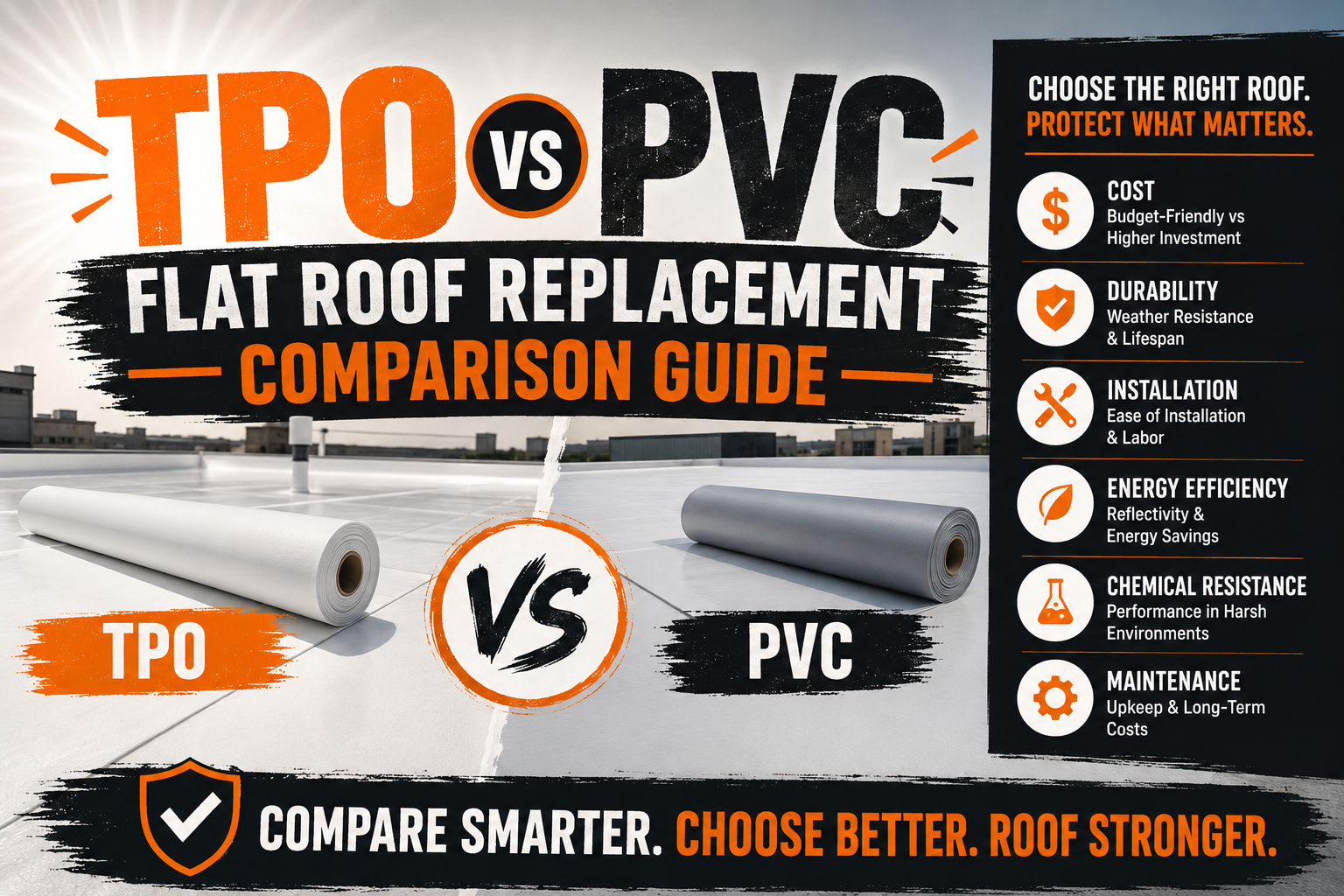
TPO vs PVC Flat Roof Replacement Comparison Guide
Introduction
Selecting the right roofing material is one of the most important decisions property owners make during a flat roof replacement project. A new roof represents a significant investment, and the material chosen will influence durability, maintenance requirements, energy efficiency, weather protection, and long term operating costs. Among the many flat roofing options available today, TPO and PVC consistently rank among the most popular choices for both commercial and residential buildings.
Although these two roofing systems share several similarities, they are designed with different materials and offer unique advantages depending on the property’s needs. Both use single ply membranes that provide dependable waterproof protection, but differences in flexibility, chemical resistance, seam construction, installation methods, and overall performance make each system better suited to certain environments.
Many property owners assume that choosing between TPO and PVC simply comes down to price. While cost is certainly an important consideration, it should never be the only factor influencing the final decision. Climate conditions, building use, rooftop equipment, maintenance expectations, and long term ownership plans all contribute to determining which roofing system delivers the greatest value over its lifespan.
Understanding the strengths and limitations of both materials helps owners make confident decisions before beginning a replacement project. Rather than focusing only on initial installation costs, evaluating durability, energy savings, maintenance requirements, and expected service life provides a much clearer picture of the true investment involved.
This guide compares TPO and PVC flat roofing systems in detail, explaining how each material performs under different conditions and helping property owners understand which option may be the better choice for their specific building.
Understanding TPO and PVC Flat Roofing Systems
TPO and PVC are both single ply roofing membranes designed for flat and low slope roofs. Instead of relying on multiple waterproofing layers, these systems use a single durable membrane that serves as the primary barrier against moisture. Their lightweight construction, reliable performance, and relatively straightforward installation have made them widely used throughout the commercial roofing industry.
Thermoplastic Polyolefin, commonly referred to as TPO, is manufactured from a blend of polypropylene and ethylene propylene rubber. The combination creates a roofing membrane that offers flexibility, resistance to ultraviolet radiation, and strong reflective properties. TPO has become increasingly popular because it balances performance with affordability while meeting modern energy efficiency requirements.
Polyvinyl Chloride, known simply as PVC roofing, has been used successfully for many decades. It consists of vinyl compounds combined with plasticizers and reinforcing materials that create a flexible yet highly durable roofing membrane. PVC is particularly valued for its exceptional resistance to chemicals, grease, oils, and industrial pollutants, making it a preferred choice for many commercial facilities.
Both roofing systems are manufactured in large rolls that minimize the number of seams across the roof surface. Since seams represent potential entry points for water, reducing their number generally improves waterproof reliability. Modern installation techniques further strengthen these seams through heat welding, creating continuous waterproof connections between membrane sections.
Although both systems appear similar from a distance, their material composition results in noticeable differences in performance under certain conditions. These differences become especially important when replacing an existing roof because the building’s intended use often determines which roofing material provides the greatest long term benefit.
Understanding how each system is manufactured and how it functions provides the foundation for comparing their performance in greater detail throughout the remainder of this guide.
Why Property Owners Compare TPO and PVC for Roof Replacement
Roof replacement is often planned decades apart, meaning the decision made today may influence building performance for many years. Because TPO and PVC represent two of the most advanced flat roofing materials available, they are frequently compared during the planning stage of replacement projects.
One reason for the comparison is that both systems provide reliable waterproof protection while supporting modern building efficiency goals. Their reflective surfaces can reduce heat absorption, helping lower indoor temperatures during warm weather and decreasing the workload placed on air conditioning systems. Property owners seeking long term energy savings naturally consider both options before making a final decision.
Durability also encourages comparison. A roof replacement should provide dependable performance through changing weather conditions, seasonal temperature fluctuations, and years of environmental exposure. Since both TPO and PVC have strong reputations for longevity, understanding how they perform under different circumstances helps determine which material better matches the property’s needs.
Maintenance expectations vary as well. Some owners prioritize roofing systems requiring minimal routine maintenance, while others focus more heavily on resistance to chemicals, rooftop traffic, or industrial pollutants. Comparing these characteristics allows decision makers to evaluate more than just installation expenses.
Commercial property owners often have additional considerations beyond weather protection. Restaurants, manufacturing facilities, warehouses, hospitals, and office buildings each expose roofing systems to different environmental conditions. Rooftop exhaust systems, grease emissions, chemical exposure, and heavy equipment all influence the choice between TPO and PVC.
Budget planning is another important factor. Although initial installation costs differ, long term ownership expenses may vary even more. Maintenance requirements, repair frequency, expected lifespan, and energy efficiency all contribute to the total cost of owning a roofing system throughout its service life.
Comparing TPO and PVC before replacement allows owners to balance immediate project costs with future performance, ensuring the selected roofing system aligns with both operational needs and financial objectives.
Key Similarities Between TPO and PVC Roofing
Before examining their differences, it is helpful to understand the many characteristics TPO and PVC roofing systems share. Both materials were developed to provide dependable waterproof protection while overcoming many limitations associated with older flat roofing technologies.
One of their most important similarities is their single ply construction. Instead of relying on multiple waterproof layers, each system uses one durable membrane designed to resist moisture penetration. This simplifies installation while reducing overall roof weight compared to some traditional roofing assemblies.
Both materials also feature heat welded seams. During installation, roofing professionals use specialized equipment to fuse overlapping membrane sections together. Properly welded seams create strong waterproof connections that often become one of the most durable parts of the roofing system.
Reflective performance is another shared advantage. Most TPO and PVC membranes are manufactured in light colors that reflect a significant portion of solar radiation. By reducing heat absorption, these roofs contribute to improved indoor comfort and lower cooling demands during hot weather.
Flexibility also benefits both systems. Building structures naturally expand and contract as temperatures change throughout the year. Both TPO and PVC membranes accommodate this movement without the brittleness commonly associated with some older roofing materials.
In addition, both roofing systems support modern insulation products and drainage designs. During replacement projects, contractors can combine these membranes with upgraded insulation to improve energy efficiency while maintaining reliable waterproof protection.
The following features are common to both roofing systems.
- Single ply membrane construction.
- Heat welded waterproof seams.
- High resistance to ultraviolet exposure.
- Reflective surfaces that improve energy efficiency.
- Compatibility with modern insulation systems.
- Suitable for commercial and residential flat roofs.
These shared characteristics explain why both TPO and PVC remain leading choices for flat roof replacement projects around the world. The differences become more noticeable when evaluating specific performance categories.
Material Composition and Manufacturing Differences
Although TPO and PVC may appear similar after installation, their internal composition differs considerably. These material differences influence flexibility, durability, chemical resistance, aging characteristics, and long term maintenance requirements.
TPO membranes are manufactured using a blend of polypropylene and ethylene propylene rubber. This combination creates a lightweight roofing material that offers good flexibility while maintaining resistance to weathering and ultraviolet radiation. Reinforcing scrims embedded within the membrane improve tear resistance and dimensional stability during installation.
PVC membranes use a different manufacturing process based primarily on polyvinyl chloride combined with plasticizers, stabilizers, reinforcing fabrics, and performance additives. These ingredients produce a membrane with exceptional chemical resistance while maintaining flexibility across a wide range of temperatures.
Manufacturing methods also influence how the materials age over time. TPO formulations have evolved significantly as manufacturers continue improving weather resistance and long term performance. Modern TPO products generally outperform many earlier generations because of ongoing refinements in material technology.
PVC has a longer history within the commercial roofing industry, giving manufacturers decades of experience refining formulations and installation techniques. This extensive development has contributed to PVC’s reputation for dependable long term performance in demanding commercial environments.
The reinforcement used inside each membrane also contributes to overall strength. Reinforced membranes resist tearing, punctures, and dimensional changes more effectively than non reinforced products. Although reinforcement methods vary among manufacturers, both roofing systems rely on advanced engineering to improve structural stability.
Understanding these manufacturing differences helps explain why each material performs differently under certain environmental conditions. Material composition influences everything from flexibility during cold weather to resistance against rooftop contaminants and long term aging.
Durability and Overall Performance
Durability is often one of the first factors property owners evaluate when replacing a flat roof. Since roofing systems remain exposed to weather every day, long term resistance to physical damage, environmental aging, and normal building movement directly affects the value of the investment.
Both TPO and PVC offer excellent durability when installed correctly by qualified roofing professionals. Their reinforced membranes resist punctures, tearing, and weather related deterioration much better than many older roofing materials. However, performance differences become more noticeable under specific operating conditions.
TPO performs particularly well against ultraviolet exposure and normal weathering. Its reflective surface helps reduce heat absorption while maintaining flexibility under changing temperatures. Modern manufacturing improvements have strengthened the material’s resistance to cracking and surface degradation compared to earlier TPO products.
PVC is widely recognized for maintaining consistent performance under demanding commercial conditions. Its chemical composition provides exceptional resistance to grease, oils, industrial pollutants, and various chemical contaminants that may damage other roofing materials. Buildings exposed to these substances often benefit from PVC’s enhanced durability.
Roof traffic also influences long term performance. Buildings requiring frequent maintenance of heating, ventilation, communication equipment, or solar systems experience greater membrane wear than roofs with limited access. Protective walkway pads improve durability regardless of which roofing system is selected.
Proper installation remains equally important for both materials. Even the highest quality membrane cannot perform as intended if seams are welded incorrectly, flashing is installed poorly, or drainage problems remain unresolved. Workmanship often influences roof lifespan just as much as the membrane itself.
Routine maintenance further extends durability by allowing small defects to be repaired before they expand into more significant problems. Regular inspections help preserve waterproof integrity while reducing unexpected repair costs throughout the roof’s service life.
Weather Resistance and Climate Suitability
Weather conditions play a major role in determining how well a roofing system performs over time. Although both TPO and PVC are designed to withstand challenging environments, certain climates may favor one material over the other depending on the building’s specific conditions.
TPO performs well in regions experiencing high levels of sunlight because its reflective surface reduces solar heat absorption. Lower roof temperatures decrease thermal stress while improving energy efficiency during hot weather. This characteristic has made TPO especially popular in warm climates where cooling costs represent a significant operating expense.
PVC also reflects sunlight effectively while offering excellent resistance to prolonged weather exposure. In addition to ultraviolet protection, PVC maintains dependable performance under heavy rainfall, snow, and changing seasonal temperatures. Its flexibility allows the membrane to accommodate building movement without sacrificing waterproof integrity.
Wind resistance depends largely on installation quality rather than membrane composition alone. Proper attachment methods, seam construction, edge detailing, and flashing installation all contribute to overall wind performance. When installed according to manufacturer specifications, both systems provide reliable resistance during severe weather events.
Cold weather flexibility also deserves consideration. Roofing materials repeatedly expand and contract as temperatures fluctuate throughout the year. Both TPO and PVC are engineered to tolerate these movements, although their exact performance characteristics vary slightly according to manufacturer formulations.
Property owners should evaluate several environmental factors before selecting a roofing system.
- Average annual temperatures.
- Amount of direct sunlight throughout the year.
- Rainfall and snowfall patterns.
- Frequency of severe storms or high winds.
- Nearby industrial or coastal environmental conditions.
- Building usage and rooftop equipment.
Matching the roofing material to local climate conditions helps maximize long term performance while reducing maintenance requirements. In the next part, we will compare TPO and PVC in greater detail by examining energy efficiency, chemical resistance, installation methods, maintenance requirements, lifespan expectations, and overall cost to help determine which roofing system delivers the best value for different types of properties.
Energy Efficiency and Reflective Performance
Energy efficiency has become one of the primary reasons property owners choose modern single ply roofing systems during a flat roof replacement. Reducing heat transfer through the roof can lower cooling costs, improve indoor comfort, and contribute to better overall building performance. Both TPO and PVC perform well in this area, but there are important differences worth understanding.
TPO roofing is widely recognized for its highly reflective surface. Most TPO membranes are manufactured in white or other light colors that reflect a significant amount of sunlight instead of absorbing it. By reducing roof surface temperatures, the building requires less energy to maintain comfortable indoor conditions during hot weather.
Lower roof temperatures also reduce thermal stress on the roofing membrane itself. Excessive heat causes roofing materials to expand repeatedly, and reducing that heat can contribute to improved long term durability. This makes TPO an attractive option for buildings located in regions with long, hot summers.
PVC roofing also offers excellent solar reflectivity. Like TPO, it is commonly available in light colored finishes that help reduce heat absorption. Many modern PVC membranes maintain their reflective properties for many years with proper cleaning and maintenance, allowing buildings to continue benefiting from improved energy efficiency over time.
Another advantage shared by both systems is compatibility with modern insulation products. During roof replacement, insulation upgrades can be installed beneath either membrane to improve thermal performance even further. The combination of reflective roofing and improved insulation often produces noticeable reductions in heating and cooling expenses.
Actual energy savings depend on more than membrane selection alone. Roof insulation, building design, local climate, ventilation, and HVAC system efficiency all influence the final results. Property owners should evaluate the complete roofing assembly rather than focusing only on the membrane itself.
For many buildings, both TPO and PVC provide substantial improvements compared to older roofing systems. The final decision often depends on other performance factors beyond energy efficiency because both materials perform well in reducing solar heat gain.
Chemical Resistance and Environmental Exposure
While all roofing systems must withstand normal weather conditions, some buildings expose their roofs to much harsher environments. Restaurants, manufacturing plants, food processing facilities, laboratories, and industrial buildings often release grease, oils, chemicals, or exhaust that gradually affect roofing materials. In these situations, chemical resistance becomes an important consideration.
PVC roofing has earned an excellent reputation for resisting a wide variety of chemical contaminants. Its material composition allows it to withstand exposure to animal fats, cooking oils, industrial pollutants, and many chemicals that may damage other roofing systems. This makes PVC a preferred choice for restaurants and facilities with rooftop exhaust systems.
Commercial kitchens are one of the most common examples. Grease exhausted through ventilation systems can settle onto the roof surface over time. Certain roofing materials may soften or deteriorate when exposed to these substances for extended periods, but PVC generally performs exceptionally well under these conditions.
TPO also offers good resistance to many environmental factors, including ultraviolet radiation, moisture, and general weather exposure. However, under continuous exposure to certain oils, grease, and industrial chemicals, PVC typically provides superior long term performance. This difference becomes especially important for buildings operating in demanding industrial environments.
Coastal environments create additional challenges because roofing materials remain exposed to salt laden air, moisture, and strong winds. Both TPO and PVC perform well when installed correctly, although maintenance inspections become particularly important in these regions to monitor flashing, fasteners, and roof edges.
Environmental pollution should also be considered. Buildings located near factories, airports, or industrial facilities may experience increased exposure to airborne contaminants. Selecting a roofing material capable of resisting these conditions helps maximize service life while reducing maintenance requirements.
Property owners should evaluate not only today’s building use but also possible future changes. A roofing system installed today may remain in service for decades, making it worthwhile to consider how future building operations could affect roofing performance.
Installation Methods and Seam Strength
Installation quality is one of the most important factors influencing the long term success of any flat roof replacement. Even the highest quality roofing membrane cannot deliver reliable performance if it is installed incorrectly. Understanding how TPO and PVC are installed helps explain why workmanship plays such a critical role in roof longevity.
Both TPO and PVC roofing systems commonly use heat welded seams. During installation, specialized welding equipment heats overlapping membrane edges until they fuse together. Once cooled, the welded seam forms a continuous waterproof connection that is often stronger than the membrane itself.
Heat welding offers several advantages over traditional adhesive based seam construction. Properly welded seams resist moisture infiltration, accommodate normal building movement, and maintain strength under changing weather conditions. Since seams are among the most vulnerable parts of any roofing system, this technology contributes significantly to long term reliability.
The membranes themselves may be installed using different attachment methods depending on the building design. Fully adhered systems bond the membrane directly to the substrate using approved adhesives. Mechanically attached systems use engineered fasteners and plates, while some specialized projects may incorporate additional attachment methods according to manufacturer recommendations.
Experienced roofing professionals carefully control welding temperature, speed, and pressure throughout installation. Excessive heat can damage the membrane, while insufficient heat may create weak seams that fail prematurely. Skilled workmanship ensures consistent seam quality across the entire roof.
Flashing installation receives equal attention because roof penetrations, parapet walls, skylights, drains, and equipment supports require carefully constructed waterproof details. These transition areas experience greater movement than open roof sections and therefore demand precise installation techniques.
Proper installation extends beyond the membrane itself. Drainage design, insulation placement, fastener spacing, edge detailing, and substrate preparation all influence overall roof performance. Selecting qualified contractors with manufacturer training often contributes more to long term success than choosing one premium roofing material over another.
Maintenance Requirements and Repair Considerations
Although both TPO and PVC require relatively little maintenance compared to many older roofing systems, routine inspections remain essential for protecting the roofing investment. Preventive maintenance allows small issues to be corrected before they develop into expensive repairs or widespread water damage.
Regular roof inspections typically focus on seams, flashing, drainage components, rooftop equipment, and areas experiencing frequent foot traffic. Detecting loose flashing, punctures, debris accumulation, or minor membrane damage early helps preserve waterproof performance throughout the roof’s lifespan.
Cleaning also forms an important part of maintenance. Dirt, leaves, branches, and other debris should be removed regularly to prevent drainage problems. Standing water caused by blocked drains places unnecessary stress on the roofing system regardless of whether the membrane is TPO or PVC.
Repair procedures for both materials generally involve replacing damaged membrane sections or installing compatible repair patches using manufacturer approved techniques. Because both systems utilize heat welded seams, properly completed repairs often restore dependable waterproof protection without replacing large roof sections.
One advantage of routine maintenance is that it provides opportunities to inspect rooftop equipment. Heating and cooling systems, communication equipment, solar panels, and ventilation units often require service personnel to access the roof. Identifying accidental damage during these visits allows prompt repairs before moisture infiltration occurs.
Property owners should also maintain detailed maintenance records. Inspection reports, repair history, warranty documentation, and photographs provide valuable information when evaluating roof performance over time. These records also help roofing contractors diagnose recurring issues more efficiently if repairs become necessary.
Regardless of the membrane selected, consistent maintenance generally produces greater long term benefits than waiting until obvious leaks appear. Preventive care extends roof lifespan while reducing emergency repair costs and minimizing disruption to building operations.
Lifespan Expectations for TPO and PVC Roofs
One of the most common questions asked during a roof replacement project concerns expected lifespan. Property owners naturally want to understand how long their investment is likely to perform before another replacement becomes necessary. While both TPO and PVC offer excellent durability, actual service life depends on several important factors.
Installation quality remains the single most influential factor affecting longevity. Proper seam welding, accurate flashing installation, correct drainage design, and appropriate attachment methods all contribute directly to roof performance. A well installed roofing system generally outperforms a poorly installed premium membrane.
Routine maintenance also influences service life significantly. Roofs receiving regular inspections, prompt repairs, and proper cleaning often remain in excellent condition much longer than neglected systems. Preventive maintenance reduces the likelihood of moisture intrusion while preserving waterproof integrity.
Environmental exposure varies greatly between buildings. Roofs located in regions with intense sunlight, heavy snowfall, severe storms, or industrial pollution experience different aging conditions than buildings situated in moderate climates. Local weather should therefore be considered when estimating long term performance.
Building usage also affects longevity. Roofs supporting frequent maintenance activities, heavy rooftop equipment, or constant foot traffic generally experience greater wear than buildings with limited rooftop access. Protective walkway systems help reduce localized membrane damage in these situations.
Both TPO and PVC have demonstrated the ability to provide many years of dependable service when installed correctly and maintained properly. Rather than focusing exclusively on projected lifespan, property owners should evaluate the complete value offered throughout the roof’s operational life, including maintenance expenses, energy savings, and repair requirements.
Long term performance is ultimately the result of quality materials, skilled workmanship, effective maintenance, and appropriate building design working together as one complete roofing system.
Cost Comparison Between TPO and PVC Roofing
Cost is often one of the final factors considered after evaluating performance, durability, maintenance, and expected lifespan. While budget plays an important role in every roof replacement project, focusing only on initial installation expenses may overlook significant long term financial considerations.
TPO is generally considered one of the more affordable premium single ply roofing systems. Its competitive material pricing, efficient installation methods, and strong energy performance have made it a popular choice for property owners seeking an effective balance between cost and quality.
PVC roofing usually involves a higher initial investment because of its manufacturing process and enhanced resistance to chemicals, grease, and industrial contaminants. Although installation costs may exceed those of TPO, many commercial property owners view the additional expense as worthwhile in demanding operating environments.
Long term ownership costs extend beyond installation. Maintenance requirements, repair frequency, energy efficiency, expected lifespan, and resistance to environmental exposure all influence the total cost of ownership throughout the roof’s service life. In some situations, a higher initial investment may result in lower long term expenses.
The following comparison summarizes many of the key differences between the two roofing systems.
| Performance Factor | TPO Roofing | PVC Roofing |
|---|---|---|
| Initial Cost | Generally lower | Generally higher |
| Energy Efficiency | Excellent reflective performance | Excellent reflective performance |
| Chemical Resistance | Good | Excellent |
| Grease Resistance | Moderate | Outstanding |
| Heat Welded Seams | Yes | Yes |
| Commercial Applications | Very common | Very common |
| Industrial Environments | Suitable | Often preferred |
| Long Term Value | Strong balance of cost and performance | Excellent for demanding environments |
Property owners should avoid making decisions based solely on material price. A roofing system should be evaluated according to the building’s intended use, expected maintenance requirements, environmental exposure, and long term ownership goals. The most affordable option initially is not always the least expensive over the full lifespan of the roof.
In the final part of this guide, we will explore which roofing system is best suited for different property types, discuss the most important factors to consider before making a final decision, highlight common mistakes to avoid during material selection, answer frequently asked questions, and conclude with practical guidance for choosing between TPO and PVC flat roof replacement systems.
Choosing the Right Roofing System for Different Property Types
Choosing between TPO and PVC roofing becomes much easier when the building’s purpose is considered alongside the material’s performance characteristics. Although both systems provide reliable waterproof protection, certain environments benefit more from one material than the other. Matching the roofing system to the property’s operational needs helps maximize long term value.
Office buildings are among the most common applications for both TPO and PVC roofing. These buildings typically experience moderate rooftop traffic and relatively low chemical exposure. TPO is often selected because it combines strong weather resistance, excellent energy efficiency, and competitive installation costs, making it an attractive solution for many commercial office properties.
Retail buildings and shopping centers also benefit from either roofing system depending on their operations. General retail stores with standard rooftop equipment frequently perform well with TPO roofing. However, shopping centers containing multiple restaurants may benefit from PVC because of its superior resistance to grease and cooking related exhaust.
Restaurants place unique demands on roofing materials. Exhaust systems release grease and oils that settle onto the roof over time, creating conditions that may gradually affect some membranes. PVC roofing has consistently demonstrated excellent resistance to these contaminants, making it a preferred option for restaurants, food processing facilities, and commercial kitchens.
Industrial buildings often expose roofs to chemicals, manufacturing emissions, and specialized equipment. In these demanding environments, PVC is frequently selected because it maintains excellent performance when exposed to many industrial substances. Facilities with chemical processing operations or manufacturing equipment often consider this added protection a worthwhile investment.
Warehouses and distribution centers usually prioritize durability, energy efficiency, and overall operating costs. Since these buildings generally have limited chemical exposure, TPO often provides an effective balance between performance and affordability. Its reflective surface also helps improve energy efficiency across large roof areas.
Residential flat roofs have become increasingly popular in modern architecture. Homeowners often compare TPO and PVC based on budget, expected lifespan, appearance, and maintenance requirements. Either system can perform successfully when installed correctly, allowing homeowners to choose the option that best matches their priorities.
Ultimately, the best roofing material depends on how the building is used every day. Evaluating current operations as well as potential future changes helps ensure the selected roofing system continues meeting the property’s needs for many years.
Factors to Consider Before Making Your Final Decision
Selecting the right flat roofing system involves evaluating several factors rather than relying on a single feature or price alone. A careful assessment helps property owners choose a roofing solution that aligns with their building requirements, financial goals, and long term maintenance expectations.
The local climate should always be considered first. Buildings located in regions with intense sunlight, frequent storms, heavy snowfall, or large seasonal temperature changes may benefit differently from the characteristics offered by TPO and PVC. Understanding how each material performs under local weather conditions supports a more informed decision.
Building use is equally important. A warehouse storing packaged goods has very different roofing requirements than a restaurant, manufacturing facility, or laboratory. Selecting a membrane designed to withstand the property’s specific operating environment often improves long term performance while reducing maintenance needs.
Energy efficiency goals may also influence material selection. Property owners seeking lower cooling costs frequently compare the reflective properties of both roofing systems. Since both TPO and PVC offer excellent solar reflectivity, insulation quality and overall roof design should also be included in the evaluation.
Maintenance planning deserves careful attention as well. Some owners have dedicated facility maintenance teams capable of performing routine roof inspections, while others rely entirely on outside contractors. Understanding future maintenance expectations helps determine which roofing system best fits the property’s management strategy.
Budget should always be viewed from a long term perspective rather than focusing exclusively on installation expenses. Material cost, maintenance, repairs, expected lifespan, and operational savings all contribute to the true value of the investment throughout the roof’s service life.
Before making a final decision, property owners should evaluate several key considerations.
- Local climate and weather patterns.
- Building type and daily operations.
- Chemical or grease exposure.
- Energy efficiency objectives.
- Maintenance expectations.
- Long term ownership plans.
- Overall project budget.
- Contractor experience with the selected roofing system.
Considering these factors together allows owners to select the roofing system that offers the greatest overall value rather than simply choosing the least expensive option available.
Common Mistakes to Avoid When Selecting a Flat Roof
Roof replacement is a major investment, and avoiding common decision making mistakes can significantly improve long term satisfaction. Many roofing problems originate not from the materials themselves but from decisions made during planning, contractor selection, or project evaluation.
One of the most common mistakes is choosing a roofing system based only on initial cost. While controlling expenses is understandable, the least expensive option may not provide the best value over several decades of service. Maintenance costs, energy efficiency, durability, and repair requirements should all be considered alongside installation pricing.
Another mistake is overlooking the building’s specific operating environment. A roofing material that performs exceptionally well on one property may not be the ideal choice for another. Restaurants, factories, healthcare facilities, warehouses, and office buildings all place different demands on roofing systems.
Some property owners also underestimate the importance of installation quality. Even premium roofing materials cannot compensate for poorly welded seams, improper flashing, inadequate drainage, or incorrect attachment methods. Hiring experienced contractors with manufacturer training greatly increases the likelihood of long term roofing success.
Ignoring insulation upgrades during replacement is another missed opportunity. Installing a new membrane over outdated insulation may limit potential energy savings and reduce overall building efficiency. Many replacement projects provide an ideal opportunity to improve thermal performance while the roof is already being replaced.
Maintenance planning is sometimes overlooked as well. Every roofing system benefits from routine inspections, prompt repairs, and regular cleaning. Assuming a new roof requires no future maintenance often leads to preventable deterioration later in its lifespan.
Finally, some owners postpone replacement for too long after significant deterioration has already developed. Continuing to repair an aging roof beyond its practical service life often increases overall costs because moisture damage continues spreading beneath the membrane. Planning replacement before severe structural damage occurs generally provides better financial and operational outcomes.
Avoiding these common mistakes helps ensure that the selected roofing system delivers dependable performance, lower long term costs, and greater overall value throughout its service life.
Frequently Asked Questions
Which roofing system lasts longer, TPO or PVC?
Both roofing systems can provide decades of reliable service when installed correctly and maintained properly. Actual lifespan depends more on installation quality, maintenance, climate conditions, and building use than on the membrane alone.
Is PVC always better than TPO?
No. PVC performs exceptionally well in environments exposed to grease, oils, and industrial chemicals, but TPO often provides excellent value for many commercial and residential buildings where these conditions are not present.
Which roof is more energy efficient?
Both TPO and PVC offer highly reflective surfaces that reduce solar heat absorption and improve cooling efficiency. Overall energy performance also depends on insulation quality, roof design, and local climate.
Can both roofing systems be repaired if damaged?
Yes. Both TPO and PVC membranes can usually be repaired using manufacturer approved materials and installation methods. Prompt repairs help maintain waterproof performance and prevent damage from spreading.
Does the roofing contractor matter as much as the roofing material?
Absolutely. Proper installation has a major influence on roof performance. High quality materials installed incorrectly are far more likely to develop problems than properly installed systems using the same products.
Conclusion
TPO and PVC roofing systems have both earned strong reputations as dependable solutions for flat roof replacement projects. Their single ply construction, heat welded seams, reflective surfaces, and long term weather resistance make them excellent choices for a wide variety of commercial and residential buildings. While they share many important characteristics, their differences become more significant when evaluated in relation to specific building environments and operational requirements.
TPO stands out for its balance of affordability, energy efficiency, and overall performance. It offers reliable weather protection, excellent solar reflectivity, and competitive installation costs, making it a practical choice for offices, warehouses, retail buildings, educational facilities, and many residential properties. For owners seeking strong value without sacrificing quality, TPO often provides an outstanding combination of performance and cost effectiveness.
PVC distinguishes itself through exceptional resistance to chemicals, grease, oils, and industrial contaminants. These qualities make it especially well suited for restaurants, food processing facilities, manufacturing plants, laboratories, and buildings where rooftop exposure extends beyond normal weather conditions. Although its initial cost is generally higher, the additional durability in demanding environments often justifies the investment.
The final decision should never be based solely on material price or marketing claims. Climate, building function, maintenance expectations, energy efficiency goals, contractor experience, and long term ownership plans all contribute to selecting the most appropriate roofing system. Evaluating these factors together provides a clearer understanding of which option will deliver the greatest overall value throughout the roof’s lifespan.
Regardless of whether TPO or PVC is selected, the success of any flat roof replacement depends on quality materials, professional installation, routine inspections, and consistent maintenance. When these elements work together, either roofing system can provide decades of dependable weather protection, improved building efficiency, and long term peace of mind for property owners.