

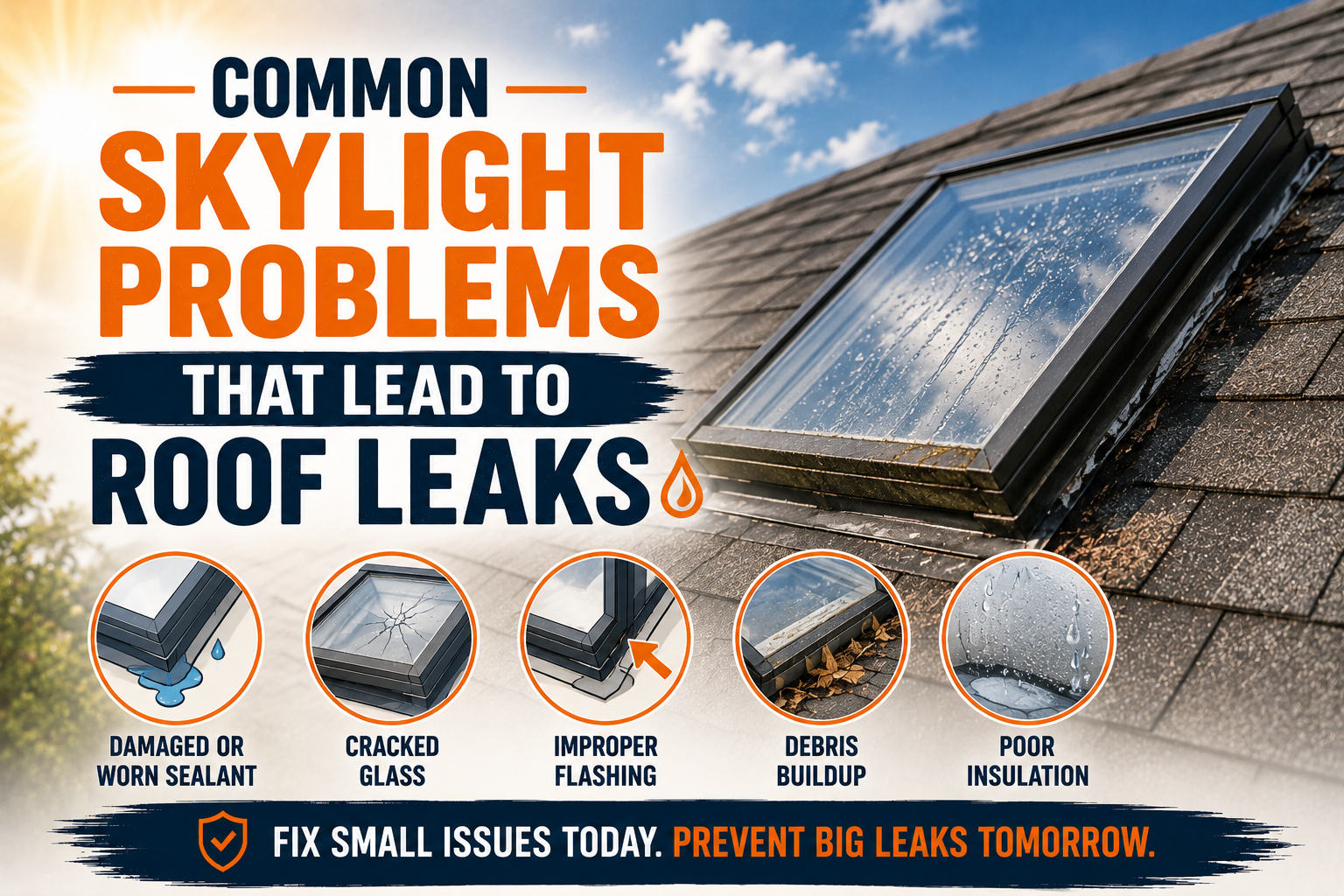
Common Skylight Problems That Lead to Roof Leaks
Introduction
Skylights are a popular architectural feature because they bring natural light into homes and improve ventilation in enclosed spaces. They create a brighter indoor environment and reduce the need for artificial lighting during the day, which makes them both aesthetic and energy efficient. However, despite their benefits, skylights are also one of the most common weak points in a roofing system when not installed or maintained properly.
Roof leaks associated with skylights are often not immediately obvious because water can travel through hidden paths before showing visible signs inside the home. A small gap, deteriorated seal, or faulty installation detail can slowly allow moisture to enter the roof structure. Over time, this moisture spreads and causes damage to insulation, ceiling materials, and even structural components if ignored.
Understanding how skylights interact with the roof system is essential for identifying early warning signs and preventing long term damage. This article explains the most common skylight problems that lead to roof leaks and how these issues develop over time.
Why Skylights Are a Common Source of Roof Leaks
Skylights interrupt the natural continuity of a roof surface, which makes them more vulnerable to water penetration compared to solid roofing sections. Every skylight requires an opening in the roof, and this opening must be carefully sealed and integrated into the surrounding materials. If even one part of this integration fails, water can find a path inside.
Another reason skylights are prone to leaks is constant exposure to weather changes. They are directly exposed to sunlight, rain, wind, and sometimes even hail, which puts continuous stress on seals and flashing materials. Unlike standard roof sections that rely on overlapping materials, skylights depend heavily on precise installation and sealing techniques.
Even minor installation errors or material aging can create small gaps that allow water infiltration. These issues often worsen over time, especially in regions with heavy rainfall or temperature fluctuations.
How Skylight and Roof Integration Actually Works
A skylight is not just a window placed on a roof, it is a carefully integrated system that must work with multiple roofing layers. The main components include the skylight frame, flashing system, underlayment, and surrounding roofing materials. Each of these components plays a role in preventing water entry.
Flashing is one of the most important parts of this system because it directs water away from the skylight opening and back onto the roof surface. When installed correctly, flashing creates a waterproof barrier that protects vulnerable edges. The surrounding shingles or tiles also help guide water flow away from the skylight structure.
The success of this system depends on precise alignment and proper sealing at every junction point. If any layer is incorrectly installed or damaged over time, the entire waterproofing system can be compromised.
Main Causes of Skylight Related Roof Leaks
Skylight leaks usually do not happen due to a single issue, but rather a combination of factors that weaken the waterproofing system over time. One of the most common causes is improper installation, where flashing or sealing is not done correctly during construction. Even a small mistake during installation can lead to long term leakage problems.
Another major cause is material aging. Sealants and rubber gaskets naturally degrade due to exposure to sunlight and weather conditions. As these materials lose flexibility, small cracks begin to form, allowing water to seep through.
Structural movement of the building can also contribute to leaks. Roofs naturally expand and contract with temperature changes, and this movement can gradually loosen skylight components if they are not properly secured.
Poor Skylight Installation and Its Long Term Impact
Improper installation is one of the leading reasons skylights develop leaks within a few years of being installed. If flashing is not layered correctly or if the skylight is not properly aligned with the roof slope, water can easily collect in weak areas. This creates pressure points where leakage becomes more likely over time.
In some cases, installers may use insufficient sealing material or fail to properly secure edges around the skylight frame. These shortcuts might not show immediate problems, but they often result in slow water infiltration that damages roofing layers from beneath.
The long term impact of poor installation is not limited to leaks alone. It can also lead to insulation damage, mold growth, and structural weakening in surrounding roof areas.
Flashing Failures Around Skylights Explained
Flashing is designed to act as a protective barrier that redirects water away from the skylight opening. When flashing fails, it becomes one of the most direct pathways for water entry into the roof system. Failure can occur due to improper installation, corrosion, or physical damage over time.
One common issue is separation between flashing layers and roofing materials. When this happens, water can slip underneath the flashing and enter the roof structure. Another issue is improper overlap, where flashing pieces are not layered correctly, leaving gaps that collect water.
Weather exposure also plays a role in flashing deterioration. Continuous exposure to rain and sunlight weakens materials, especially if low quality metals or sealants were used during installation.
Sealant Deterioration Over Time and Weather Exposure
Sealants are used around skylight edges to provide an additional waterproof layer, but they are not permanent. Over time, exposure to ultraviolet rays, rain, and temperature changes causes sealants to dry out and lose elasticity. Once this happens, small cracks begin to form.
These cracks may initially be too small to notice, but they allow water to slowly seep into the roof structure during rainfall. In colder climates, trapped moisture can expand when it freezes, further widening these gaps and increasing leakage risk.
Regular inspection of sealant condition is important because early replacement can prevent more serious damage. Once sealant failure progresses too far, water may begin affecting internal roof layers and insulation.
Condensation Problems That Are Often Mistaken for Leaks
Not all moisture around skylights comes from external leaks, and condensation is often misidentified as a roof failure. Condensation occurs when warm indoor air meets the cold surface of the skylight glass, causing moisture to form on the inside surface.
This moisture can drip down and appear similar to a roof leak, especially during colder months. Homeowners often assume the roof is leaking when the actual issue is poor ventilation or high indoor humidity levels.
Improving airflow in the room and controlling humidity can significantly reduce condensation issues. Understanding the difference between condensation and actual leaks is important to avoid unnecessary roof repairs.
Skylight Frame Damage and Structural Weak Points
The skylight frame is responsible for holding the glass or acrylic panel in place while maintaining a sealed connection with the roof. Over time, this frame can develop cracks, warping, or loosening due to weather exposure and structural movement.
When the frame becomes compromised, it creates uneven pressure points that weaken seals and flashing connections. Even small shifts in alignment can create gaps where water begins to enter.
Older skylights are particularly vulnerable because materials degrade naturally over time. In such cases, even proper sealing may not be enough to prevent leakage if the frame itself is no longer structurally sound.
Early Warning Signs of Skylight Leaks Homeowners Miss
Skylight leaks rarely start as major visible problems, and early signs are often subtle. One of the first indicators is discoloration or staining around the skylight edges on the interior ceiling. This usually suggests slow moisture penetration over time.
Another early sign is peeling paint or bubbling drywall near the skylight area. These symptoms indicate that moisture has already begun affecting interior materials. In some cases, a musty smell may also develop due to hidden moisture buildup.
Ignoring these early signs can lead to more serious structural damage, making early detection extremely important for preventing costly repairs.
How Small Skylight Issues Slowly Turn Into Major Roof Damage
Small skylight issues often start with minor seal failures or tiny flashing gaps, but they can escalate quickly if not addressed. Once water enters the roof system, it begins to spread across insulation layers and wooden structures. This hidden movement of moisture makes it difficult to detect the full extent of the damage early on.
Over time, repeated exposure to moisture weakens surrounding roofing materials and can lead to mold growth and structural decay. What begins as a small leak around the skylight can eventually affect larger sections of the roof if left untreated.
This gradual progression highlights the importance of regular inspection and timely repair. Addressing small issues early prevents them from developing into widespread roof damage that is far more expensive to fix.
Water Pooling and Drainage Issues Around Skylights
Water pooling around skylights is one of the most overlooked causes of long term roof leakage problems. Skylights are designed to shed water efficiently, but when surrounding roof slopes or drainage channels are not properly aligned, water can collect near the frame instead of flowing away. This standing water slowly increases pressure on seals and flashing, making it easier for moisture to find entry points.
Over time, repeated pooling can weaken even properly installed skylights because constant moisture exposure accelerates material breakdown. It also encourages dirt and organic debris to settle in the same area, which further blocks smooth water flow. In heavy rainfall regions, this issue becomes more serious as water volume exceeds the drainage capacity of poorly designed skylight installations.
Regular inspection of water flow paths around skylights is essential to ensure that no stagnation occurs, especially after storms or seasonal changes.
Cracked or Broken Glass and Acrylic Skylight Panels
Skylight panels, whether made of glass or acrylic, are exposed to constant environmental stress that can eventually lead to cracks or fractures. Impact from hail, falling branches, or even thermal stress can create small cracks that gradually expand over time. These cracks may not immediately cause visible leaks but they weaken the overall barrier against water entry.
Acrylic panels are more flexible but tend to scratch and degrade faster under UV exposure, while glass panels are stronger but more prone to sudden breakage under impact. Once the surface integrity is compromised, water can begin seeping through edges or damaged sections. In some cases, even microscopic cracks can allow moisture penetration during heavy rain conditions.
Ignoring damaged skylight panels often leads to more serious structural issues because water entering through cracks spreads into surrounding roof layers and insulation.
Thermal Expansion and Contraction Stress on Skylights
Skylights constantly expand and contract due to temperature changes throughout the day and across seasons. This natural movement may seem minor, but over time it places significant stress on seals, flashing, and frame connections. When materials expand in heat and contract in cold conditions, small gaps can gradually form at connection points.
These repeated cycles weaken adhesive bonds and reduce the effectiveness of waterproofing layers. In regions with extreme temperature variation, this issue becomes more noticeable as skylight components are forced to adjust frequently. Even high quality installations can develop small separation points if not designed to accommodate movement.
Proper installation techniques that allow flexibility are important, but long term maintenance is equally necessary to ensure that thermal stress does not lead to leakage paths.
Roof Shingle and Skylight Interface Problems
The area where roof shingles meet the skylight frame is one of the most critical waterproofing zones in the entire roof system. If shingles are not properly layered or aligned around the skylight, water can slip underneath and bypass the intended drainage path. This often results in hidden leaks that travel beneath the roof surface before becoming visible indoors.
Shingles that lift, curl, or shift over time can also expose gaps around the skylight edges. Wind exposure and aging materials contribute to this movement, gradually weakening the seal between roofing layers and skylight flashing. Even small misalignments in this interface can allow water to enter during heavy rainfall.
Maintaining proper shingle alignment and ensuring tight integration with skylight flashing is essential for preventing long term water intrusion.
Ice, Debris, and Dirt Buildup Around Skylight Edges
Although ice is not a concern in all regions, in colder climates it can significantly increase the risk of skylight leaks. Ice formation around skylight edges can block proper drainage and force melting water to flow in unintended directions. As ice expands, it can also place pressure on seals and flashing materials, creating small fractures.
In warmer climates, debris such as leaves, dust, and bird droppings can create similar problems by blocking water flow channels. When debris accumulates around skylights, it traps moisture and creates a damp environment that accelerates material degradation. Over time, this buildup increases the likelihood of leaks developing along the skylight perimeter.
Routine cleaning of surrounding roof areas helps maintain clear drainage paths and reduces stress on skylight sealing systems.
Improper Roof Slope and Its Effect on Skylight Leakage
Roof slope plays a major role in determining how effectively water moves away from skylight structures. If the roof angle is too flat or incorrectly designed around the skylight, water may slow down and accumulate instead of draining efficiently. This increases the exposure time of seals and flashing to moisture.
Poor slope design can also lead to uneven water distribution, where certain sides of the skylight receive more water pressure than others. Over time, this imbalance weakens specific sections of the waterproofing system and creates leakage points. Even well installed skylights can experience problems if the surrounding roof geometry does not support proper drainage.
Correct slope design and water flow planning are essential during installation, but adjustments and maintenance may also be needed in older roofing systems.
Hidden Leak Paths That Travel Inside Roof Layers
One of the most deceptive aspects of skylight leaks is that water does not always enter directly below the skylight. Instead, it can travel along roof layers, beams, and insulation before appearing as a visible stain inside the home. This makes it difficult to identify the exact source of the leak.
Water can move horizontally within roofing materials, especially when it encounters barriers that redirect its flow. As a result, the actual entry point may be several feet away from where the damage is visible indoors. This hidden movement often leads homeowners to misdiagnose the problem and focus on the wrong area during repairs.
Understanding how water travels through roof systems is important for accurate leak detection and effective repair planning.
Interior Ceiling Stains Caused by Skylight Failures
Interior ceiling stains are one of the most common signs of skylight leakage, but they often appear after significant internal damage has already occurred. These stains typically start as light discoloration and gradually darken as moisture continues to spread through ceiling materials.
In many cases, the stain may not be directly under the skylight because water can travel along internal structures before reaching visible surfaces. This delayed appearance makes it difficult to assess how long the leak has been active. If left untreated, stains can expand and lead to peeling paint, warped drywall, and mold growth.
Addressing the root cause early is important because surface repairs alone will not stop ongoing moisture intrusion.
Diagnosing Whether Leak Comes From Skylight or Roof Itself
Determining whether a leak originates from the skylight or the surrounding roof can be challenging because both systems are closely connected. A skylight leak may actually be caused by damaged shingles, faulty flashing, or nearby roof deterioration rather than the skylight itself.
One method of diagnosis involves observing water patterns during rainfall or controlled water testing. This helps identify whether water enters directly through the skylight or from higher roof sections and flows downward. Careful inspection of flashing joints and roof transitions is also essential in this process.
Accurate diagnosis is critical because treating the wrong area will not resolve the underlying issue and may allow further damage to develop.
Repair Options for Different Types of Skylight Damage
Repair options for skylight leaks depend heavily on the type and severity of the damage. Minor issues such as sealant cracks or small flashing gaps can often be repaired using resealing techniques or localized flashing replacement. These solutions are effective when the skylight structure itself is still in good condition.
More significant damage, such as frame deterioration or repeated leakage, may require partial reconstruction of the skylight sealing system. In such cases, replacing multiple components ensures long term reliability rather than temporary fixes.
For severe cases involving cracked panels or structural failure, full skylight replacement is often the most practical solution to restore proper waterproofing performance.
When Skylight Replacement Becomes Necessary
Skylight replacement becomes necessary when repairs are no longer effective in preventing recurring leaks or when structural integrity is compromised. If multiple components such as flashing, seals, and frames have deteriorated simultaneously, patch repairs will only provide short term relief.
Another clear indicator for replacement is frequent leakage despite repeated maintenance efforts. This usually suggests that the skylight has reached the end of its functional lifespan. Modern skylights also offer improved insulation and sealing technologies, making replacement a more efficient long term solution in many cases.
Choosing replacement over repeated repairs can ultimately reduce long term maintenance costs and significantly improve roof reliability.
Preventing Skylight Roof Leaks With Proper Installation
Preventing skylight leaks begins long before any maintenance or repair work is needed, because installation quality determines how well the system will perform over time. A properly installed skylight integrates seamlessly with the roof structure, ensuring that water is directed away from vulnerable points instead of collecting around the frame.
Correct installation also ensures that flashing layers, underlayment, and roofing materials are aligned in a way that supports natural water flow. When these components are not properly coordinated, even a new skylight can begin leaking within a short period of time. Careful planning during installation reduces the chances of future structural stress and moisture penetration.
In many cases, investing in professional installation from the beginning is far more cost effective than dealing with repeated repairs caused by installation errors.
Best Materials and Flashing Systems for Leak Free Skylights
The choice of materials plays a major role in preventing skylight leaks, especially in areas exposed to heavy rainfall or extreme temperatures. High quality flashing systems made from durable metals such as aluminum or galvanized steel provide stronger protection against water intrusion compared to low grade alternatives.
Modern skylight systems often include multi layered flashing kits that are designed to channel water away in stages rather than relying on a single barrier. This layered approach significantly reduces the risk of leakage even under heavy water flow conditions. Sealants used in these systems should also be flexible and weather resistant to accommodate roof movement over time.
Selecting materials that are specifically designed for skylight applications ensures long term durability and reduces the likelihood of premature failure.
Regular Maintenance Tips to Extend Skylight Lifespan
Regular maintenance is essential for keeping skylights in good condition and preventing small issues from turning into major leaks. One of the simplest but most effective practices is periodic inspection of seals and flashing areas to identify early signs of wear or separation.
Cleaning the skylight surface and surrounding roof area also helps prevent debris buildup that can block drainage paths. When leaves, dust, or dirt accumulate around skylights, they trap moisture and increase the risk of water seepage over time. Keeping these areas clean ensures smooth water flow and reduces stress on sealing components.
It is also important to check for condensation patterns inside the home, as these can indicate ventilation issues that may indirectly affect skylight performance.
Professional Inspection Methods for Skylight Leak Detection
Professional roof inspectors use systematic methods to identify skylight leaks and determine their exact source. These methods often include visual inspection of flashing joints, moisture detection tools, and controlled water testing to replicate rainfall conditions.
Infrared scanning is sometimes used to detect hidden moisture within roof layers, which helps identify leaks that are not visible on the surface. This is especially useful in cases where water has traveled away from the original entry point and caused damage in distant areas.
Professional inspections are valuable because they provide a clear diagnosis, which ensures that repairs are targeted correctly instead of relying on guesswork or surface level fixes.
Cost Considerations for Skylight Repair vs Replacement
Cost is an important factor when deciding between repairing or replacing a skylight, but the decision should not be based on price alone. Minor repairs such as resealing or flashing adjustments are generally more affordable and suitable for early stage issues. These solutions work best when the skylight structure is still in good condition.
However, repeated repairs can become more expensive over time if underlying structural problems are not addressed. In such cases, replacement may offer better long term value by eliminating recurring issues and improving energy efficiency. Modern skylights often provide better insulation and sealing technology, which can reduce maintenance costs in the future.
Evaluating long term performance rather than short term expense helps homeowners make more practical decisions.
DIY Fixes That Are Safe and When They Are Not
Some skylight maintenance tasks can be safely handled by homeowners, especially when the issue is minor and accessible. Simple actions such as cleaning debris around the skylight, checking visible sealant condition, or clearing drainage paths can help prevent larger problems from developing.
However, DIY repairs become risky when they involve structural components, flashing replacement, or roof access on steep surfaces. Working at height without proper safety equipment increases the risk of accidents, and improper repairs can worsen leakage issues. Applying incorrect sealants or patching materials can also trap moisture and lead to hidden damage.
Knowing when to stop and call a professional is important because skylight systems require precise installation techniques to maintain waterproof integrity.
How Professionals Waterproof Skylight Areas Effectively
Professional waterproofing involves more than just applying sealant around the skylight edges. It requires a layered approach that integrates flashing, underlayment, and roofing materials into a complete water diversion system. This ensures that water is guided away from vulnerable areas at multiple stages.
Professionals also ensure that all materials are compatible with the existing roof structure, which reduces the risk of expansion or contraction issues over time. Proper sealing techniques are applied in a way that allows flexibility while maintaining a strong waterproof barrier.
In many cases, professionals also reinforce surrounding roof sections to ensure that water flow remains consistent and does not create pressure points near the skylight.
Final Checklist for Skylight Leak Prevention
Before considering skylight maintenance or installation as complete, it is important to follow a final prevention checklist to reduce long term risks. This includes ensuring that all flashing joints are securely fitted and that no gaps are visible around the skylight perimeter.
It is also important to confirm that surrounding roofing materials are properly aligned and free from damage that could redirect water toward the skylight. Drainage paths should remain clear so that water flows naturally away from the structure without pooling or obstruction.
A simple but effective checklist includes
- Confirm flashing is intact and properly sealed
- Ensure no debris buildup around skylight edges
- Check for interior condensation patterns regularly
- Inspect roof slope drainage behavior after rainfall
These preventive steps help maintain skylight performance and reduce the likelihood of unexpected leaks.
Conclusion
Skylights add beauty, natural light, and energy efficiency to homes, but they also introduce potential weak points in the roofing system that require careful attention. Most skylight leaks develop gradually due to small issues such as seal deterioration, flashing failure, or material stress rather than sudden structural breakdown.
Understanding how skylight systems function and how water moves through roof layers is essential for identifying problems early and preventing major damage. Regular maintenance, proper installation, and timely repairs all play a critical role in keeping skylights watertight and reliable over the long term.
While minor issues can sometimes be managed with simple upkeep, more complex problems require professional expertise to ensure proper waterproofing and structural safety. With consistent care and informed decisions, skylights can remain both functional and leak free for many years without compromising the integrity of the roof.